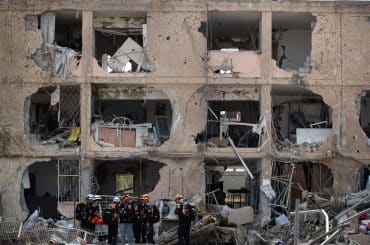
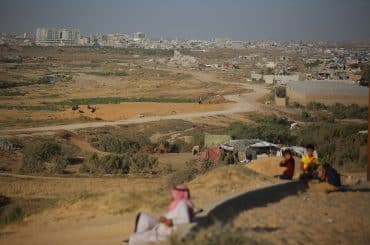
There looks to be controversy brewing inside the college Jewish community over J Street’s honorable sponsorship of speeches on campus by John Ging, the director of the UN Relief and Works Agency who has done more than anyone to instil in the west the idea of the civility of the Gazans.
Ging spoke at Barnard last night. The day before the event (as commenter Psychopathic God noted here in comment 5) an email went out from Abby Backer, president of Just Peace at Columbia– which organized the event and which says it has a similar mission to J Street–ending the group’s sponsorship of Ging’s speech.
As student organizers with Just Peace, we were looking forward to hosting an event for John Ging because we think it’s important to hear from experts on our issue that speak from many perspectives, even if we don’t necessarily agree with everything they have to say. Other community organizations on campus took issue with our involvement with Mr. Ging, and we are now unfortunately unable to co-sponsor the event….
We are thankful to the five Columbia groups, including the Columbia Political Union, the Institute for the Study of Human Rights, and the Columbia Democrats, for working with J Street U to hold this event.
Who are those “other” groups? Rebecca Wright at the Columbia Spectator did some reporting and showed that Hillel couldn’t stomach Ging, and suggested that Hillel wanted to censor his goddamn speech, and the Just Peace group went along with Hillel:
“There was a lot of back-and-forth. … Discussions went on for about a week,” said Abby Backer, BC [Barnard] ’13 and president of Just Peace. “There just wasn’t time to find a solution. We dissociated ourselves from the event so we wouldn’t have to dissociate ourselves from Hillel.”
Jonah Liben, GS [General Studies?] and Israel coordinator for Hillel, said that he would have supported the event if Hillel could control the format, but representatives from Just Peace said they wanted Ging to have the opportunity to deliver an uncensored speech. Backer said she also heard concerns that the conversation might spiral out of control in an unproductive way.
“It’s unfortunate that this event couldn’t happen with Hillel’s name on it,” Liben said—and both he and Backer said that time constraints, and not fundamental disagreements, prevented the two groups from reaching a compromise. Referring to the national Jewish organization that supported Ging’s trip to the United States, where he is visiting a number of campuses, Liben added, “We know that J Street isn’t bringing Ging in to bash Israel, and he tried to contextualize his statements … [but] Ging is a controversial speaker.”
Meanwhile, the head of the college branch of J Street– J Street U director Daniel May– affirmed J St’s sponsorship of Ging. May says doing so is important to lessen the “polarizing” atmosphere on campus, and to acknowledge the “basic human rights” catastrophe in Gaza; but he halfway apologized for doing so:
This does not deny that his presence brings with it a measure of discomfort for some of us It must be acknowledged: Gaza is not an easy issue of discussion – for all who feel passionately about this conflict. The rockets that continue to terrorize innocent Israeli civilians living in Sderot are murderous and defy justification. And the conditions in Gaza – extreme poverty amidst a decimated economy, near complete limitations to movement – ought to trouble all who believe in basic human rights.
Yet despite the difficulty of this conversation, peace demands that we look at the most difficult issues and bring to bear upon them our convictions as well as our reason, our passion and our generosity. The historical moment demands it. For Jews, a tradition of argument and debate obligates it.
It is in the hope of encouraging such a discussion – difficult, challenging, crucial and reasonable – that I invite you all to continue involvement with J Street U. At universities across the country students are working to forge a middle path in a polarized debate; joining together to host programming and advocate powerfully on behalf of peace and human rights. We hope this is just a beginning of that ongoing conversation and it is with great hope in the potential of that conversation that I am so honored to welcome, with you, Mr. John Ging.
I can’t sort this out. Ging is obviously a stretch for J Street, and that’s a good thing. The usual J Street event is happening at Goucher College tonight, with Hussein Ibish as the Palestinian advocate– though I would say that Ibish is not representative of Palestinian opinion. The panel is on whipping up the horse of the two-state solution. Is it alive?
Leading analysts will discuss the current progress–or lack of it–in the Middle East peace negotiations. Goucher President (and former NPR correspondent) Sanford J. Ungar will moderate a discussion entitled “Trying Again : Prospects for Peace in the Middle East ” at 7:30 PM in the Hyman Forum of the Athenaeum on the Goucher campus. Attendees must reserve tickets in advance through Goucher.
The four panelists are as follows : Dr. Robert O. Freedman, the Peggy Meyerhoff Pearlstone professor of Political Science Emeritus at Baltimore Hebrew University and visiting professor of political science at the Johns Hopkins University; Dylan J. Williams, deputy director of government affairs at J Street; Hussein Ibish, senior fellow at the American Task Force on Palestine and executive director of the Hala Salaam Maksoud Foundation for Arab-American Leadership; and Ann LoLordo, who served as The Baltimore Sun’s Middle East bureau chief in Jerusalem from 1996 to 1999.