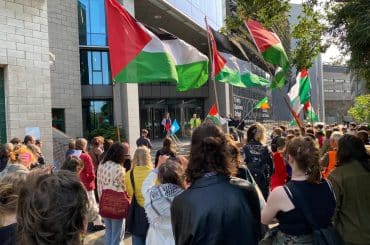
I missed Omar Barghouti’s debate with George Fletcher at Columbia Thursday night but Roane Carey of the Nation set it up to have coffee with him at a cafe downtown on Friday afternoon and he asked me along. They were sitting at a back table, and a half dozen others were crammed in to listen to Barghouti, who wore a red jersey and sat with his back to the wall. I recognized him at once as an international activist in a classic mold. He wore glasses and his posture was very erect, he might have been running a marathon. His hair was cut short on his large head. He is in his mid-40s but seems younger. He has a slightly beaklike nose and spoke in forceful long-considered paragraphs that he had surely said before. Around us was the glittering hubbub of downtown New York, attractive young people slouching onto couches or playing idly with their computers, but Barghouti was focused on one thing, the international campaign of boycott, divestment and sanctions.
I had heard that he had polished off Fletcher the night before without much argument. Barghouti said that the debate was a farce. "I might have been talking to myself." An earlier debate had gone the same way. The hardcore Zionists are not coming forward. The mood in the
“I’m very optimistic. On this tour, for the first time I did not meet any—how should I put it diplomatically—I did not meet any reasonable Zionist position.” No the Zionists were hunkered down, talking among themselves.
Barghouti told stories meant to inspire. He said that Naomi Klein after touring the West Bank had been so devastated that she needed to delay her Ramallah speech, she needed to sit quietly for a half hour to deal with what she had seen.
And that was before she went to
Gaza has accelerated the BDS campaign, but the urgency of the campaign is also growing. "The cancer rate in Gaza is skyrocketing." What a coup it was to get Jane Fonda and Danny Glover’s signature on the Toronto Declaration that used the word "apartheid." Yes there has been terrible pressure on Fonda from funders of her own nonprofit in Atlanta, but she did not remove her name.
The impression I carried away was a simple one. You don’t often meet such committed and articulate people. Barghouti personifies the idea that Ali Abunimah and Nadia Hijab have both expressed: BDS is essential because it is the most powerful weapon Palestinians have in seeking to fashion their destiny.
I’m stunned, too, by the fact that Barghouti has gotten so little media coverage here. As another friend told me, Barghouti is the future. He is intelligent, empowered and non-violent. He is completely impressive. It would help Americans to see such a picture of Palestinian political engagement, when they have such a distorted image of who Palestinians are. Some day they will know him.