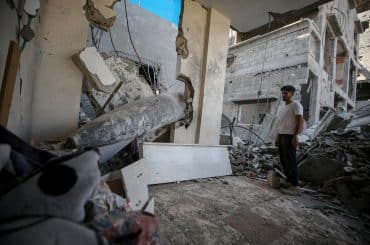
Roger Cohen also scores Obama’s "lovefest" with Netanyahu here, and is shrewd in pointing out the conflation of Israel’s permanent war with the U.S. "war on terror." I don’t like his sardine can metaphor for Gaza; it dehumanizes 1.5 million people in an open-air prison. (I don’t get his love affair with Fayyad. I mean I like Fayyad too but I don’t really get to vote now, do I? And whom does Fayyad represent? That’s the central question in a national struggle, isn’t it?)
The war on terror, an expression dropped by President Obama, was a catchall phrase that enabled Israeli leaders to bundle the Palestinian national struggle into the terror camp, where much of it did not belong. This has proved a terrible distorting lens.
I sense some Israeli realization at last that this course — the terror-propagating Gaza sardine can, the ad-hominem outrage of the reaction to the Goldstone report on Gaza, the facile recourse to disproportionate force, the repetitive “no Palestinian interlocutor” complaints, the too spin-doctored slogans of constant existential threat — leads only to a dead end. Israel can do much better.
How else to interpret the prising open, to some degree, of that Hamas sardine can? And the Israeli indictment of officers and soldiers for their roles in Gaza — precisely the possible war crimes of which Richard Goldstone wrote? And the dawning realization that in Salam Fayyad, the West Bank Palestinian prime minister, Israel has the last best interlocutor it will ever encounter? And a toning-down of the overdone Iran threat drumbeat?
I’ve long argued for such shifts. I’m pleased to see them. I’ve no idea how lasting they will be: Benjamin Netanyahu’s right-wing government gives cause for doubt. Much will depend on whether Obama — this week’s pre-November love-fest with Netanyahu notwithstanding — is prepared to be tough.