

Yesterday we posted reflections from Pamela Olson who has been in the West Bank during the UN debate over Palestinian statehood. Here is a follow up post on where she sees hope.
Despite everything I outlined in the post yesterday, there is some amount of hope in three places. One is the dramatic shift in American and global public opinion. Even Thomas Friedman has started lamenting the Israel lobby’s stranglehold on US foreign policy (two years ago he wouldn’t even have dared suggest there was any such thing as an Israel lobby), and other news sources have started asking questions, inviting guests, and boldly making suggestions they’d never made before.
And Benjamin Netanyahu’s speech at the UN was fantastic. It was like some kind of cartoon alien spouting every tired line of campy hasbara kitsch all in one long string of mendacious, tone-deaf nonsense. It was like he was trying to get all the talking points in at once because somewhere deep down, he understood that this was their eulogy. He didn’t want to leave any of his old friends out of what I predict will be a historic speech—the last major event when anyone dared to say such utter crap on the world stage with a straight face.
The world’s reaction to his cringe-worthily sophomoric bluster spoke for itself (though apparently his popularity in Israel actually rose after it—which just goes to show how mentally isolated Israel is from the rest of the world).
The second place of hope is in the global Boycott, Divestment, and Sanctions movement, which already has several victories to its name, and which is clearly terrifying the Israeli establishment. Along with non-violent direct actions like the Gaza flotillas, it’s the ultimate non-violent tactic to burst a dangerous bubble, and it’s just getting started.
The third is mass non-violent resistance by the Palestinians themselves, first Intifada-style. But there are three things suppressing this option. One is the Palestinian Authority, which is paid by Israel and the US to keep the Palestinians from taking matters into their own hands in this manner in any large-scale way. (Hamas is doing the same in Gaza to protect their own monopoly on power.)
The second is that people are still utterly exhausted from the evisceration of their economy by Israel’s occupation policies and the never-ending attacks by settlers and harassment by soldiers. People just want to scratch out a living and send their kids to school. This is enough of a massive burden given the conditions of occupation. To resist in a serious and sustained way means to risk losing every last scrap of what they hold dear.
The third is that the Palestinian people have understood for a long time what Amos Gilad, the head of Israel’s Defense Ministry’s political department, was recently quoted as saying by Wikileaks: “We don’t do Gandhi very well.”
Israelis are terrified of non-violent resistance. It’s not their strong suit. It’s not good for the world to see them bashing in the heads and shooting out the eyes of unarmed men, women, and children on their own land. So there’s no doubt in anyone’s mind that if there is a mass non-violent uprising, Israel will do everything in its power to turn it into a military struggle.
This is where Israel is comfortable. This is where they win, especially where it matters most, in American public opinion: When they can point to someone else’s violence to justify their own massively more deadly violence. In this scenario, the framework switches from Palestinian human rights to Israeli security. And once the framework revolves around Israeli security, anything goes.
Most people forget that the second Intifada started as a mass non-violent movement. Israel responded by firing more than one million bullets into crowds of unarmed demonstrators. Six months later, the suicide bombings started. And we all know the rest.
A sustained non-violent movement on a massive scale in Palestine would be no passive Kumbaya sit-in. It would involve serious danger and horrible risk, and it would require many people to die while others would be forced to watch and do nothing but continue to protest peacefully. And it would take only one spark to turn it into another all-out militarized conflict, and all the devastation that brings.
But who knows? No one predicted that the Soviet Union would fall when it did. Apartheid fell, French control of Algeria fell apart, and one way or another this insane occupation, this rotten house of cards, is not long for this earth.
Another Palestinian I talked to, a pilot who used to fly Yasser Arafat around the world, said, “Netanyahu thinks he has everything under control.”
I replied, “So did Hosni Mubarak.”

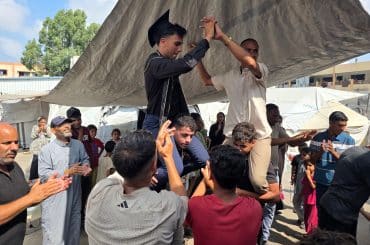
The standing ovation at the UN last Friday trumps decades of hasbara. People all over the world care about the sha’ab al filisteeni.
“Another Palestinian I talked to, a pilot who used to fly Yasser Arafat around the world, said, “Netanyahu thinks he has everything under control.”
I replied, “So did Hosni Mubarak.””
Because you’re not capable of telling the difference between a democracy and a dictatorship.
No one does Ghandi well, particularly the Palestinians.
“And Benjamin Netanyahu’s speech at the UN was fantastic.”
He did the same thing on Charlie Rose. Poor me, said Bibi, it’s really tough being disliked all the time. Poor you, said Charlie, it must be tough.
And Bibi went on to regurgitate every revolting Hasbaric line. With no other guest there to question anything, he had sympathetic Charlie all to himself.
Although I read Mondo every day, this is the first time I have posted.
This is a pretty good summary for what needs to be done. In terms of mass resistance inside the WB I suspect that the PA itself will be less likely now to put down “unauthorized” demonstrations. With Abbas’s new stature and hopefully confidence he should be able to more effectively resist Israeli pressure to suppress nonviolent street action. In addition, if PA gains the right to bring cases in the ICC this will provide the Palestinians with even greater international legitimacy. BDS will grow even faster with these new tools.
Much depends on Abbas right now in order to see this grow. It is so important that he avoid any more momentum draining negotiations and continue to defy US and Israeli demands for unilateral concessions. We should have a better idea in a few weeks if he has the courage to take this path.
“A sustained non-violent movement on a massive scale in Palestine would be no passive Kumbaya sit-in. It would involve serious danger and horrible risk, and it would require many people to die while others would be forced to watch and do nothing but continue to protest peacefully.”
A similar statement could be made about the situation here in the U.S. And until we do begin to embrace such a strategy there is little or no hope for us or the Palestinians. Once the Empire (the U.S.) is toppled, oppressed peoples around the globe will begin to rebuild their cultures and nations. Not until.