

This post is part of Marc H. Ellis’s “Exile and the Prophetic” feature for Mondoweiss. To read the entire series visit the archive page.
Hurricane Sandy is past us here but the Northeast is being hitting hard. At the Cape, we’re used to the anxiety before storm hits and the clean up after. Hurricane weather is part of the charm of living on the coast in Florida. Hurricanes combined with Northeasters aren’t charming in any geography.
Storms are bad enough but when storms combine, its worse. Like life, sometimes weather comes in devastating bundles. If you survive you pick up the pieces and move on.
What pieces are left to pick up in Israel/Palestine? Yesterday I Skyped with a friend who reads my commentaries. Our chat began with my understanding of Noam Chomsky’s place in Jewish history. We then explored my take on Amos Goldberg’s (storm cancelled) lecture on the place of the Holocaust and the Nakba in contemporary Israeli-Palestinian life.
From our conversation, I understand that part of my thinking on Chomsky has been misunderstood. Chomsky’s ‘absent’ Jewishness touched a nerve. Apparently, there are those who think Chomsky’s absent Jewishness is disingenuous. They see it as a disguise. By disguising his Jewishness, he pretends to have an unbiased viewpoint in the Israel/Palestine debate.
People can believe what they want. I believe Chomsky is totally honest in the way he presents himself. His ‘absent’ Jewish is his Jewish ‘presence.’ Chomsky’s absent/presence isn’t a trick of the trade. It’s central to modern Jewish prophetic.
How else to embody the prophetic in the post-modern age? Appeals to God and tradition have lost their credibility. Though Chomsky’s force comes from both, in our time they’re hidden from view. I believe they are hidden from Chomsky, too.
Chomsky is best understood as a Jewish prophet. To be so acclaimed is the greatest honor possible. Chomsky will be remembered as a prophet within the folds of Jewish history. I think he will remembered in Palestinian history in the same way.
I tried to write a cautionary introduction to Goldberg’s thinking about the ‘mutual’ suffering of Jews and Palestinians. Again, I may have been misinterpreted. I don’t seek to minimize Jewish suffering in history. Likewise, I don’t think Jews are reducible to an ethnic, power hungry or lobbying for Israel group. Jews have real concerns for their wellbeing because of an extensive and recent history of defamation and assault. What I oppose is the use of that history, including the Holocaust, to oppress another people.
Mutual suffering in the past is one piece of the Israel/Palestine puzzle. With other pieces in place that might make possible a ‘mutual’ future for Jews and Palestinians. Left to itself, however, it’s a non-starter. The justice piece is more promising. Yet justice is only human if it is directed to individuals who live in real time.
Conceptual justice is important to think through and propose. When imposed, conceptual justice is a disaster.
Left to itself, justice is a non-starter. It isn’t only the Israel/Palestine situation that makes justice alone problematic. Look at our world and the conflicts around the globe. Justice is part of their solution. It isn’t the only part.
Much depends on how justice is defined. A complicating factor in many disputes is how far justice reaches into the past. It’s better if justice is oriented to the present. When our concentration is focused on who is impacted and how, our actions are illumined and limited by the human face.
Of the various theoretical and practical definitions of justice that exist, the definitions and pathways we choose are crucial. In most ‘resolved’ conflict areas, satisfied constituencies are rarely sizable. In the best of agreements, previously unlivable space is made livable.
New life is carved out within the shattered remnants of past conflict. Individual grievances are rarely addressed. Agreements create a place where individual grievances are superseded through a creative future.
This is a basic and debilitating truth about factions in the Israel/Palestine debate. Whatever resolution is worked out, the idea that individual grievances will be redressed is illusory. So, too, is the idea that historical wrongs will be overturned entirely. The best we can hope for – and this is very far away – is the creation of a new entity that allows Jews and Palestinians to embark on a journey toward justice and equality.
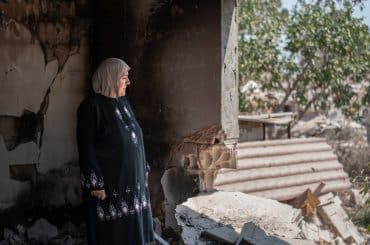
This journey will commence in the ruins of Palestine, the place where Jews and Palestinians now live. It will also be played out in the Jewish and Palestinian Diasporas.
I believe that any solution to the Israel/Palestine conflict will see the growth of both Diasporas rather than their diminishment. This growth will be voluntary. This should give us pause about elements of the conflict itself. If both the Jewish and Palestinian Diasporas would grow voluntarily with a settlement, what indeed is the conflict about? The typical answers – land and power – are obvious. Still, there are other issues at stake. Those ‘other’ issues are crucial. The conflict in Israel/Palestine isn’t only about justice.
Most conflicts are resolved through an imposition of a new order. Sometimes that imposition comes from the warring parties. Other times it comes from outside interventionist forces.
This was yet another part of my Skype chat. I find it amazing how those against outside foreign intervention in principal and practice can, in certain situations, argue for the same intervention they oppose. In the case of Israel/Palestine, the argument for outside intervention is carried mostly by those who usually oppose it, especially when conducted by Europe and the United States.
The truth is more complex. Who on the political Left doesn’t pray for the day that Europe and the United States pulls the plug on Israel’s occupation? Would they oppose an American military intervention, even under the flag of the United Nations, if it pushed Israel back to its 1967 borders?
The concern isn’t about intervention per se, since Europe and the United States (not to mention the former Soviet Union) have been huge interventionist players in Israel/Palestine from the beginning. The issue is what kind of intervention is to occur. But, then, looking at the facts on the ground, is a more positive intervention by Europe and the United States already too late?

The need for international intervention has never been more clear. Left to itself, Israel has been flooding (“Sandy” reference) people and infrastructure into occupied Palestine and has for many years said (especially to Israelis and their supporters, thereby creating psychological resistance to peace-making) that the settlements that exist (and more exist day by day) are permanent, especially in “Jerusalem” (as territorially unilaterally remapped by Israel).
It is necessary, but also unlikely, because the tail of the AIPAC stranglehold on the USA wags the dog of the USA, which (as another tail) in turn muscles (wags) the (dog of the) whole world into flaccidity w.r.t. I/P.
Some bravery somewhere is necessary. Let’s keep working.
A lot of words, but some negation of logic.
If a compromise is meant, there won’t be justice but, well, a compromise.
If justice is meant, the shitty little occupation states is totally undone and disappears.
So a “just” resolution, by definition, is not in discussion.
The Palestinian diaspora includes people who have settled comfortably in other countries and so may well choose not to return except for visits, but the bulk of it still consists of people living in miserable conditions in refugee camps and often with very limited rights in their countries of residence. They still want to return and that is their right. But for most of them return will be a real and not just a formal option only if adequate provision is made for their livelihood in Palestine. That will require an enormous program of resettlement, restoring where feasible old Palestinian villages and neighborhoods, and will have to be staged over a period of years — and somehow financed.
By contrast, the Jewish diaspora will certainly expand as many Jews leave Palestine, either with the positive motive of restoring their old communities in other countries (under conditions negotiated by Palestine with those countries) or for the negative reason of no longer wanting to live in Palestine once there is no longer a “Jewish state” there. A Jewish minority will remain in Palestine, consisting mainly of those who identify with the country and its indigenous people rather than with Zionism, although there will also be some who remain reluctantly because for one reason or another it is impossible for them to return to their countries of origin. (For instance, who knows when conditions in Iraq will permit the restoration of the ancient Jewish community there?)
Anyway, these are my guesses about what might happen under the most optimistic scenario.
World Net Daily:
Could ‘Frankenstorm’ be a sign from God?
‘When we put pressure on Israel to divide their land, we have record-setting events’
…
“Whatever resolution is worked out, the idea that individual grievances will be redressed is illusory. So, too, is the idea that historical wrongs will be overturned entirely. The best we can hope for – and this is very far away – is the creation of a new entity that allows Jews and Palestinians to embark on a journey toward justice and equality.”
So, you think, basically, behind all the equivalence and equivocation, we can get away with it? There’ll be a little compromising (for Israel) on the road to the I-P peace horizon (if you’ll excuse the interpolation), but basically, we get away with it?