
Ostriches.
In the New York Times, Samuel G. Freedman has a profile of Sara Hurwitz, 36, a New York spiritual leader who broke the gender barrier inside Orthodox institutions to head a yeshiva.
The story involves the fact that Hurwitz was raised in South Africa and inspired by Nelson Mandela. There is a lot of Sunday morning sermonizing:
For Ms. Hurwitz, born and raised in South Africa during the turbulent years of apartheid, Mr. Mandela had long served as the inspiration for her journey to breaking the gender barrier in the Orthodox Jewish rabbinate.
“I looked at this person as someone who could have been so angry and so disappointed at the land that incarcerated him for so many years for civil disobedience,” Rabba Hurwitz, 36, said in a recent interview. “And he walked out of prison and formed a peaceful government. He could have focused on the injustice of it all, the time he had lost. But instead he saw this newfound freedom as a chance to make change and do what was right…”
Freedman, religion columnist and professor of journalism at Columbia University, goes on to the broader issue of the “Jewish experience in South Africa” and the political contradictions involved.
Jews, including the politician Helen Suzman, the underground activist Lionel Bernstein and the Communist Party leader Joe Slovo, constituted a significant share of white leaders in the anti-apartheid movement. Yet Israel maintained a lucrative arms trade and an unofficial alliance with the South African government, despite its historic strains of anti-Semitism and Nazi sympathies. In addition, the African National Congress allied itself with Palestinian guerrillas waging armed struggle against Israel.
Underlying these opposing trends was the precarious situation of the Jewish minority in a nation built on rigid racial categories. Not unlike their brethren in the American South during segregation, South African Jews understood that they were viewed by the white power structure as racially ambiguous and politically suspect. Standing up for freedom invited retaliation.
Oh those Palestinian guerrillas. Reminiscent of Ho Chi Minh and Central Americans. As if it’s a surprise that the ANC would be allied with a movement to resist ethnic cleansing and colonialism. And a friend points out: “Mandela founded the ANC’s armed wing Spear of the Nation. He believed armed resistance was at times necessary.”
The story is an “On Religion” column, but Freedman never pursues the obvious moral questions: He never asks Hurwitz about apartheid in Palestine. No, this is a feel-good moral parable about breaking gender bonds among the Orthodox, a narrow band of American Jewish life.
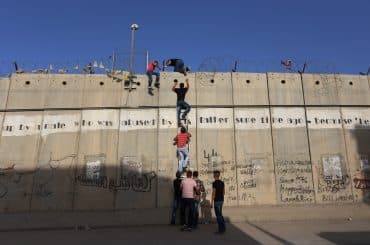
And so: Apartheid is over and done with. The leading spiritual question for Jews in our time– we are implicated in Israel’s discriminatory actions– ignored.
Ostriches.
P.S. How representative were Slovo and Lionel Bernstein of the South African Jewish community? Ilene Cohen tells me about a friend who recommended Joseph Lelyveld’s Move Your Shadow: South Africa, Black and White (1986). He wrote:
I hope you enjoy it. I read it a couple of years before I went into exile. It didn’t tell me anything that I didn’t know, but I found it an evocative account of apartheid at its apogee. There were so many white South Africans of my generation who chose to turn a blind eye to the brutality of the regime, and I thought this an excellent book to “introduce” them to their country. I have since recommended it to many friends to give them a clearer insight as to how the system worked and affected people in their day-to-day lives. Let me know what you make of it.
Ilene’s response: “The question of ‘turning a blind eye’ could not be more pertinent today, with Israeli apartheid at its apogee.”
P.P.S. Freedman’s worthy thoughts on the Jewish experience in South Africa reminds me of Judge Richard Goldstone being excommunicated by his tightknit religious community over the Goldstone report, to the point that he recanted charges against Israel. Also I thought of my post on Doris Lessing and Jewish identity in Southern Rhodesia (a Jewish community that was co-extensive with South Africa’s). Lessing is more sociological than Freedman, which is to say, she dealt frankly with issues of privilege and capitalism. Her Children of Violence series is electrified by the character of Thomas Stern, the Jewish Communist Zionist Polish emigre who has lost his entire family in the Holocaust and then discovers in Rhodesia that– he is a capitalist.
“I’m learning that it’s terrifyingly easy to make money.”
[Martha] laughed…
“I don’t want you to laugh about money. I’ve got to outwit it. I’ve got to find a way of not becoming Thomas Stern, rich merchant of this city.”
Stern outwits that fate at the cost of his life.
Well done, Phil. Through the looking glass, indeed.
Sara & Sam: Apartheid is alive and thriving as finessed by Israel. Are you feeling proud NOW?
And calling the Palestinians “guerillas” really is beyond the pale. I thank the ANC for what it did to help the indigenous Palestinians stand up to the naked aggression and ethnic cleansing of the Israelis.
Phil Weiss wrote:
“Freedman never pursues the obvious moral questions. He never asks Hurwitz about apartheid in Palestine.”
Because … for Freedman and Hurwitz there *are* no moral questions there?
I mean, isn’t this the story over and over now in the Diaspora community—in chronic alleged disgust if not rage over what their adopted countries are doing, while being blithely supportive of Israel doing even worse—so absolutely common, long-standing and clear now that the explanation for same can’t possibly lie in the mere vagaries of individuals or coincidences and must be part of a very widely shared and distinct world-view? A world view with a simply huge, blatant double standard? That the equation is that … Israel remains morally immaculate while doing precisely what renders everyone else not just inferior but repulsive and sub-human?
[…]
How, after all, can “Israel” act without someone’s human volition being behind same? So how to even *say* this equation is really “just” about Israel and doesn’t really mean the individuals behind that mere construct?
The silver lining in this sliver of public life – which I think NY Times readers may be beginning to notice – is the emerging awareness of the structural fault lines between Israeli Judaism and American Judaism. Not even the insular Orthodox community is immune to the local political system it belongs to.
The status women is, alongside interfaith marriage (and related issues), the key ideological divide between Israeli and the United States Jewish communities: the ordination of Rabbi Sara Hurwitz is going to strain even further relations between the new, hardline, state -appointed Chief Rabbis in Israel and the liberal Modern Orthodox establishment in the United States.
Why should anybody else outside the Orthodox Jewish community care?
Because many liberal Jews (and I expect their non-Jewish friends too), see in the Orthodox as the most authentic, contemporary expression of the traditional Jewish past. The editors of the Times believe the ordination of a woman is news for their liberal readership.
So it’s time to expose the lie: what matters is not the religious community but the political system. American Judaism, with separation of church and state and the drive to fully emanicipate women is always going to lead the world’s Jewish community. Israeli Judaism may, or – in the case of the ordination of women and accepting non-Jews in the community – will not, follow suit.
P.S. Contrary to legend, in response to danger, ostriches do not bury their heads in the sand. If they did, lions and the other big cats would have long ago eaten them all up.
I’d like to point to this article:
Liberal Zionists and the demographic dogma
http://warincontext.org/2013/07/23/liberal-zionists-and-the-demographic-dogma/
And to this report:
Israel is an Example of an Economy Hijacked by Military-security Interests
Although the U.S has the world’s largest military industrial complex, Israel has the largest ratio of its economy dedicated to the military and security industry
http://therealnews.com/t2/index.php?option=com_content&task=view&id=31&Itemid=74&jumival=10497
Wasn’t one of South Africa’s main industries gold mining? A Russian documentary on Israeli-S.A. relations focused in part on that, showing that on one hand, the miners were blacks working in tough conditions.