

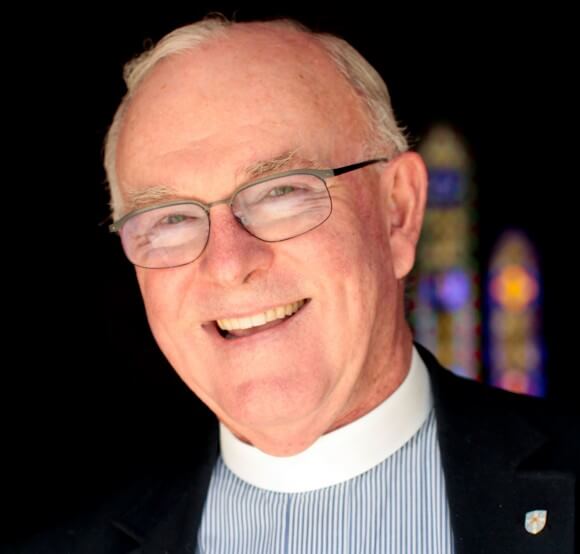
The Rev. Bruce Shipman case at Yale is not going away. The Religion News Service is now covering the case; and the Episcopal Peace Fellowship’s Palestine Israel Network steering committee has deplored Shipman’s treatment as a “disgrace.” The Yale chaplain was forced to resign his position on Sept. 4 following an uproar over his three-sentence letter to the New York Times on August 26, saying that a growth in anti-Semitism in Europe had as one cause Israel’s “carnage” in Gaza so Israel’s “patrons” should press the Netanyahu government to shift policy so as to counter anti-Semitism. (You can read the short letter at that link.)
I’ll get to the Episcopal Peace Fellowship’s message in a moment, but I want to offer two more arguments in favor of Shipman’s statement.
First, DNA Info covers a press briefing by NY Police Commissioner Bill Bratton on Wednesday, where he seems to say what Bruce Shipman said in part:
Anti-Semitic hate crimes are up 40 percent across the city this year, according to Police Commissioner Bill Bratton who downplayed the spike Wednesday and then pointed the finger at the press.
“When (the media) cover something, it tends to attract more attention,” Bratton told reporters following a security briefing for the Jewish High Holy Days at police headquarters.
“But we have seen this before, that when there’s attention paid to an issue, that it brings this about,” Bratton continued. “And when there’s continued attention — and the issue in Gaza, where it stretched over several weeks — we could see a continuing increase.”
So Bratton is saying that when people learn about Israeli atrocities, some respond in an anti-Semitic manner. This seems quite similar to portions of Bruce Shipman’s statement. (“[G]rowing anti-Semitism in Europe and beyond… parallels the carnage in Gaza over the last five years, not to mention the perpetually stalled peace talks and the continuing occupation of the West Bank.”)
Here’s another point in Shipman’s favor. The other day we picked up a report that Yale President Peter Salovey’s office was involved in applying pressure on Shipman over his statement within hours of its appearance in the Times. Yale chaplain Sharon Kugler applied the pressure; she promptly emailed Shipman in outrage and cited calls to Salovey’s office from around the country calling for his termination. And lo and behold, Shipman resigned inside of another ten days, at the urging of the Episcopal board. So much for free speech.
In applying that pressure, Yale officials disregarded the spirit and letter of the Woodward Report of 1975, which is Yale policy on expression of uncomfortable ideas. Go to this link, pages 5-10. It is a stirring document from a committee chaired by C. Vann Woodward, and has long been invoked by Yale officers resisting pressure from student groups and alumni to ban speakers, or penalize offensive statements from officials. The leading argument of the Woodward Report was that “the central purpose of the university is to foster the free access of knowledge” — which entails the right to “think the unthinkable” and “challenge the unchallengeable,” even over the “social and ethical” responsibilities for members of the university community to maintain “civility and mutual respect.”
I.e. the “civility” code lately issued by the University of Illinois in firing Steven Salaita for angry tweets over Gaza, or by UCal Chancellor Nicholas Dirks, who is surely worried about the conflict breaking out bigtime in Berkeley, is a real stepdown from the free-speech standard universities ought to have. Corey Robin, Bill Mullen and Tithi Bhattacharya have all seen the advance of corporate neoliberalism in that civility standard.
Woodward’s committee acknowledged that “shock, hurt and anger” can result from “the provocative, the disturbing, and the unorthodox.” But the committee said that if civility is the highest standard, a “willful minority” can become the “arbiters of truth for all.” They cited with pride the breakup in the 1960s of a “homogeneity” of opinion at Yale, thanks to the shifting makeup of campuses during the civil rights movement and the Vietnam war. They surely included William Sloane Coffin Jr., the antiwar chaplain at Yale to whom some have compared Shipman in his dedication to Palestinian freedom.
OK. Other developments in the case. Mark Oppenheimer, a religion writer who slammed Shipman at Tablet, told the Religion News Service that Shipman shouldn’t have lost his job.
“I’m opposed to drumming people out of communities,” he said. “I don’t think the answer is to call for someone’s scalp.”
That drumming out is why the Episcopal Peace Fellowship’s Palestine Israel Network steering committee justly calls the case a “disgrace.”
[That committee] deeply deplores the institutional pressure exerted on the Reverend Bruce Shipman, Episcopal chaplain to Yale University, which has culminated in his resignation. The pressure to resign his post followed Fr. Shipman’s question, in a brief letter to the New York Times, whether certain actions by the State of Israel might partly cause anti-Semitic responses in Europe. In no way did he blame Jews for anti-Semitism, as some have claimed. As a result of this simple act of free speech, Fr. Shipman is no longer the Episcopal Chaplain at Yale. The whole episode is a disgrace to the cause of academic freedom of thought.
While Bishop Ian Douglas states in the Yale Daily News “It’s not as glamorous a story to hear that Priest-in-Charge Bruce Shipman resigned because of institutional dynamics within the Episcopal Church at Yale and not the debates related to Israel and Palestine – but it’s the truth,” the strong perception amongst many who work on issues around Palestine/Israel is that the letter did indeed play into Shipman’s resignation. We believe that the Bishop, in his role as chair of the board of the Episcopal Church at Yale, and as head of the Diocese of Connecticut, had every opportunity to affirm publicly that Father Shipman had done nothing wrong. If Father Shipman was to be dismissed for other reasons, Bishop Douglas could surely have delayed the action so that the public would not draw the conclusion that the dismissal was related to the letter. This week, Fr. Shipman’s account of the events surrounding his resignation has appeared in the Yale Alumni Magazine: “At a meeting of the Board of Governors of the Episcopal Church at Yale that took place on Tuesday, Sept. 2, the Executive Committee asked me to resign. They alluded to pressure from a number of people on campus, including the university chaplain, Sharon Kugler. Without their support, I could not imagine functioning effectively as chaplain, and the following morning I tendered my resignation.”
The EPF PIN leadership stands behind Father Shipman and his long standing support for justice for all people. We express alarm at the vitriol present on many campuses across the US whenever someone or some group raises questions about Israel’s draconian policies of occupation or advocates for the rights of the Palestinian people.


Um, no. Saying that antisemites respond to obsessive media coverage of Gaza is not the same thing as saying it’s the Jews who are responsible for the antisemites because they don’t speak out enough on Gaza. It’s not even close to the same thing.
Israel is a “Jewish State”, the only “Jewish State” in the entire world, the “Jewish homeland”, the nation-state of the “Jewish people”, granted by gawd and Holocaust to all Jews, everywhere, forever and ever, amen.
But don’t you dare even *think* that Jews might be responsible when the “Jewish State” does something wrong because, well, that just means you’re anti-Semitic!
Funny how that works…
The same point that Shipman made was made by a “report published … by the Coordination Forum for Countering Anti-Semitism, a body sponsored by the Jewish Agency, the Prime Minister’s Office and the Ministry for Diaspora Affairs” in 2009, according to Ynet news.
http://www.ynetnews.com/articles/0,7340,L-3661455,00.html
And yet another report from a Tel Aviv University Institute around the same time frame made a similar point.
http://www.ynetnews.com/articles/0,7340,L-3703686,00.html
A scholarly analysis touching on the import of these reports stated the problem this way:
How do we know that things are going to come to a head? Israeli policy is a longstanding one, and eventually people are going to take notice. The US activist dissident Left has taken notice of the issue. But that is not really a guarantee of anything by itself.