
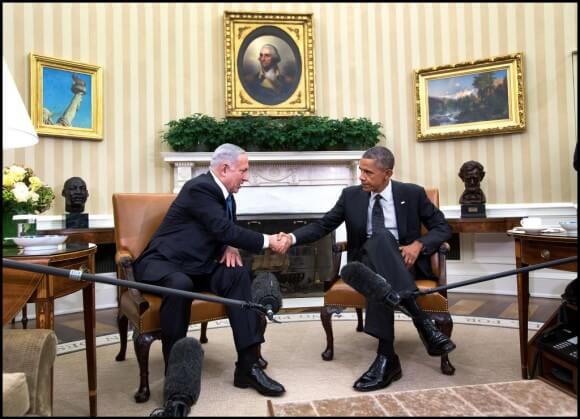
Yesterday, President Obama met with Prime Minister Netanyahu for the 12th time, more than any other world leader. The meeting was icy as usual. In their opening remarks Obama told Netanyahu the status quo in Gaza cannot stand:
You know, throughout the summer, obviously, all of us were deeply concerned about the situation in Gaza. I think the American people should be very proud of the contributions that we made to the Iron Dome program to protect the lives of Israelis at a time when rockets were pouring into Israel on a regular basis. I think we’ve also recognized that we have to find ways to change the status quo so that both Israeli citizens are safe in their own homes and schoolchildren in their schools from the possibility of rocket fire, but also that we don’t have the tragedy of Palestinian children being killed as well, and so we’ll discuss extensively both the situation of rebuilding Gaza but also how can we find a more sustainable peace between Israelis and Palestinians.
Netanyahu wanted to bring the focus back to Iran:
And even more critical is our shared goal of preventing Iran from becoming a military nuclear power. As you know, Mr. President, Iran seeks a deal that would lift the tough sanctions that you worked so hard to put in place and leave it as a threshold nuclear power, and I fervently hope that under your leadership that would not happen.
Still, there wasn’t much drama beyond strained bonhomie and a photo op. Politico summed it up, “Finally, a meeting between President Barack Obama and Israeli Prime Minister Benjamin Netanyahu that was short and sweet — or at least not long and bitter.”
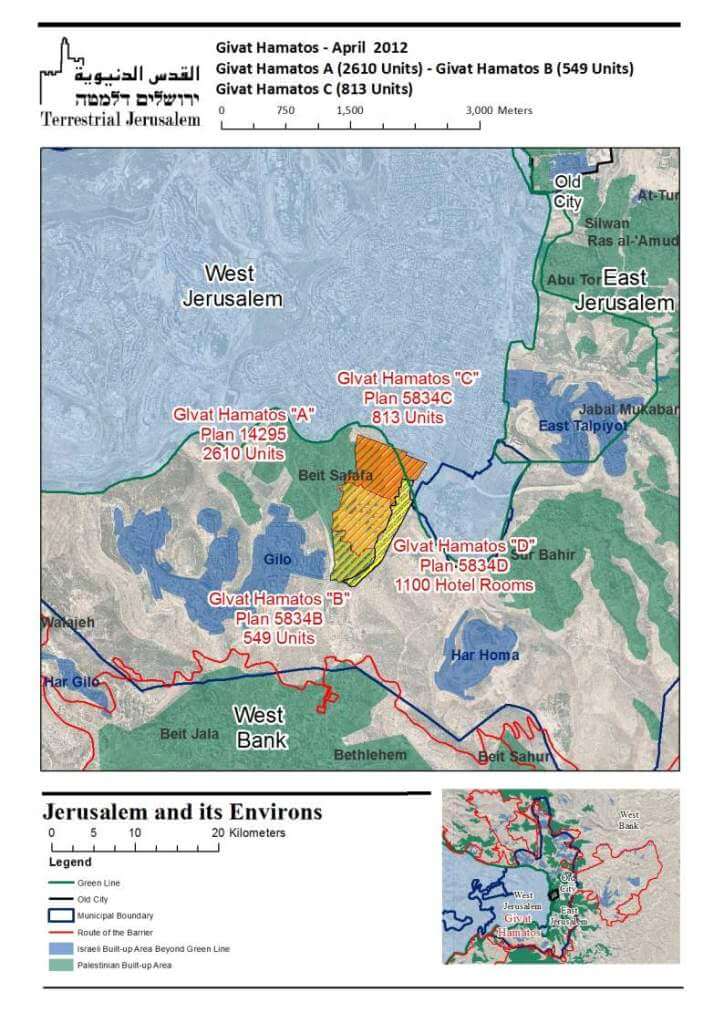
Then news broke that the Israeli government, with Netanayahu’s okay, had approved a massive settlement expansion in Givat Hamatos in East Jerusalem. Some timing! The settlement is the first Israel has announced since last April, and recalls Israel’s announcement of settlements in 2010 as VP Joe Biden was meeting with Netanyahu. “Just in time for the Bibi-Obama meeting,” AP’s Matt Lee wrote. The decision will create 2610 new settlement units and many analysts say it could mark the end of the two-state solution.
The U.S. government was quick to respond with a relatively harsh condemnation. State Department spokesperson Jen Psaki told reporters during an afternoon briefing:
We are deeply concerned by reports that the Israeli Government has moved forward the planning process in the sensitive area of Givat Hamatos in East Jerusalem. This step is contrary to Israel’s stated goal of negotiating a permanent status agreement with the Palestinians, and it would send a very troubling message if they proceed with tenders or construction. This development will only draw condemnation from the international community, distance Israel from even its closest allies; poison the atmosphere not only with the Palestinians, but also with the very Arab governments with which Prime Minister Netanyahu said he wanted to build relations; and call into question Israel’s ultimate commitment to a peaceful negotiated settlement with the Palestinians.
What “distance Israel from even its closest allies” means in practice remains to be seen, and given the administration’s actions to this point it’s doubtful it will add up to much.
It does seem that the move will dog Netanyahu during the rest of his U.S. trip. NPR’s Steve Inskeep interviewed Netanyahu for today’s Morning Edition, it was the first questions he asked. The settlements dim hope for a Palestinian state, according to the State Department, and will distance Israel from even its allies. Why is that particular settlement worth that? Inskeep asked. Netanyahu was defensive.
Netanyahu: These are not settlements. These are neighborhoods of Jerusalem. Jerusalem has been the capital of the Jewish people for thousands of years. And I think in any conceivable peace plan including those that were discussed with the Palestinians even the Palestinians understood that… Jewish neighborhooods would remain in Jerusalem.
Inskeep: We’re talking about 2500 homes, in East Jerusalem.
Netanyahu: They’re not in East Jerusalem, they’re in South Jerusalem actually, and they include 700 units for Arab residents of Jerusalem. That’s a little fact that hasn’t gotten any press.
Inskeep: We are talking about east of the 1967 line.
Netanyahu: Sure. Of course…
Inskeep: So when you say South Jerusalem, it’s former East Jerusalem.
Netanyahu: Nearly half of Jerusalem’s population live in neighborhoods that abut the ’67 borders. And nobody in his right mind thinks they’re going to be uprooted… [Palestinian swaps idea entails the understanding that] these neighborhoods are going to stay.
The Israeli advocacy organization Terrestrial Jerusalem issued the following update on the move:
Today it has come to light that the Government of Israel has gone ahead and granted statutory (final) approval to Plan 14295, which will allow for the construction of 2610 new settlement units in Givat Hamatos A.This is the first Jerusalem settlement plan approved since the April 1 breakdown in talks.As we have reported previously, this plan is not just another politically or symbolically “detrimental” settlement, or even one that just makes a resolution to the conflict a little more difficult on the ground. This plan is a game-changer.This approval could not have taken place without Prime Minister Netanyahu’s advance knowledge and consent.KEY FACTS ABOUT THIS APPROVAL
-

(Click to enlarge) The approval of this Givat Hamatos plan was published quietly late last week (September 24), on the eve of the Jewish New Year (Rosh Hashana), permitting it to fly under the public radar until today.
-
This is the final statutory approval of the plan.
-
Construction permits can be issued commencing 15 days from now.
-
While tenders could technically have been issued before this approval, almost invariably the statutory approval precedes the issuance of tenders.
-
The plan is not just another politically or symbolically “detrimental” settlement, or even one that just makes a resolution to the conflict a little more difficult on the ground. This plan is a game-changer.
-
Today, implementation of Clinton-style parameters in Jerusalem (Palestinian neighborhoods will be Palestine, Israeli neighborhoods will be Israel), while difficult, remains possible. After Givat Hamatos is built, that will no longer be the case.
-
There is every reason to believe that this move will prompt the Palestinians to take this matter to the International Criminal Court, and they will not be without their reasons. Should they do so, the final approval of E-1 is an eminently possible reaction by Netanyahu.
-
Thus, approval of Givat Hamatos has the potential to set off a chain of events with far-reaching implications that extend far beyond this single settlement question or even simply Jerusalem.


The timing of this is another deliberate two fingers from Israel to Obama and the US taxpayer. They seem to think that humiliating your main sponsor and arms donator is a clever move. Idiots.
Here’s a fearless prediction on what Ms. Harf will say at her next presser: “This is not helpful.”
No, Marie, it’s not.
There is another interesting exchange further down that briefing.
.
Obama is still stronger than Warren, and the kibbutzniki Bernie Sanders, the first Israeli to run for President.
““Obama is just more of the same, in my opinion. Did I hope for something different? Yes. I wished for something different, and I was delusional. I think that unfortunately, no matter who I’ve ever voted for, it’s been the lesser of the evils, and I’ve been grossly disappointed because they always have to get funding from somebody. AIPAC is always a big part of the funding source and Wall Street is the other big source. I’m sorry, but they’re owned. I don’t have any better hopes for Bernie Sanders or Liz Warren, although I had hopes at one point for both of them, but then I hear both of them stand up for Israel and I want to vomit,” said Baird.”
http://www.liberationnews.org/tampa-protests-war-in-syria-at-centcom-2/
Sanders (born September 8, 1941) was born in Brooklyn, New York, the son of Polish Jewish immigrants. Sanders graduated with a B.A. in political science from the University of Chicago in 1964 and afterwards spent time working on a kibbutz in Israel.
https://www.jewishvirtuallibrary.org/jsource/biography/Sanders.html
“The meeting was icy as usual.”
Not icy enough. Should never have occurred. Israel and Bibi Amin should never get this close to the President of the US.
“Idi Amin Dada (/ˈiːdi ɑːˈmiːn/; c. 1925 – 16 August 2003) was the third President of Uganda, ruling from 1971 to 1979. Amin joined the British colonial regiment, the King’s African Rifles in 1946, serving in Kenya and Uganda. Eventually, Amin held the rank of major general in the post-colonial Ugandan Army and became its commander before seizing power in the military coup of January 1971, deposing Milton Obote. He later promoted himself to field marshal while he was the head of state.
Amin’s rule was characterized by human rights abuses, political repression, ethnic persecution, extrajudicial killings, nepotism, corruption, and gross economic mismanagement. The number of people killed as a result of his regime is estimated by international observers and human rights groups to range from 100,000[1] to 500,000.[2]”
(wiki)