

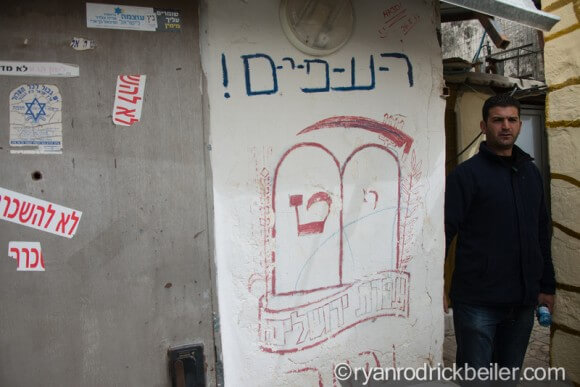
When you walk through the streets of the Old City with Daoud El Ghoul your eyes are opened to the various levels of Palestinian history and life in Jerusalem. You can actually point to a stone in the Old City wall and Daoud can tell you from which era that stone is from. Yet it is not only the history of the Old City that jumps to life, as you walk the narrow streets with him the people that live and struggle in that space are given voice. You meet the residents of the Old City who have had their water cut by the Jerusalem Municipality, people who have to share common living space with Israeli settlers, people arrested and beaten by soldiers, and people who are struggling to build a strong and vibrant community in Jerusalem.
In early December, 2014, Daoud El Ghoul and four other Palestinians from Jerusalem were given an Israeli military order banning them from Jerusalem for 5 months. Following the order, Daoud and the four others went to the West Bank to live out the order. However six days after arriving in the West Bank, Daoud was given another order banning him from the West Bank. This order only applied to him.
Both military orders were given to Daoud with the claim that he was risk to public security. Any information that could give reason to such a security concern was and is still kept secret. Marked as a security risk by the State of Israel, Daoud found that the only place he was allowed to live was within the boundaries of the state itself in Haifa. The banned group appealed to the Israeli Supreme Court in an effort to overturn the ban, but the Court upheld it.
On April 30th, 2015, the military ban from Jerusalem was to expire. Whereas the four Palestinians are now allowed to return to their home, Daoud’s ban has been extended for another four months. In addition, in March he was given a travel ban for one month which was then extended until October 2015, not permitting any travel abroad.
Although this is not the first time Israel has exiled Palestinians from their homeland, a temporary military order banning a person from their home town is a relatively new practise. Even though this may seem like a new and isolated event, it is important to place Daoud’s ban within the larger context of settler colonialism. Many writers such as Patrick Wolfe write that settler colonialism is a structure of land confiscation, a process of what Glen Coulthard calls “territorial acquisition in perpetuity”, meaning that it is a spatial and territorial process of control and domination without time limit. However what is missing from these writings and can help us understand why Daoud is facing such oppression is the body-spatial relation that is intrinsic in the settler colonial project. It is not only about dominating space, it is about inscribing space that is created by the colonizer onto the bodies of the inhabitants. Therefore, we need to see Daoud’s ban not as a strange form of punishment, but part of a broader strategy and plan of settler colonialism.

The separation and compartmentalization of space
Frantz Fanon, in The Wretched of the Earth, describes how control of the land is achieved through separation and compartmentalization of space. What is practised in these landscapes is a physical separation of life and realties between the settler and Indigenous. The process of separation allows for the colonizer to create distinct zones for the settler and the Indigenous each marked with various characteristics that then become the characteristics of the population that inhabit that space.
For example, Fanon writes that the colonizer’s space is marked by lit streets, built from strong materials and it is clean and structured. The government and police officials operate in the spaces of the colonizer to preserve order and give an impression of ease. The space where the settler, or the foreigner, lives is constructed for the benefit of life.
The Indigenous space is marked differently. It is a place in turmoil as the settler tries to mark it as a degenerate space. In the spaces of the colonized the police and government officials are there to impress force and submission. Therefore the Indigenous’ space is marked with chaos and violence.
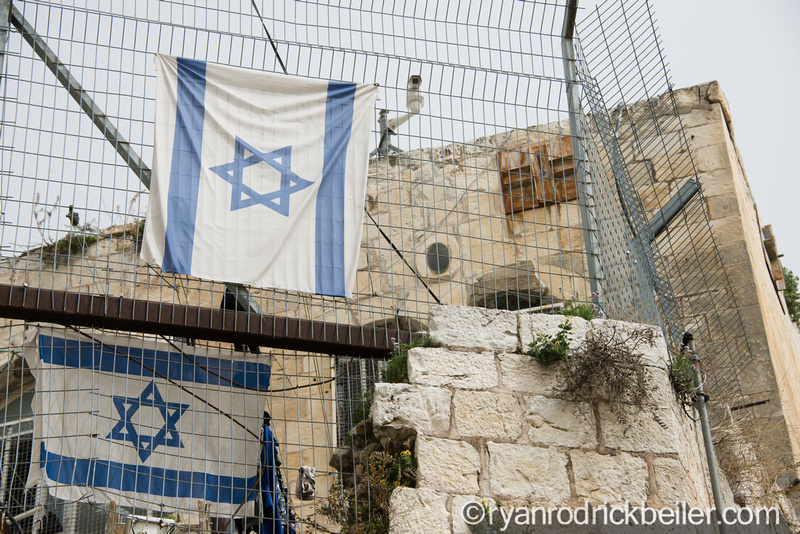
This two marked spaces can be clearly seen in Jerusalem, where Daoud is from. On the visual surface driving through the city, you can see the differences between Palestinian and Israeli areas – colonized and colonizer. The roads in the Israeli neighbourhoods are maintained, the garbage is regularly picked up, and there is even an active recycling program. It has the appearance of order.
Palestinian neighbourhoods tend to be overcrowded, roads are deteriorating with potholes and since garbage collection is unreliable, it is not uncommon to find a dumpster on fire. To the initial observer one community is in ‘chaos’ while the other preserves ‘order’. Yet what they initial observer fails to see is that this is a created space, manufactured by the Israeli colonizer. For example, Palestinians in Jerusalem pay the same amount of taxes as every other person in the city. However, despite Palestinians being 30 percent of the city’s population only seven percent of the money spent by the municipality is spent in Palestinian areas. The discrepancy of living conditions is created by the colonizing forces.
Internalized oppression and resistance
After creating a space of degeneracy, the colonizer hopes that colonized will begin to internalize the space that they are from, that the characteristics of the space the colonizer has inscribed on the body of the Indigenous will start to be believed by the subject. If they begin to internalize the space they are from, the hope is that the Indigenous population will either become passive and submissive subjects of the state or turn to self-defeating behaviour such as alcohol or drugs.
However the youth of Jerusalem have refused to internalize the oppression set before them. Rather the resistance we have seen the last few months has been the ultimate force of externalization of their oppression. Their anger and violence both against the colonial forces and structures of colonization such as Jerusalem’s light rail, is the epitome of this politicized anger and the refusal to internalize their oppression. Their outrage and resistance is the ultimate externalization and a rejection of Israel imprinting space on their bodies.
With collective resistance in Jerusalem running high, why is the individual, Daoud, being targeted? Not only does Daoud host international groups to do political tours in Jerusalem, in addition he is an employee at the Health Work Committees that works with youth. Through their work, they helps organize various lectures and programs that encourage the youth to learn about the importance of identity, community development, volunteerism, and resiliency. Such work has helped foster the resiliency that has disabled Israel’s ability to inscribe space on the bodies of the youth that can lead to internalization. That is not to say that Israel has not tried to repress the resistance in Jerusalem. Since June Israel has detained over a 1300 Palestinians from Jerusalem, including a 7 year old child. With the help of organizations like HWC and people like Daoud, despite the violent oppression, Israel has been unable to inscribe space onto the bodies of the youth. Unfortunately, on May 6, 2015, the Israeli police forcibly closed the HWC office in Jerusalem.
Unable to inscribe space onto Daoud’s body, the Israeli forces are controlling which spaces Daoud is allowed to inhabit. It is Israel controlling the physical body of Daoud in an attempt to dislocate him from his community and limit access to international advocacy initiatives. Daoud’s military bans on home and travel, seek to assert Israel’s control on his body not through a common avenue of imprisonment, but placing him in a particular space outside of his community but still on his ancestral land. If Daoud refuses to let Israel ‘write space’ on his body, Israel will control where his body is allowed to be. He will become marked by living in a perpetual state of unfreedom, while still living outside of prison.
Yet there is an interesting twist. There is no checkpoint between Haifa and Jerusalem, and so Daoud is given what appears to be a ‘choice’ to either respect the military order or go to prison. This ban becomes a method in testing whether Daoud will respect the spatial boundaries applied to him. Through spatial control, Israel is trying to have Daoud internalize his submission to the state. However, no matter which decision Daoud makes to stay in Haifa or return to Jerusalem, he is unfree. Yet despite these pressures, Daoud remains resilient networking with internationals, his community from Jerusalem, and new friends in Haifa.
Although Daoud’s case is unique in a sense, it symptomatic of the body-spatial violence that exists within settler colonialism. If we want Daoud to live in freedom we must stop the forces that aim to control the body and write space onto the body that allows for the maintenance of settler colonialism. Therefore when we advocate for a free Palestine, we are also advocating for Daoud and countless other exiled Palestinians to return to their home and homeland.
Thanks for this very important piece, Rachelle.
Words fail me @- this moment.
Mark LeVine calls this type of control “The Quantum Mechanics of Israeli Totalitarianism”. It leaves the Palestinian with as little control over his life as an atomic particle has over the nuclear or quantum forces determining its movement.
http://www.aljazeera.com/indepth/opinion/2015/05/quantum-mechanics-israeli-totalitarianism-150507072609153.html
RE: “After creating a space of degeneracy, the colonizer hopes that colonized will begin to internalize the space that they are from . . . the hope is that the Indigenous population will either become passive and submissive subjects of the state or turn to self-defeating behaviour such as alcohol or drugs.” ~ Rachelle Friesen
MY COMMENT: The creation of a “space of degeneracy” combined with the imposition of “permanent temporariness”* on the Palestinians is used by the Israelis to maintain the acquiescence of the Palestinians to the occupation.
* FROM ALISTAIR CROOKE, London Review of Books, 03/03/11:
SOURCE – http://www.lrb.co.uk/v33/n05/alastair-crooke/permanent-temporariness
Thank you Rachelle. This is a great article
The descriptions, especially of the differences between the areas inhabited by the colonisers and the native population are extremely accurate. It is precisely what you see on the ground and what I have seen and experienced over the years.
Palestinian villages within israel proper (wherever that really is) suffer in the same way. The same resources (refuse collection, general maintenance) are simply not allocated and as a result there is usually a marked difference in general appearance between those villages and other neighbouring villages and towns. And this then leads to comments from Israelis (speaking of the ones I know including my own family) such as ‘look at the way they live! They are dirty disgusting people! They like to live with their rubbish!’ etc
This is all part of the process of ongoing discrimination and the ‘us and them’ mentality. In reality of course the Palestinians would love to live in less crowded conditions with much better maintained villages but they are not allocated the resources to do so and they are then accused of being dirty and uncivilised
The situation, as you describe, in the occupied territories is even worse and much more pronounced. It’s incremental ethnic cleansing, ongoing and relentless
Thank you article Good bless all Palestine