
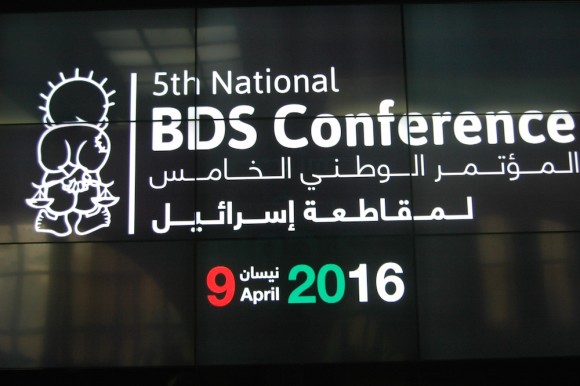
Tamam Abdul, 60, sells Israeli goods in her West Bank supermarket, but she would rather not. “All of the products we receive are Israeli, unfortunately,” she said Saturday outside of Ramallah at a fifth conference about the boycott, divestment and sanctions movement against Israel, otherwise known by the initials BDS.
Antendee Sana Sharif from Yatta, a town south from Hebron, said, “BDS is a tremendous effort, despite that few people are involved in it. I suggest that it should be part of our civic education.”
“My suggestion is that you could conduct campaigns that raise campaigns of children in school not to buy Israeli products,” Janna Jihad, 10, said in a plenary session.
Ways of increasing boycotts of Israeli goods were on the minds of many.
Over the past few years BDS has proliferated abroad and as a debate inside of Israel. Some multi-national corporations have severed ties with Israel, mainline Christian churches have divested their portfolios citing the plight of Palestinian Christians, and a slew of university campuses and academic association have endorsed BDS. A major sign of BDS’s impact came last month at an Israeli conference on how to deal with it, in which the campaign was described as looming crisis by leading members of the Israel’s government.
“We must distinguish between criticism and delegitimization when we deal with the BDS,” Israel’s President Reuven Rivlin said in an address to the forum, which was hosted by the Israeli daily Yediot Aharonot. Rivlin went on: “The claims of the proponents of BDS and the organization’s criticism, is based on a hatred and enmity of Israel, including anti-Semitic elements with regard to the right of Jews to return to their homeland.”
But there is one corner of the world where BDS has only recently gained traction and political leaders still veer from addressing the topic directly, or send mixed signals. Surprisingly it is in the West Bank, the occupied Palestinian territory, where Israeli products are abundant in shops, although many want them gone.
“We have a captive market,” said Mahmoud Nawajaa, the general coordinator of the BDS National Committee (BNC). He explained there are some products in the West Bank where there simply is no alternative other than an Israeli provider. Medication, water and electricity are prime examples.
“Then something ignited in 2014 in the West Bank during the war in Gaza. People started seeing boycott as a tool that they can use to pressure Israel,” Nawajaa said. At this time restaurants and markets chose to de-shelve Israeli products in an uncoordinated effort and groups of teenagers posted placards in West Bank cities calling on more to rid their stores of Israeli imports. The products were replaced with Palestinian brands.
The pressure has trickled up to the top tier of the Palestinian government in the West Bank.
An effort is underway to expand awareness of BDS in classrooms. Starting this year, the Palestinian Ministry of Education will train 600 teachers on BDS in order to launch curriculums in 25 schools. The program will instruct on the basics—BDS is a grassroots initiative brought about by Palestinian civil society organizations in 2005 who appealed to their supporters abroad to boycott, divest or sanction economic ties with Israel until three core principles are met: the end of the occupation over territories conquered in 1967, equality among all citizens of Israel, and the right of return of Palestinian refugees whose numbers near seven million, primarily scattered across the Middle East.
In 2014 the Palestinian government passed a law banning the sale of products made in Israeli settlements. Two weeks ago, the Palestinian Authority renewed their efforts and called for a boycott of Israeli dairy and meats in response to Israel turning back trucks loaded with similar Palestinian products from the West Bank seeking entry into Jerusalem in March of this year.
But the measures are viewed as half-steps by seasoned BDS activists. Both resolutions were passed without consultation of local BDS organizers (who call for a full boycott of Israeli goods, not only settlement products) and no enforcement mechanism was in place. Moreover, the Palestinian government shares economic ties with Israel. While on the political front there is no movement, with back and forth unanswered invitations to resume talks cancelled in 2014, the two continue meeting on joint industrial ventures across the West Bank in three manufacturing zones.
“We are not surprised,” Nawajaa said of the government boycott, “because we at least when something happens, they adopt our tactics. At least they started to think about boycott as a tactic of struggle and this is good.”
Others were frustrated with what they see as conflicting messages from the Palestinian government, where figureheads are seen both endorsing the boycotts and expanding business efforts with Israeli companies at the same time.
A sore point that was raised repeatedly in the conference is that the head distributor for the Israeli dairy brand Tnuva also serves as the mayor of Beit Jala, a Palestinian town outside of Bethlehem.
“I think the moral responsibility requires that he either stops being their agent—which I prefer—or resigns from his position,” said Mustafa Barghouti, a conference presenter and head of the Palestine National Initiative.
“People are fed up with some elites in Palestinian society,” said Omar Barghouti, a leading BDS organizer and conference founder (and a distant relation to Mustafa Barghouti).
“The criticism of the PA [Palestinian Authority], the president of the PA, the government was really strong,” Omar Barghouti added of the conference participants, “that reflects at the popular level people are sick and tired, and want to see their supposed representatives do something about actually ending Israel’s injustices rather than moving from one negotiation to another.”
BDS secured one of its biggest boosts, Barghouti said, last fall when the French company Veolia sold its shares of a light rail that runs through East and West Jerusalem. Barghouti estimated the service provider lost nearly $20 billion in contracts due to the BDS campaign launched in 2009 asking businesses and governments to hold off on contracts with Veolia until it disposed of its five-percent ownership of the tram.
Since then, more companies are re-thinking their investments in Israel.
“By this standard if it takes seven years to get one company out you need seven-thousand years to end the complicity of companies, but it doesn’t work like this,” Barghouti went on. “It’s a domino effect.”
“Over the past ten years we have shifted over symbolic and cultural boycotts if you will, to effecting the economy of the regime, of the occupation, of apartheid. So several multinationals are pulling out already,” Barghouti concluded. “We—it’s also Israel—are both starting to see the ‘South Africa’ moment.”

It would be absurd to ask the Palestinians, who either within or without the green line are entirely at the mercy of the occupiers, to boycott Zionist entity products.
Inviting a population without disposable income beyond the very basics of life to bypass an absolute tyrant of an occupier that controls all supplies anywhere on the territory is just as absurd, to refer to a similar situation, as asking the barely surviving people under German occupation to forgo anything produced anywhere in occupied Europe.
Even if such a boycott would be possible it is only symbolic: what hits hard the Zionists is not the economic loss by itself –the US taxpayer and other dark sources probably compensate for that kind of loss. It is the message they deliver that the Zionists are losing the European and Atlantic “Western” connection, most of all manifest in academic and sports boycott.
That is precisely why limiting our boycott in the West to the post-67 occupation is downright criminal. Moustafa Barghouti correctly said “if you want to only boycott an egg, we want you to boycott that one egg”, but that only applies to people (generally lib-Zionists) profiting from only post-67 area boycott. Not to normal peop… pardon, other than Zionists.
There will always be exceptions, excuses and justification why israeli products such as teva drugs, cell phone/computer technology, medical and environmental innovations, etc will never be boycotted, neither here, nor EU or america. therefore the cause of bds will always be tinged with hypocrisy by elite, merchant or lower classes. bds may continue to win battles here and there(mostly liberal ‘where’s) but will always lose the larger war. but dedicated and idealistic, they are
Haha you can’t even get so called Palestinians to stop consuming awesome Israeli products. BDS is done.
I suspect DaBakr is going to be called in for some Hasbara refresher training soon. He concedes here that BDS ‘… may continue to win some battles…’ while MaxNarr tells us that ‘BDS is done’. Remember guys, it’s important to stay on message!
“Yes, Goldman Sachs Funds Hebron’s Settlers. And Charles Schwab Is Funding BDS
read more: http://webcache.googleusercontent.com/search?q=cache:http://www.haaretz.com/opinion/.premium-1.714201
So giving illegal squatters aid to commit war crimes is equal to Charles J Schawb giving aid to JVP who work to end Israel,s war crimes and oppression.
Zionist logiic at it,s finest.
You can,t dream this stuff up.