

Why isn’t this stuff in the NY Times? Cause it’s on the blogosphere: Excellent report by Pamela Olson on delegation of kibbutzniks and Rabbis for Human Rights going to the West Bank to protect an olive harvest. Olson neatly compares the competing claims to the land: the religious nationalist ideology of the settlers, and the living connection of the Palestinians. No contest. Also has this good speech by an unnamed American-Israeli rabbi:
“Look, this work we do is not fun. It’s not nice to see what’s happening here and to think it’s our nation doing it. But it’s a moral duty for us to be here. Not only that, it’s also in our self-interest. Think about it. We won’t survive here very long if we don’t have neighbors who see us as human beings. I’ll give you an example. One time the army had captured a Palestinian kid, maybe twelve years old, and had tied him to their Jeep to use him as a human shield while they shot tear gas at some demonstrators. The kid was terrified. I was the only one stupid enough to walk through the tear gas and try to free the kid. The soldiers stopped me and beat me, but eventually the kid was released. Later he told his friends, ‘A tall man in a kippah saved me.’ A tall man in a kippah. He said this to his friends. How can his friends demonize someone in a kippah after that? It’s just one example, but these things can have ripple effects. Another time I was harvesting olives and talking with a man, and it turned out he was a member of Arafat’s presidential guard. Can you imagine? But here’s the thing. I could be wrong, but I think that after he saw the work we did, if there comes a time when he has to choose between violence and non-violence, I think he stands a better chance of choosing non-violence.”
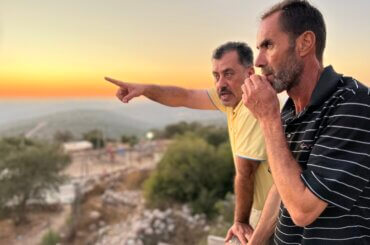
These statements are the necessary ones. This Rabbi — if you’re out there and reading this — is a gem. A jewel.
Good work. Humanization.
I worry about becoming a jaded person but I have to say, that story just about moved me to tears.
That’s why I’m on this blog. It’s not just that I believe in Palestinians. I believe in Jews as well.
I am sorry, but this guy embodies the typical arrogant, self-serving Israel supporter or Israeli.
The only reason why he does his “good deeds” is to promote his ethnicity– hasbara basically, although at least this kind of hasbara is better than the duplicitous tactics that pass for hasbara on this side of the atlantic.
Then his stupid comment about the Palestinian choosing between violence and non-violence– the arrogance of the colonial occupier, even those who claim to work for the natives, is that their own violence is completely invisible to them– even when they see it, they don’t see it. They don’t see it as violence, they see it as law, as security, as justice, but they never see it for what it is: violence.
I daresay the typical, arrogant, self-serving Israeli wouldn’t cross through a cloud of tear gas toward gun-toting IDF soldiers to free a twelve-year-old Palestinian child being used as a human shield. I think some credit where credit is due here.
That was my impression too, though I won’t state it as denigratingly as Madrid.
The sense I got in reading the rabbi’s words was one of deeds being done first and foremost in the interest of Jewish “self-preservation,” as opposed to being done because he saw a fellow human being treated as an animal.
Why the need to go on about “in our self-interest,” and a “man in a kippah?” Why can’t it can’t be kept simple: I saw a defenseless human being, a child no less, being tortured, and as a fellow human being I did what anyome with a conscience would do.”
The rabbi does begin by saying “it’s a moral duty for us to be here.” But then the rest of his words describe that moral duty through the prism of a”Jewish people,” not humanity.
This might be valid criticism, but one other way to think about it: this rabbi is speaking to other Israelis, to Israeli culture. Which means (paradoxically) he needs to “sell” his courageous expression of his Jewish faith in terms that the average Israeli will “buy.”
I hate to put it in such vulgar terms but I’ve my share of interactions with Israelis (contrasting sharply with my interactions with most American Jews) and that’s the culture the culture this rabbi lives in. I say give him credit for overcoming that and trying to put others on the right path.
I understand Chaos. Small steps.
Dan, your comment echoes the classical talmudic pros and cons debated among Orthodox Jews of whether and why a Jews should break the Sabbath to help a Gentile in immediate distress.
Since the Talmud was written before 1948, here’s an article raising some basic macro-contextual Jewish ethical/moral questions regarding “the tall man in the kippah.”
link to clal.org
RE: “Covering the olive harvest”
ALSO: Israel settlers’ ethnic cleansing strategies, by Steve Clemons*, 10/27/09 Source: palestinenote.com – link to palestinenote.com
“Browsing Haaretz this morning, I saw this top of the column story about Israeli settlers muscling Palestinians for harvesting olives from their orchards — because of the fear that the Palestinians could be gathering intelligence on the settlers.
This is perverse.
The settlers should be removed from the site near the Palestinian village and/or arrested for the harassment of the Palestinians.
This kind of behavior is consistent with ethnic cleansing efforts — which have been going on too long without serious comment.
The IDF’s role in simply separating both sides rather than punishing the provocations by the settlers — and actually allowing the Israeli settlers to protest inside the Palestinian village — is wrongheaded.” [END OF SHORT POST]
”HAARETZ” ARTICLE (referred to by Mr Clemons) – link to haaretz.com
P.S.
* Steve Clemons of “The Washington Note” and the ‘New America Foundation’
link to thewashingtonnote.com
link to newamerica.net
I think half of what the Rabbi said (and thus half of his intention) was good, and the other, self-aggrandizing and patronizing.
Adding to the above: The quoted RHR Rabbi disappointingly made something that should be about Israeli violence become about Palestinian violence, in a rather typical liberal-colonialist manner. I doubt very much he and others are aware of this point.
You do raise a good point about that. I appreciate most of what this Rabbi is saying but you raise a good point — it’s wonderful that he’s shaping his own behavior but rather disingenuous that he believes it’s Palestinian behavior that must also be shaped, and not Israeli behavior. Kind of a big blind spot he casts, talking about Israeli violence and never really addressing it directly.
I think that’s a little unfair–using your numerical partitioning, I’d say what he said was 80 percent good and 20 percent questionable.
Okay, more seriously, I’m relatively aware of the self-aggrandizing tendencies of mainstream liberals in both America and Israel–this need to pat oneself on the back and elevate oneself over the Other. The funny thing about liberals (and I’m somewhere between liberal and far left) is that they often have no clue as to just how racist they sound–they seem to think it’s only those crude Fox News viewers (or the crude settlers, I suppose, if one is an Israeli liberal) who are racist.
But I think this guy has mostly good intentions. Yes, he wants to influence Palestinians to resist nonviolently and there’s nothing wrong with that. As for Israeli violence, he shows what he thinks about that with his actions–he got beat up by Israeli troops trying to save this boy.
Anyway, he does say he’s there to do good, but also, it’s in Israel’s self-interest. Which is true. The objection I’d have is that often the self-interest theme tends to take over, and once that happens then you get the sort of discussion I’ve seen in the comments section of “Realistic Dove”–that is, how do we best control the Palestinians? By force or through diplomacy?
Incredibly thoughtful comments as usual, Donald. Thank you.
In expanding upon your thoughts on liberal racism, I’m reminded of a show I saw recently in which Janeane Garofalo was responding to the tea baggers. She was incredibly disparaging, and I couldn’t help but think to myself, “Gee Janeane, I thought the idea was to put yourself in others’ shoes, and even if you don’t agree with them, to try to understand.” That quality is sadly lacking in much of the “liberal left,” and is why I refuse to label myself a “liberal” or “leftist” or “progressive” or anything else, even though much of my thought and feeling is in line with many of their ideas, as well as with much of the “Libertarian right.”
It’s interesting to note that the “less educated” working class of this country who may use racial eptithets and what have you are nevertheless better able to communicate with and understand people from different backgrounds than are university-educated liberals who decry any and all vulgar langauge.
how do we best control the Palestinians?
Bullseye. That’s the contradiction of the progressive Zionists: they’re against the oppression, but not quite totally for freedom and equality. If only there were some middle ground.
The peace process!
The Rabbi isn’t trying to impress leftists with his mastery of post-colonial modes of discourse. He’s addressing the real fear that if the Israelis yield power to the Palestinians it will lead to oppression or violence against Jews.
Giving up power is a dangerous proposition for colonists or their descendents. Palestine/Israel is not Rhodesia, and I think much (not all) of the fear in Israel and among Zionists is based on atavistic paranoia. Their fear is real fear, though, and advocates for Palestine must address it if they hope to win over moderate Zionists.
The day the bulldozers came…
West Bank farmer Mahmoud al-’Alam won’t forget the day Israeli army bulldozers cut off his water supply… and destroyed his livelihood.
The village of Beit Ula, where Mahmoud lives, is not connected to the Palestinian water network. Instead the community, located north-west of Hebron, relies on rainwater, which it collects and stores in pots dug in the ground, known as cisterns.
The nine new cisterns built in 2006 as part of a European Union-funded project to improve food security became the pride of the village. The cisterns were vital to the survival of the nine families that used them… until the bulldozers arrived.
“[The Israeli army] destroyed everything; they went up and down several times with the bulldozer and uprooted everything,” recalls Mahmoud al-’Alam.
In a few hours, years of hard work had been undone. The cisterns had been built with the help of two local nongovernmental organizations, the Palestinian Agricultural Relief Committees and the Palestinian Hydrology Group.
The cisterns provided water for 3,200 newly planted trees including olive, almond, lemon and fig trees. The farmers had also contributed a significant portion of the overall cost of the project.
“We invested a lot of money and worked very hard,” said Mahmoud al-’Alam. “This is good land and it was a very good project. We put a lot of thought into how to shape the terraces and build the cisterns in the best way, to make the best use of the land, and we planted trees which need little water… the saplings were growing well…”
link to amnesty.org.au
Anyone expect to see a resolution in Congress condemning this?
More from that article:
Pamela Olson’s web site is so very personal yet telling about the people of the land; she writes concisely, plainly, and her many articles on her site are compelling–she brings you right there–anyone who visits and spends time on Pam’s site cannot possibly come away with the stereotype of Palestinians we are fed here in the USA.
in the article of Pam’s Phil references, a local Palestinian farmer tells us how the locals view their fig and olive trees–each one is part of the family, like a human child or grandparent–read his own words–give new meaning to just how hard the Israeli bulldozing of the fruit trees is to deal with for a Palestinian–makes me wonder why every Palestinian isn’t a suicide bomber.
Basically everyone I tour guide around the West Bank — Jewish, Christian, or atheist — says the same thing after they begin to grasp just how bad the situation is: “I can’t believe more Palestinians don’t become suicide bombers.”
Neither they nor I support suicide bombings on either moral or strategic grounds, but it should give you a small idea of the brutally inhuman situation the Palestinians are living under. The fact that they still welcome people like me into their lives without suspicion — in fact with more kindness than any other place I’ve visited in the world — is nothing short of a miracle. It’s the reason that despite it all, I have more faith in human nature after my time in the Holy Land, not less.
link to fasttimesinpalestine.wordpress.com