

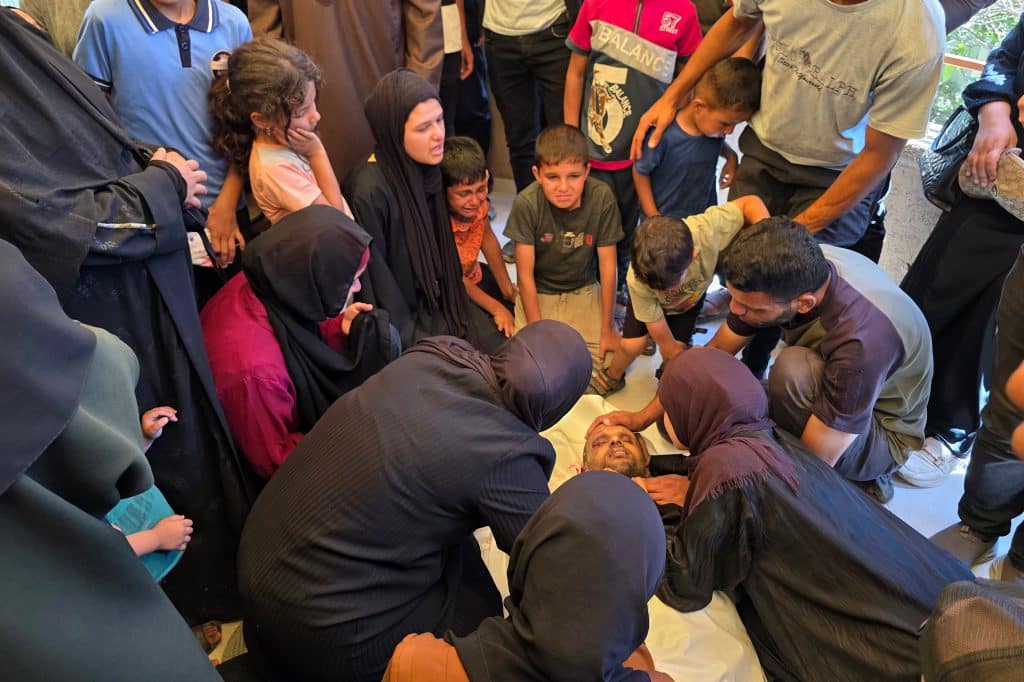
Earlier this week, Iyad Nofal was drinking his morning coffee outside his tent in Gaza when an Israeli missile struck and killed him. He was in the Mawasi displacement camp when he was killed.
“My brother was sitting in an area designated as a humanitarian safe zone, crowded with civilians and unrelated to any military activity,” Hussam Nofal, Iyad’s brother, told Mondoweiss. “He was sitting outside his tent when the missile killed him before anyone understood what was happening.”
After the strike, the Israeli army announced that Nofal was targeted alongside Ahmad Abd al-Hamid Hamad Maarouf, characterizing both men as members of the armed wing of the Palestinian Islamic Jihad (PIJ), with Nofal described as a “Nukhba [elite] commander” and Maarouf as the head of a “terrorist cell.” The army claimed that the two were planning to carry out an imminent attack on Israeli soldiers.
There has been no documented deliberate attack against Israeli soldiers inside of Gaza since the ceasefire between Israel and Hamas went into effect in October 2025, with the possible exception of a handful of soldiers who were allegedly killed by besieged Qassam Brigades resistance fighters during the early days of the U.S.-brokered agreement, when news had not yet reached all Hamas members located in remote parts of the Strip under Israeli control.
Hussam Nofal told Mondoweiss that he had no knowledge concerning whether his brother was a fighter in the PIJ, but maintained that he and the other man he was with “were out in the open and were not fighting when we saw them getting bombed.” Later, the PIJ announced in a statement that the Israeli army had killed 5 of its fighters and cadres in Gaza, although the statement did not mention any names.
The Israeli strike is the latest in a string of attacks against Palestinians in Gaza, targeting both civilians and resistance fighters in a clear violation of the terms of the ceasefire with Hamas that went into effect nine months ago. It is part of an escalating pattern of strikes across the Strip, which take place alongside the progressive expansion of the Israeli army’s control over Gaza’s territory, as well as the continued denial of the entry of adequate amounts of aid into the Strip, falling well below the amounts that had been agreed upon as part of the ceasefire’s first phase.
The result is a status quo in which Israel continues to systematically violate the agreement at every turn without any consequence, while Hamas and other Palestinian factions continue to observe its terms.
A pattern of violations
The Israeli violations are part of a systematic pattern that began as soon as the October 2025 ceasefire went into effect. In the first weeks after the agreement, the Israeli army’s strikes were justified by manufacturing pretexts of imminent threats to Israeli forces, or in “retaliation” for alleged attacks by Hamas fighters. In subsequent months, when the pace of Israeli violations continued unabated, the need to present such pretexts faded. With the outbreak of the U.S.-Israeli war on Iran, these policies escalated dramatically, including cutting off aid and targeting aid workers.
In addition, Israeli forces have not withdrawn from the areas along the so-called “Yellow Line,” which cuts Gaza roughly in half between Israeli and Hamas control, and which Israel has progressively expanded to bring over 65% of the Strip’s territory under its control. This is in stark contradiction to Israel’s requirements to progressively withdraw its forces and pull back the Yellow Line in accordance with the ceasefire agreement.
Meanwhile, Egyptian-mediated discussions continue with Palestinian factions in Cairo to explore ways of reinforcing the ceasefire and addressing the issue of Hamas’s disarmament.
Hamas spokesperson Hazem Qassem told Al Jazeera on Tuesday that the Palestinian factions had responded positively to the mediators’ proposals presented during the recent Cairo meetings regarding the implementation of U.S. President Donald Trump’s plan to end the war in the Gaza Strip.
He added that the factions had dealt with the mediators’ proposals with flexibility and called on the mediator countries to pressure Israel to halt its violations of the ceasefire agreement and to pressure the Israeli authorities “to implement the remaining provisions of the first phase of the agreement, stop the ongoing violations, and accept reasonable approaches concerning the pathways of the second phase.”
Qassem also stated that Israeli violations of the agreement had resulted in the deaths of 1,000 Palestinians since the ceasefire took effect.
Intensifying attacks
Over recent weeks, Israeli strikes have intensified, with the death toll reaching 13 people in a single 24-hour period earlier this week.
Last Friday at dawn, Israeli forces bombed a tent sheltering displaced families in al-Mawasi, killing three people, including a 22-year-old woman. On Saturday, Israeli aircraft targeted additional tents housing displaced civilians in the same area.
The attacks have not been limited to Palestinians on land. On Sunday, two fishermen were killed in Deir al-Balah, including 15-year-old Muhammad Abu Jiab. On the same day, Israeli military aircraft struck a naval unit position west of Khan Younis, killing five members of the force and injuring more than 20 others who were passing nearby. On Monday, targeting of displaced persons’ tents in Al-Mawasi continued, killing two more Palestinians.
In the same area of al-Mawasi that experienced the highest number of airstrikes during the past week, and where the majority of Gaza’s displaced population has lived in tents since the beginning of the war, Khaled Zarab described how his home was bombed and collapsed onto nearby tents, displacing dozens of families.
“We thought the war had ended,” he told Mondoweiss. “But every day the Israeli army proves that it has not ended and will not end. What more does the occupation want from us?”
Leveling what remains
But the ongoing Israeli escalation in Gaza is not limited to military strikes. Civilian and humanitarian conditions continue to deteriorate as a result of restrictions imposed on Palestinians, including limits on border crossings and the movement of patients seeking medical treatment abroad.
More than 1,500 patients died while waiting for permission to travel abroad for medical care. During a press conference in Gaza City, Deputy Health Minister Maher Shamia said that restrictions on crossings and medical evacuations had created a catastrophic situation. He noted that, as of May 20, 2026, Gaza patients had received 17,757 medical referrals, yet only 1,204 patients had been able to leave the Strip for treatment.
“The issue of patients is a humanitarian matter that cannot be manipulated,” Shamia said. “They have the right to receive treatment, and the guarantors of the ceasefire must ensure mechanisms that allow them to leave for medical care.”
He added that health officials are calling on Israel to reopen the Rafah and Kerem Shalom crossings to guarantee the safe passage of Gaza patients requiring specialized treatment in host countries.
In other parts of Gaza, including the town of al-Zawayda in the central part of the Strip — one of the few areas not completely destroyed during the war — residents received evacuation warnings on June 4, ordering them to leave residential blocks that were later targeted by airstrikes.
After residents evacuated without being able to remove their belongings, Israeli forces bombed a house, causing extensive destruction throughout the area.
Ibrahim Zayed, a resident of Al-Zawaida, said the world must know that the bombing has not stopped for a single day since the ceasefire began. “We remain under attack every day,” he said. “Israel claims it is committed to the agreement, but in reality it is the Palestinians who are observing the ceasefire, while Israelis continue to kill Palestinians every day.”
Tareq S. Hajjaj
Tareq S. Hajjaj is the Gaza Correspondent for Mondoweiss and a member of the Palestinian Writers Union. Follow him on Twitter/X at @Tareqshajjaj

And in the West Bank,
More Palestinians killed in West Bank since 2023 than in previous 17 years, Oxfam says…Citing data from the UN Office for the Coordination of Humanitarian Affairs (OCHA), Oxfam said that 1,244 Palestinians, including 268 children, were killed in the West Bank from 2023 through 2025….
https://www.middleeastmonitor.com/20260612-more-palestinians-killed-in-west-bank-since-2023-than-in-previous-17-years-oxfam-says/