

Every year, in the last evenings of spring, Hassan Kbeineh would watch the sky for the rise of the Pleiades — the cluster of seven bright stars that Palestinian farmers have long used to gauge the approach of the harvest season. When he spotted it, he would smile and repeat the proverb to his wife: “If the Pleiades rises in the evening, summer is on its way…bring the sickle.”
The sky wasn’t the only guide Kbeineh relied on. His wife watched for her own signs in the earth: tracking the wheat ears until they dried out, turned yellow, and moved past the milky stage into full hardness, when the grains become tough enough to resist weevils during storage.
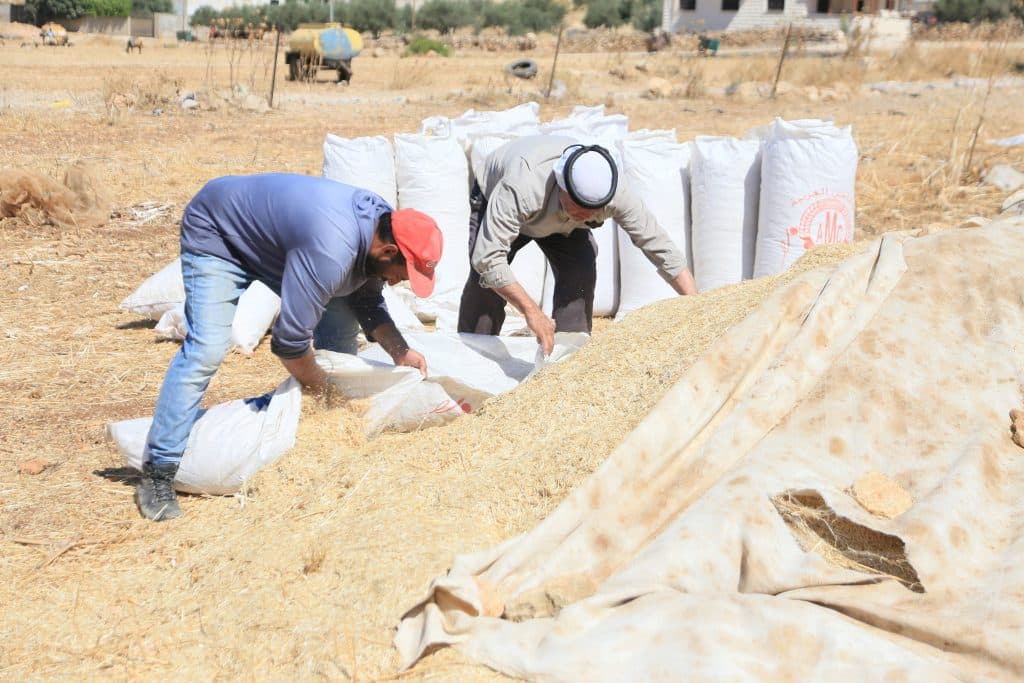
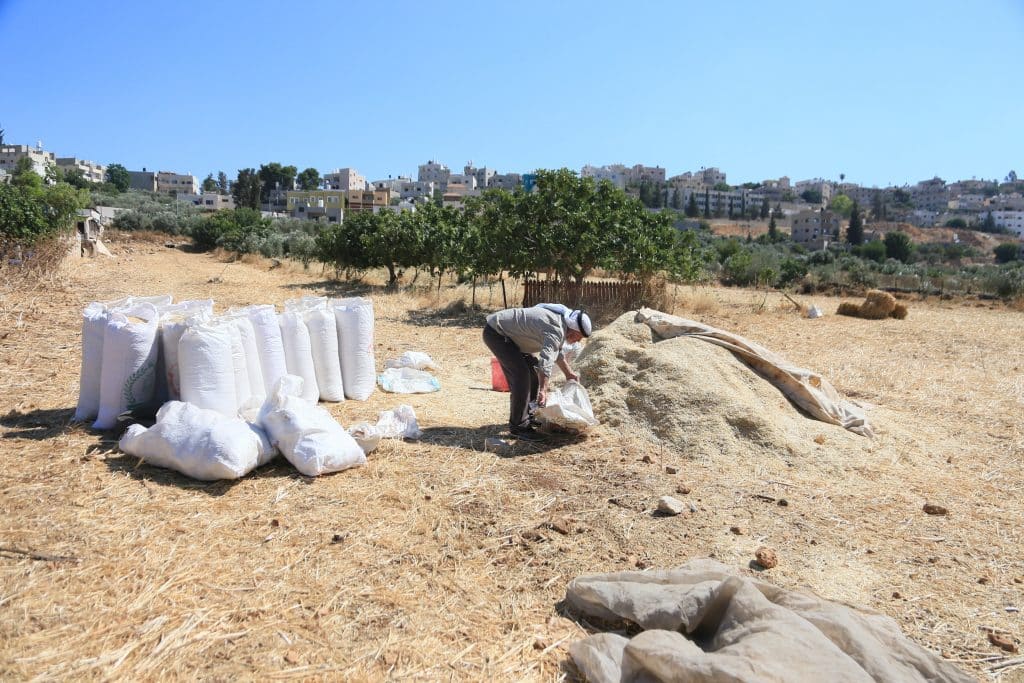
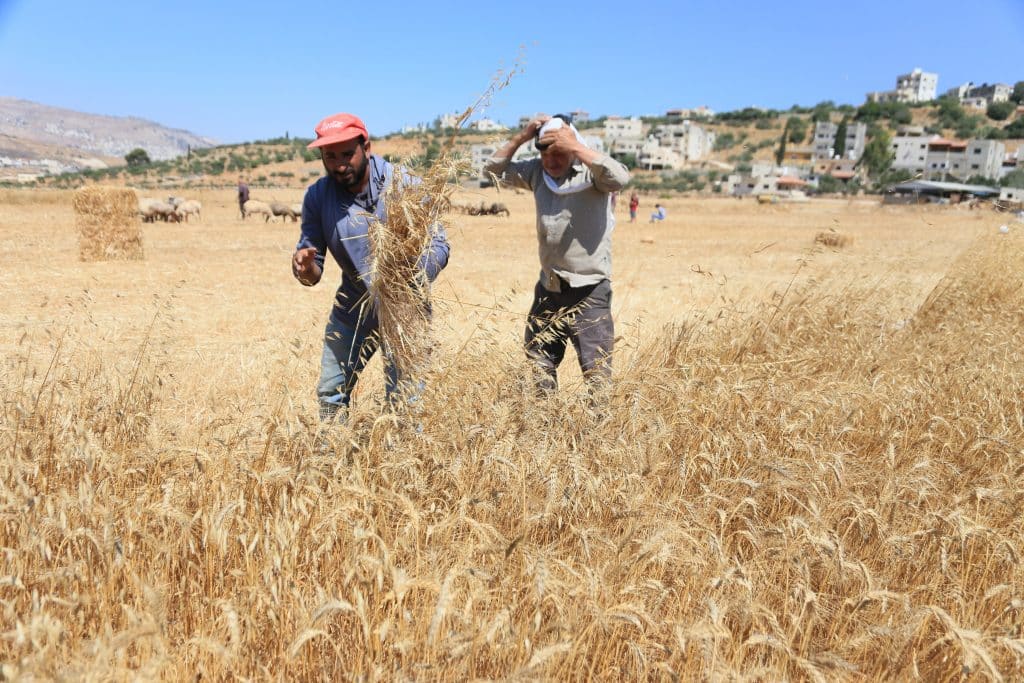
When we arrived at the farm in the village of Sawiya to document the wheat’s life cycle, we found the crop already piled up in storage, well before the harvest was due. Surprised, we asked why they harvested the wheat so early.
“We weren’t watching for the Pleiades to rise this time,” he answered, turning over a handful of unripe wheat ears. “We were watching for settler attacks. We harvested the wheat before its time while it was still green, because we were afraid we’d be harvesting ashes instead.”
The Palestinian agricultural calendar has long served as a mirror of the environment, organizing farmers’ lives in lockstep with the changing seasons, the movement of the stars, and the cycles of rain. But the succession of Israel’s wars and manufactured crises has battered Palestinians and imposed a harsh political dimension upon nature’s rhythm. Road closures, denial of access to land, and repeated settler attacks have forced farmers to redraw their planting and harvest schedules. The wheat harvest has seen the most dramatic impact.
After the harvest ended, families would often exchange help through the “awnah” system, a collective form of mutual aid in Palestinian society that has organized Palestinian village life for generations. Relatives and neighbors gather to harvest the land together, before journeying to mill the grain into flour.
But disruptions to the wheat harvest schedule have rippled through an entire cycle of relationships and customs built around the grain, says Kbeineh’s wife. “We lost the way we used to live through the season,” she explained. “Everything had its own time. The harvest had its time, the selling had its time, and the celebration had its time.”
Zionism’s war on wheat
Wheat’s economic standing in Palestine has gradually declined despite its status as the most widely grown crop under the British Mandate. The 1930 Johnson-Crosbie Commission report found that grain accounted for about 53 percent of Palestinian farmers’ income, a share that had fallen to 28 percent by 1939, although grain-planted land accounted for about 69 percent of cultivated land in Palestine.
This contradiction reflects the declining economic viability of wheat farming, driven by falling prices, rising land costs, and the financial burdens farmers carried from loan interest, the cost of seeds, animals, and farming tools, according to Iskandar Atiyeh, director and lead researcher at the Center for Rural Studies, a Palestinian research institute based in the Galilee.
“This reality gradually eroded local production and deepened dependence on imports,” Atiyeh explained. “While around 17 percent of the wheat consumed in Palestine was imported in 1923, that share rose to 52 percent by 1930, an early sign of the decline of subsistence farming.”
Even so, local wheat remained the backbone of Palestinian rain-fed agriculture until shortly before the Nakba. The Center for Rural Studies has documented around 33 local wheat varieties, including the “Hourani” variety in the Upper Galilee, the “Jaljulani” on the coastal plain, and the “Abu Fashi” in the Tulkarem district, as well as varieties such as “al-Hiti,” “al-Qasri,” “Dabiyya,” “Nab al-Jamal” (“Camel’s Tooth”), and Hirbawi.
These varieties once covered about 1.38 million dunams (138,000 hectares) of historic Palestine, and their cultivation was tied to a fully integrated rural system that included seed-saving and exchange between families, collective harvesting, threshing floors, mills, and local markets. According to the center, 165 mills operated in the West Bank alone in 1966, grinding around 40,600 tons of wheat annually.
The 1948 Nakba tore this system out from its roots. Palestinians lost a majority of the most fertile and productive wheat-growing plains, chief among them Marj Ibn Amer, the coastal plain, and large parts of the Hula plain, says Iskandar. He emphasizes that “the destruction of more than 530 Palestinian villages meant the loss of threshing floors, grain stores, mills, and the seed-exchange networks that had preserved local varieties for decades.”
According to the Center, this shift accelerated after the occupation of the West Bank in 1967, as the Palestinian economy was folded into Israel’s. Israeli companies, working with agricultural extension agencies, began marketing “improved” and hybrid varieties imported from Israeli and European plant-breeding programs, gradually displacing local seeds. The Paris Economic Protocol of 1994 cemented the Palestinian market’s dependence on Israel by giving the new state control over crossings and imports, leaving Palestinian farmers to compete with Israeli and globally imported wheat with no real tools to protect their own production.
These commercial varieties differ from local wheat in that many of them lose their productive qualities when their seeds are replanted, forcing farmers to keep buying new seed and rely more heavily on chemical fertilizers. Local wheat, by contrast, lets farmers keep part of their harvest as seed for the following season, sustaining an independent, self-sustaining, and inherited agricultural cycle.
As settlement expansion, land confiscation, and shrinking farmland have taken their toll, local wheat cultivation has contracted sharply. “Palestinian land today is almost empty of most local wheat varieties, after imported varieties took their place,” Iskandar said. “Meanwhile, the areas planted with local wheat in the West Bank have shrunk to just a few thousand dunams, down from what once stretched across vast areas.”
The loss of local wheat wasn’t confined to the fields; it reached the Palestinian table, too. Years of siege and famine have historically been tied to the search for bread substitutes, and some communities mixed wheat flour with barley or corn, and in the poorest villages, people processed acorns or colocynth and mixed them into the flour just to get by.
Atiyeh adds that “mixing barley into wheat is tied, in Palestinian memory, to hardship and loss.”
“Widowed women would bake it when their husbands were killed in war,” he explained. “They would recite the adage, ‘I never saw her weep for her lost days, save with barley bread and little to go with it.'”
This image appears in Personal Memoirs: A Collective Memory, by Adel Abu al-Hayja, who recalls eating “berdakoush,” a bread made by mixing wheat with corn. Al-Hayja describes it as “the bread of the poor and refugees, which tasted awful.” These scenes have returned more brutally in the Gaza Strip, where Israel’s genocidal war has disrupted wheat’s entire life cycle, from the field to the mill to the family table. Residents were forced once again to mix flour with barley or other substitutes just to secure at least some bread, and at the height of the genocide, Palestinians resorted to making bread out of animal feed, painfully echoing previous famines in Palestinian history that many thought belonged to the past.

Palestinians revere wheat as sacred across their religious traditions, a sanctity so deep that people still swear oaths on bread, proclaiming, “I swear by this blessing that…” And if a piece of bread falls to the ground, people rush to pick it up, kiss it, touch it to their forehead, then set it back on the table out of respect.
Kbeineh’s wife holds wheat especially sacred, saying it can only be planted and harvested by someone who is deeply devout, and that animals must never be used to harvest it to avoid defiling the crop. Its seeds, she says, are used to ward off harm from certain people.
But farmers have started to see these rituals tied to wheat disappear. Imported grain holds none of the Palestinian stories and traditions passed down through generations, and is instead subject to the calculation of profit and loss. The variety of wheat is chosen based on which is more productive or more resilient to the weather, giving rise to the notion that local indigenous wheat varieties lacked certain qualities that imported wheat provided.
Kbeineh rejects the claim that imported wheat is superior to indigenous wheat, especially as he still grows the native Kahla variety today. “Local grains have evolved alongside the climate changes in Palestine over the years,” he said. “Many farmers have crossbred and developed them locally so they’d become more productive and higher-yielding.”
Women, in particular, have lost their central role in the wheat season. From the “ghammara,” who led the gathering of cut wheat ears and bound them into bundles, carrying those heavy loads on her head from the rough fields to the threshing floors, through the process of “taqshish” — selecting the long wheat stalks and storing them in bundles for use throughout winter in traditional straw crafts — and ending with cleaning and sifting the wheat of debris before milling, according to Iskandar Atiyeh’s documentation in a co-authored book with Shukri Arraf, Bread in Palestine.
The harvest that mirrored Palestinian life
As the original wheat seasons have increasingly disappeared, a group of volunteers running agricultural cooperatives recognized the importance of reviving native grains to preserve Palestine’s agricultural heritage.
“We planted about 30 dunams [3 hectares] this year, spread across the village of Saffa in the Ramallah district, the village of Arraba in the Jenin district, and the village of Tamra (through the Nabat cooperative) in the western Galilee region [inside Israel proper], as well as other areas near the separation wall,” Adham Karajah, owner of the Ard al-Ya’s cooperative in the village of Saffa, told Mondoweiss.
“We had a very abundant harvest,” he added. “And we didn’t expect the experiment to succeed to this degree. It shows that local grains, with its current traits, are capable of competing [with foreign varieties].”
Those behind the initiative succeeded in collecting heritage wheat varieties native to Palestine, including “Nab al-Jamal,” “Hiti,” “al-Kahatat,” “al-Baraka,” and “Umm al-Rabee,” as well as the non-native “Anbar” variety, which remains indigenous to the broader Mediterranean region.
As part of preserving the rituals tied to the wheat season, the cooperative launched the “Awnah Wheat” event for collective wheat harvesting, bringing together farmers and interested participants to help with the harvest while exchanging knowledge about seed varieties and the best places to grow them. A group of bakers who had run numerous trials using the grain to make bread for the local market also took part in the awnah.
During these gatherings, participants revived old stories about Palestinian bread, including what was historically known as “khubz al-sha’b” (“the people’s bread”) — a rationed loaf tied to Palestine’s wheat crisis in the final months of the British Mandate, meant to guarantee bread at a fixed price and to fight the black market amid the wheat crisis and the war.
“Bread was, and still is, a mirror of the crises Palestinians live through,” Karajah said. “Just as it has been a mirror of their ability to invent collective solutions in the face of scarcity.”
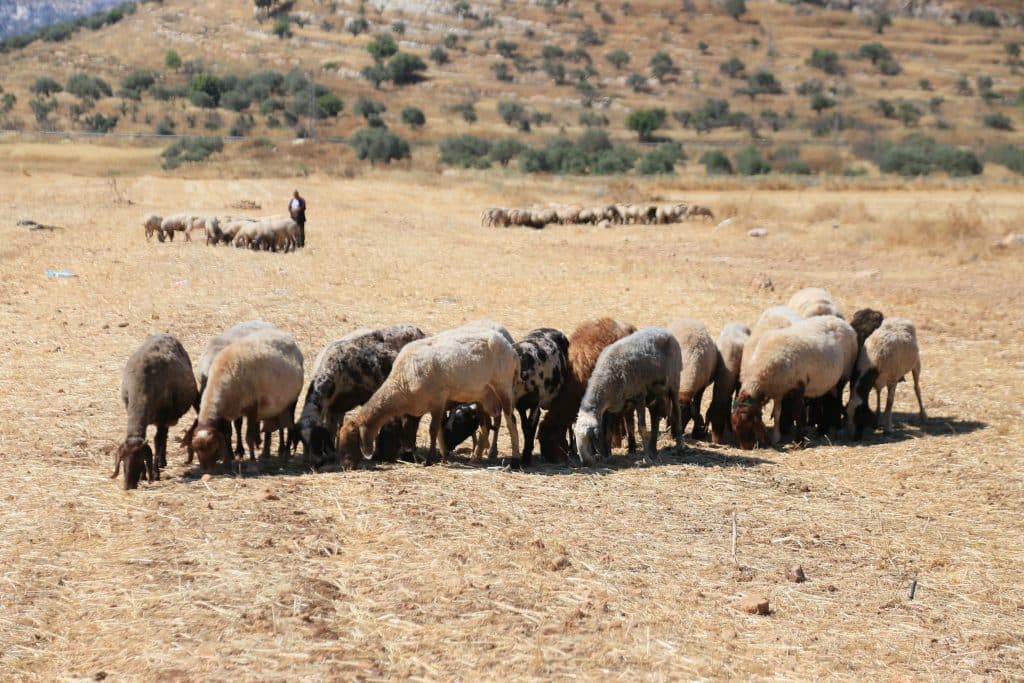
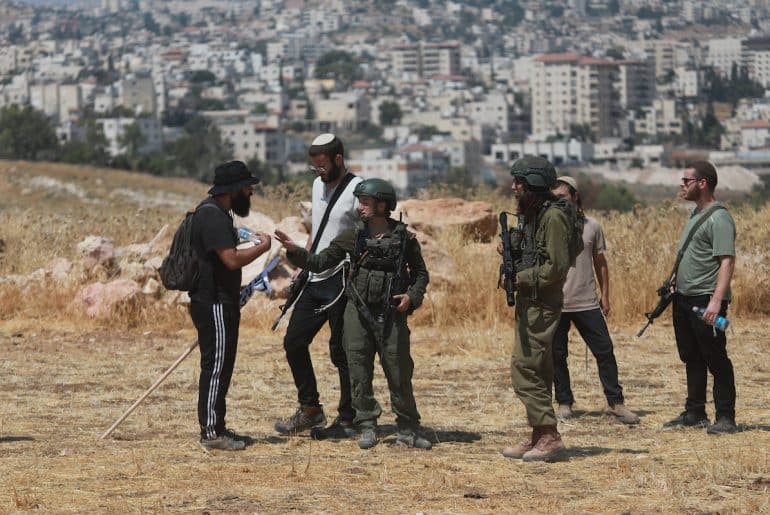
Settler encroachment on Palestinian farmland today is one such crisis, and it is mirrored in the intimate implications of the wheat harvest on the Palestinian farmers trying to keep the wheat-growing tradition alive in Palestine. For farmer Kbeineh, the notorious “shepherding outposts” set up by settlers — which have already expelled scores of Palestinian Bedouin communities from their generational grazing pastures to make way for settler livestock — are now threatening wheat crops, with settler cattle herds turned loose to graze in the wheat fields.
“It’s strange that a cow decides when we harvest!” Kbeineh said, explaining that settlers’ cow herds have become part of their calculations in the growing season, including dictating the hours farmers can work the land. “We used to go out to harvest while the cows were asleep, and when they woke up hungry, we’d rush to gather what was left of the crop before they devoured it. We had to change our own calendar to match the schedule of the settlers’ cows.”
Cows pushed up the date of Kbeineh’s son’s wedding, originally set for July, after the harvest season ended and the wheat crop was sold. The sale was a main source of funding for the wedding, but moving up the date came at a cost. “Our income ended up lower than we expected, and that affected the wedding preparations,” Kbeineh’s wife explained. “When we harvested the wheat before its time, the grains hadn’t fully matured yet, so the yields dropped, moisture levels rose, and we had to dry the crop and cover extra costs we hadn’t planned for.”
Kbeineh turns the green wheat grains in his hand, harvested before their time. “It’s an attempt to steal our own calendar and replace it with theirs,” he said. “They’ve turned our lives into a string of emergencies. We always have to do things in a rush. We harvest early, we celebrate early.”
“But this unfinished crop is our small victory,” he added, rolling the grains between his fingers. “Eating bitter bread from your own land is far better than waiting for flour that doesn’t resemble us.”
Majd Jawad
Majd Jawad is a Journalist and researcher from Jenin, Palestine, holding a Master’s degree in Democracy and Human Rights from Birzeit University and a Bachelor’s degree in Journalism.

Ecocide: Israel’s systematic destruction of Palestinian agriculture revealedBritish-based investigation unveils targeting, destruction of land by Israeli forces in Gaza Strip since last October…A British-based investigation group has unveiled the systematic targeting and destruction of orchards and greenhouses by Israeli forces in the Gaza Strip since last October, when the current conflict in Gaza began, undermining Gazan Palestinians’ ability to feed and provide for themselves….Analysis by Forensic Architecture, a multidisciplinary research group based at Goldsmiths, University of London, identified more than 2,000 agricultural sites, including farms and greenhouses, that have been deliberately destroyed, and often replaced with Israeli military earthworks….The destruction, particularly intense in northern Gaza, has led to the devastation of nearly one-third of the region’s greenhouses and approximately 40% of agricultural land previously used for food production….The investigation suggests that the destruction is a deliberate act of ecocide exacerbating the ongoing catastrophic famine in Gaza, part of a wider pattern of depriving Palestinians of critical resources for survival….
Ecocide: Israel’s systematic destruction of Palestinian agriculture revealed
More ecocide:
The Guardian:
https://www.theguardian.com/world/2026/aug/12/israel-deliberately-starting-wildfires-in-southern-lebanon-firefighters-say
It seems that never ever has Apartheid and Genocide been so much fun for its pepretrators. Just watch the videos of the Hilltop terrorists who calll themselves “The happy Jews”. Or the aettler terrorists in Gaza, when they flatten an entire street.
It’s No Wonder Israelis Want War. Violence Has Become a Source of Joy