

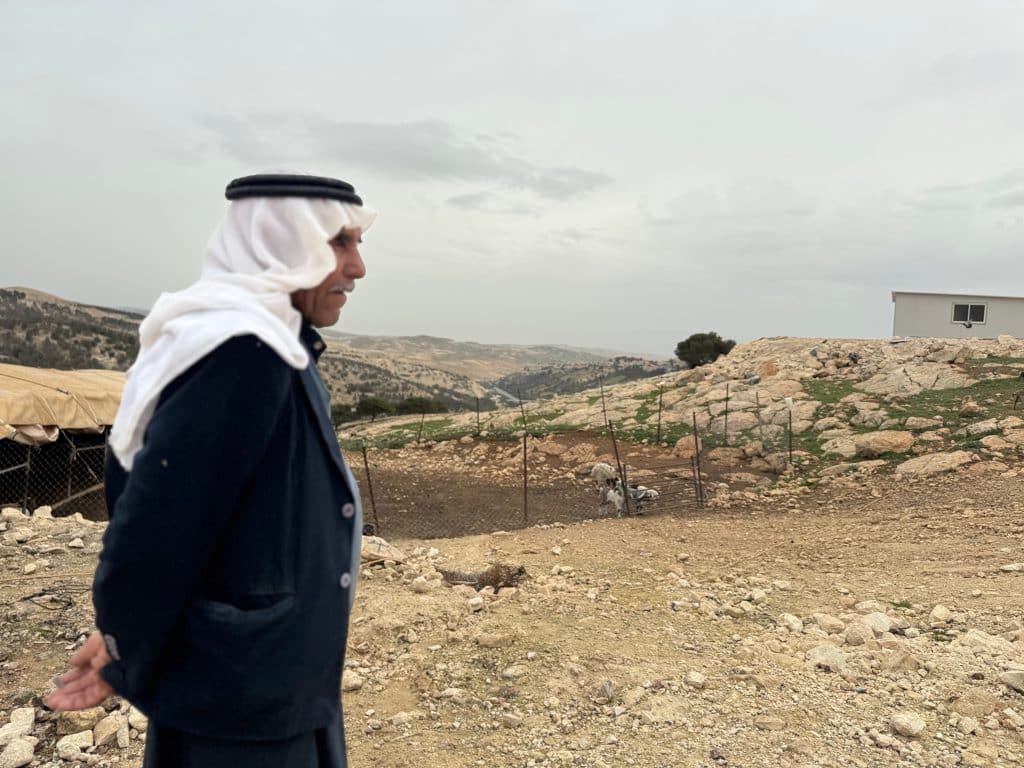
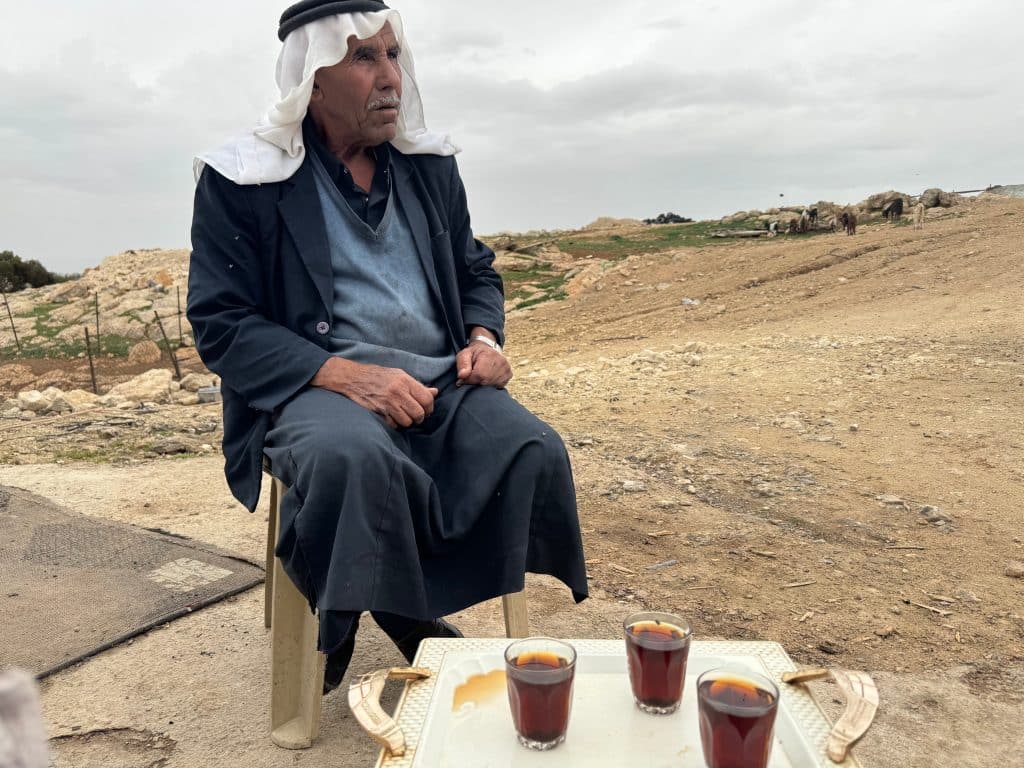
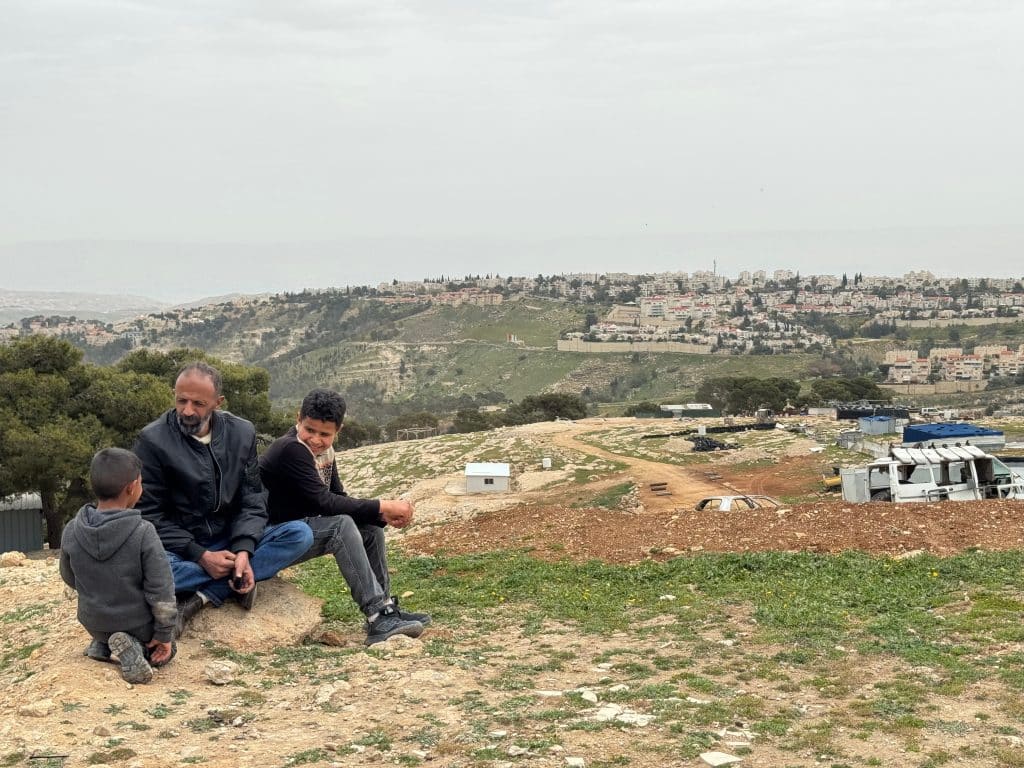
Salem al-Jahalin,73, also known as Abu Nayef, circles his home in the Jabal al-Baba Bedouin community outside the town of al-Aizariya, east of Jerusalem. His eyes scan the surrounding terrain as far as he can see, bracing for any incursion by the Israeli army. This is the fourth time the military has threatened to demolish his home, delivering, once again, a notice informing him that his land had been claimed by one of the largest settlement blocs in the West Bank: “Your home is built on the lands of Ma’ale Adumim.”
Abu Nayef’s cup of tea goes cold before he gets a chance to sip it, his mind occupied by the uncertain fate that stalks him, as it does all the Bedouin around Jerusalem. His fingers roll a new cigarette as he tries to light it, raindrops hitting it once, the wind extinguishing it the next. “Every time they demolish, we rebuild,” Abu Nayef says. “Where would we go? They want to displace us from the land, but it’s impossible — we’ll die before we leave.”
Salem’s situation is similar to that of every Palestinian Bedouin living in the Jerusalem wilderness — locally known as the badiya of Jerusalem, a vast expanse of semi-arid plains and rolling hills that Bedouin communities have called home for generations. These communities now stand as the last barrier against the E1 settlement project, a long-halted colonization plan that aims to seize a strategic tract of land at the node separating the northern West Bank from the south, and which also encompasses the area Israel calls “Greater Jerusalem.”
Jabal al-Baba is one of 46 Bedouin communities scattered across the badiya, stretching across the steppe to the Dead Sea. Together they form a large Palestinian population bloc east of the city, alongside the four Palestinian towns of Abu Dis, al-Aizariya, Za’im, and al-Sawahra. Although an exact estimate of the total number of people in these 46 communities is unavailable today, in 2017 the UN Office for the Coordination of Humanitarian Affairs (OCHA) put the number at 8,174.
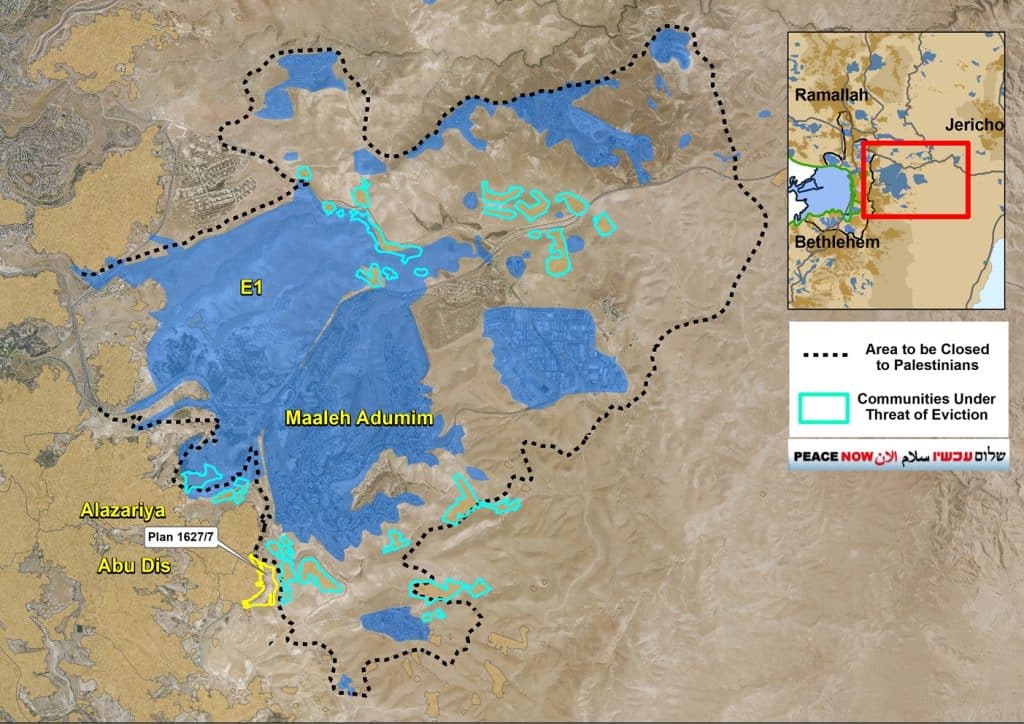
A key lynchpin in the plan to transfer the Bedouin population from the E1 area is their forced sedentarization in 170 dunams of land in Abu Dis. Known as the “Shami neighborhood” project or Plan No.1627/7, the plan was submitted in March to the Israeli Civil Administration, the military body in charge of governing the civil affairs of Palestinians in most of the West Bank.
The so-called “neighborhood” is intended to host the Bedouin communities of Khan al-Ahmar, Abu al-Nuwar, Arab al-Jahalin, Wadi Jamal, Jabal al-Baba, Wadi Suneisel, and Bir al-Maskub.
Earlier this week, the first steps in the forced resettlement plan were set in motion by hardline Israeli Finance Minister Bezalel Smotrich, who issued an order on Tuesday for the immediate removal of the Bedouin community of Khan al-Ahmar. Israeli newspaper Yedioth Ahronoth reported that Smotrich’s move came in response to the disclosure of a secret request by International Criminal Court (ICC) prosecutor Karim Khan for an international arrest warrant against him.
Jabal al-Baba and the terror of the E1 plan
The Jahalin clan, from which Abu Nayef descends, was first displaced by Israel during the Nakba in 1948, expelling them from the town of Tel Arad in the northeastern Negev. Since then, the Jahalin have spread across the Jerusalem wilderness, but those steppes have been gradually seized by the Israeli army for settlement construction over several decades, corralling the Jahalin into fixed Bedouin communities. This forced Abu Nayef to settle in the Jabal al-Baba community near the Palestinian town of al-Aizariya. “There are no Bedouin left,” he says. “They’ve hemmed us in — we can’t reach the grazing lands anymore. Anyone who gets there gets his sheep taken. Half of us have sold our livestock.”
Today, Jabal al-Baba is threatened with displacement, Abu Nayef says. “The wall wraps around us, and once it’s complete, the land will be annexed to Ma’ale Adumim,” he states.
A flock of pigeons wheels above the shelters of the Jabal al-Baba community, roofed with sheets of corrugated steel, before disappearing into the horizon. On the ground, a family busies itself rebuilding a home damaged by winter. A sense of uneasy normalcy pervades the community, as children play between homes and the smell of food wafts through the air, signaling the shepherds’ return and the approaching jingle of livestock bells.
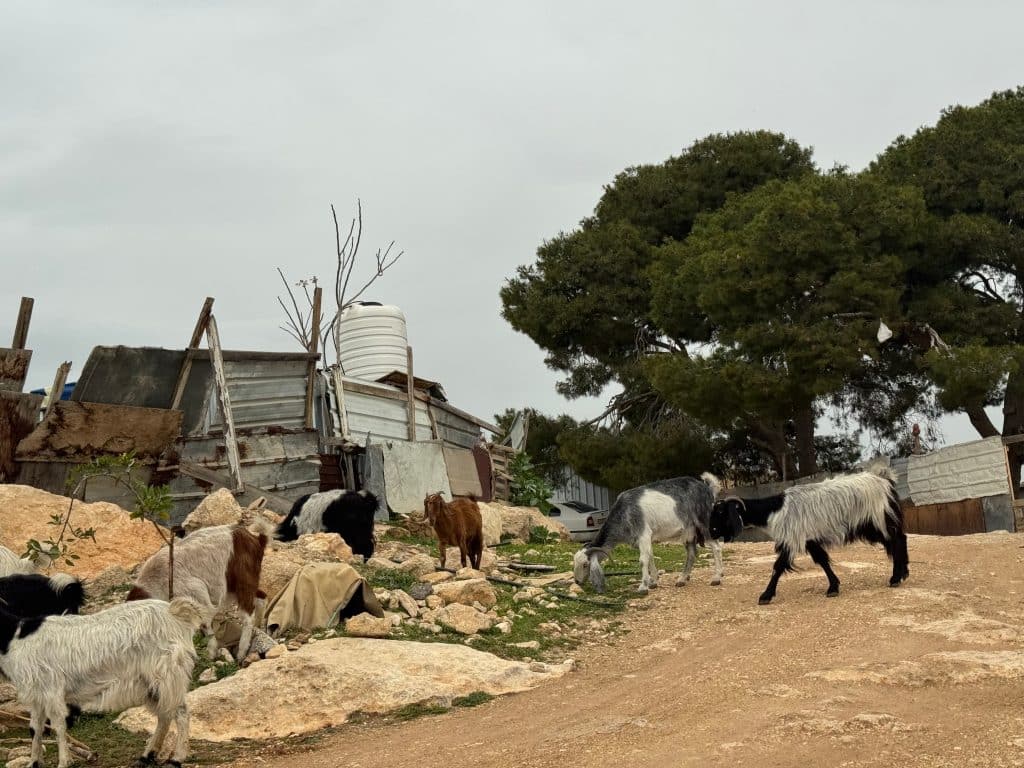
From the center of Jabal al-Baba, you can see the Ma’ale Adumim settlement creeping closer, expanding as part of a slate of newly-approved settlement construction projects. In another direction, the roads that serve the settlement are visible, and to the east, the separation wall cuts the community off entirely from Jerusalem. The scene that unfolds is of a people surrounded from all sides, with the only entrance to and from their community going through al-Aizariya.
“Our encirclement began with the confiscation of grazing lands for settlements and roads,” says Atallah al-Jahalin, representative of the Jabal al-Baba community. “But Israel is never satisfied. It doesn’t just want to eliminate us as Bedouin communities — it wants to erase us as part of Jerusalem’s demographic fabric.”
Today, the Jabal al-Baba Bedouins have become a thorn in the side of the E1 project, protecting roughly 12,000 dunams (approximately 12 square kilometers) and obstructing settlement expansion in those lands. Removing them would constitute the first step toward connecting Ma’ale Adumim to Jerusalem. “Over all these years, Israel has pressured us to leave the area,” Atallah says. “More than 100 demolition operations have been carried out until now. Nearly every home in Jabal al-Baba has been demolished at some point.”
“And every time, we rebuild, because we have no alternative,” he adds. “We refuse to live through the Nakba that our fathers endured.”
Wiping out an entire way of life
Hassan Mlehat, general supervisor of the Baidar Organization for Bedouin Rights, explains that the Bedouin communities “form a security belt for the city of Jerusalem from the east against settlement expansion.”
For precisely this reason, Israel has intensified its establishment of pastoral settlements and so-called “shepherding outposts” near these communities over the past three years.
“The shepherding outposts have become centers for terrorist attacks against Palestinian Bedouins,” Mlehat says, “including the destruction of infrastructure, severing water pipes, smashing solar panels, and stealing livestock.”
The people of Hathroura refused to receive journalists or any organization. They responded to us with one question: “What have we gained from all the talk? Why has no one helped us?”
As a result, many communities were forced to leave their lands and sell their livestock. Some, like the Bedouin communities of the eastern slopes of Ramallah, which overlook the Jordan Valley, moved up toward the hill country to the west, where they were forced to buy property and settle due to the lack of grazing pastures. Others, like the over 1,200 people who once lived in the blooming valley of Ras Ain al-Auja just a few months ago, were forced to dismantle their homes with their own hands and abandon an entire way of life. The most recent community to be wiped off the map was the hamlet of Khallet al-Sidra near the village of Mikhmas, northeast of Jerusalem. The 16 families that made up the community were displaced in March 2026.
By now, roughly 88 Bedouin communities have been displaced, and as of April 2026, settlers have planted six additional rural outposts across the wilderness east of Jerusalem, transplanting the model that settlers have used to displace the others.
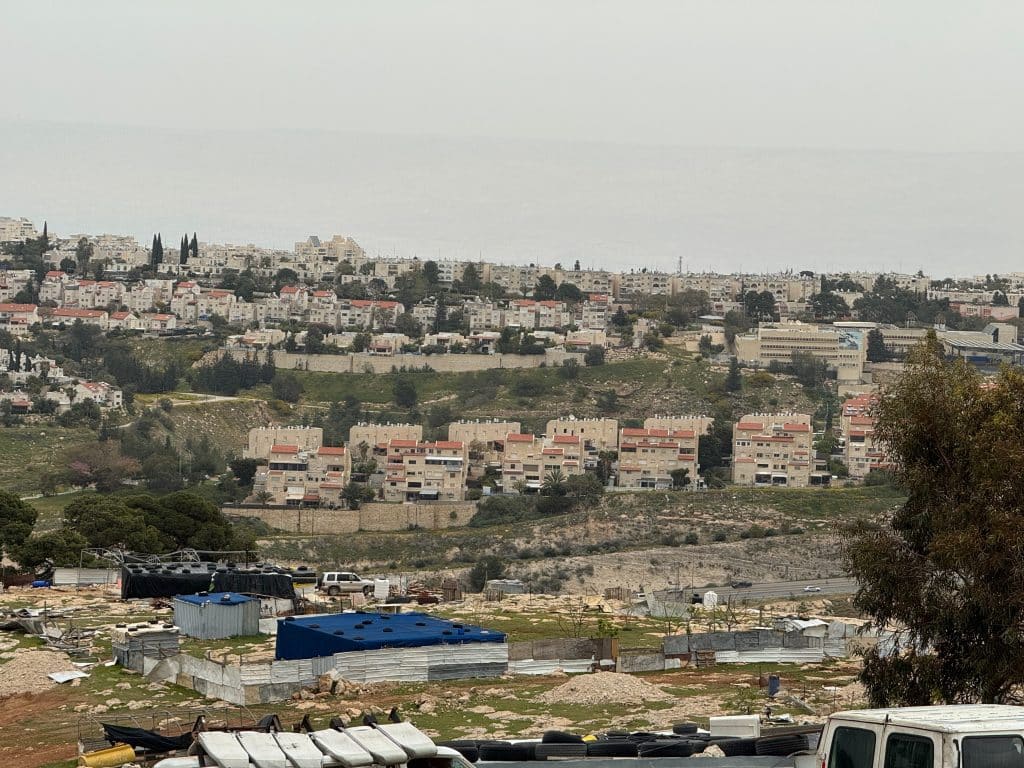
According to the Israeli Jerusalem watchdog Ir Amim, settlement activity around Jerusalem has undergone fundamental, rapidly accelerating changes, threatening the Palestinian presence in the area. The most significant developments include the approval of plans for roughly 3,400 housing units and the major expansion of Ma’ale Adumim. Four new settlements — Mevasheret Adumim, Mishmar Yehuda, Yatzeef, and Bar Kokhba — are also set to be built, alongside a number of settlement outposts and the construction of Road 45 (one of many infrastructure projects meant to connect the settlements to Jerusalem). The Israeli army has also erected around 16 iron gates that restrict Palestinian movement and enable long-term road closures.
Amid this escalation, al-Baidar estimates that well over 10,000 Bedouin Palestinians have been displaced from their ancestral pastures across the entire West Bank over the past two years. Thousands more remain threatened with transfer.

A giant prison for Bedouin communities
According to a statement from the Palestinian governorate of Jerusalem, plans for the “Shami neighborhood,” intended to house the remaining Bedouins of E1, aim to convert the land from open pastoral and agricultural use into an urban residential neighborhood, with 79 dunams allocated for residential construction and over 35 dunams for road networks. The residential blueprints for the neighborhood would allocate 12 housing units per dunam, with each unit comprising 6 stories — an indication that the project aims to forcibly sedentarize the Bedouins and erase their identity. “Israel’s goal is not to modernize the Bedouin, who are part of Palestine’s diverse social fabric,” Mlehat says. “Its goal is to displace them and replace them with settlers.”
It also isn’t the first time that Israel has put forward sedentarization plans for Bedouin communities in the West Bank, mainly because they have lived in geographic areas that Israeli authorities have deemed necessary to control. In 2007, Israel attempted to establish an urban settlement for Bedouin communities, according to Maruf al-Rafai, spokesperson for the Jerusalem governorate. The Bedouins rejected the proposal, and also rejected a repeat of the attempt in 2016–2017, when Israel built a neighborhood of several urban housing units east of al-Aizariya and attempted to relocate the Khan al-Ahmar communities there.
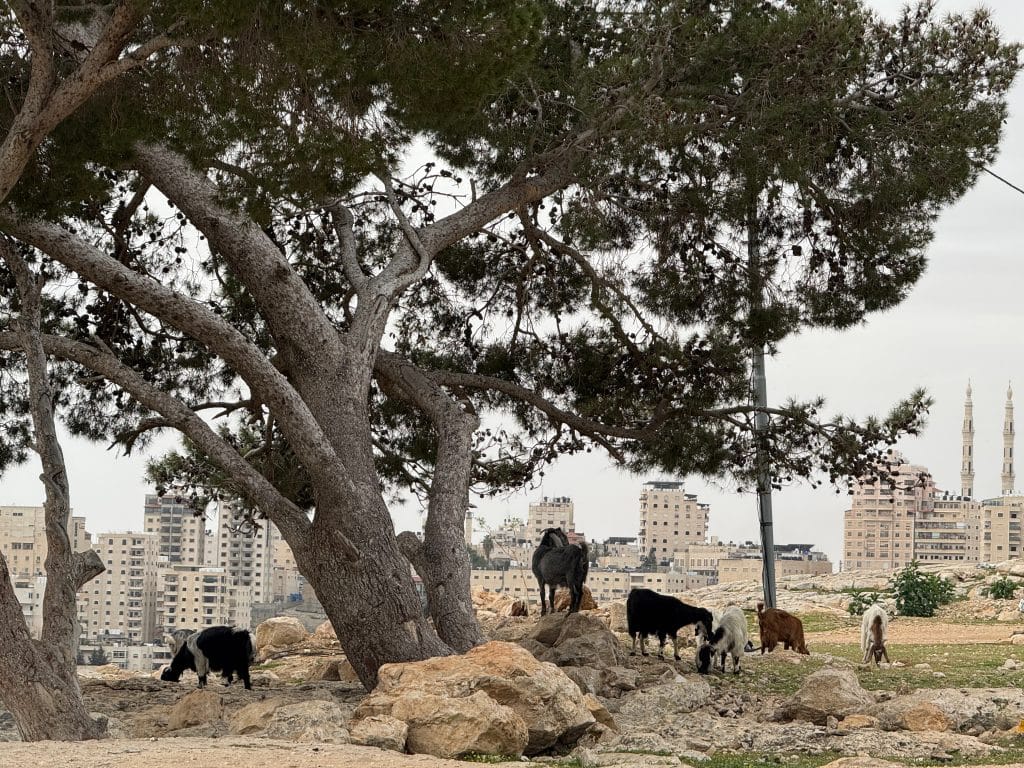
“The Shami neighborhood project is proceeding in parallel with Israel’s attempt to annex Ma’ale Adumim to Jerusalem and carve new settlement roads,” al-Rafai added. When asked why these communities have been targeted, he responded that it is “because these Bedouin communities are an obstacle to completing these settlement plans.”
Even as Bedouin communities reject the Shami neighborhood plan, Israel is pressing ahead with the project, building infrastructure and preparing engineering blueprints. “We have real fears today that Israel will begin forcibly displacing the Bedouin communities around Jerusalem and compelling them to move to this neighborhood,” al-Rafai said.
Bedouins abandoned
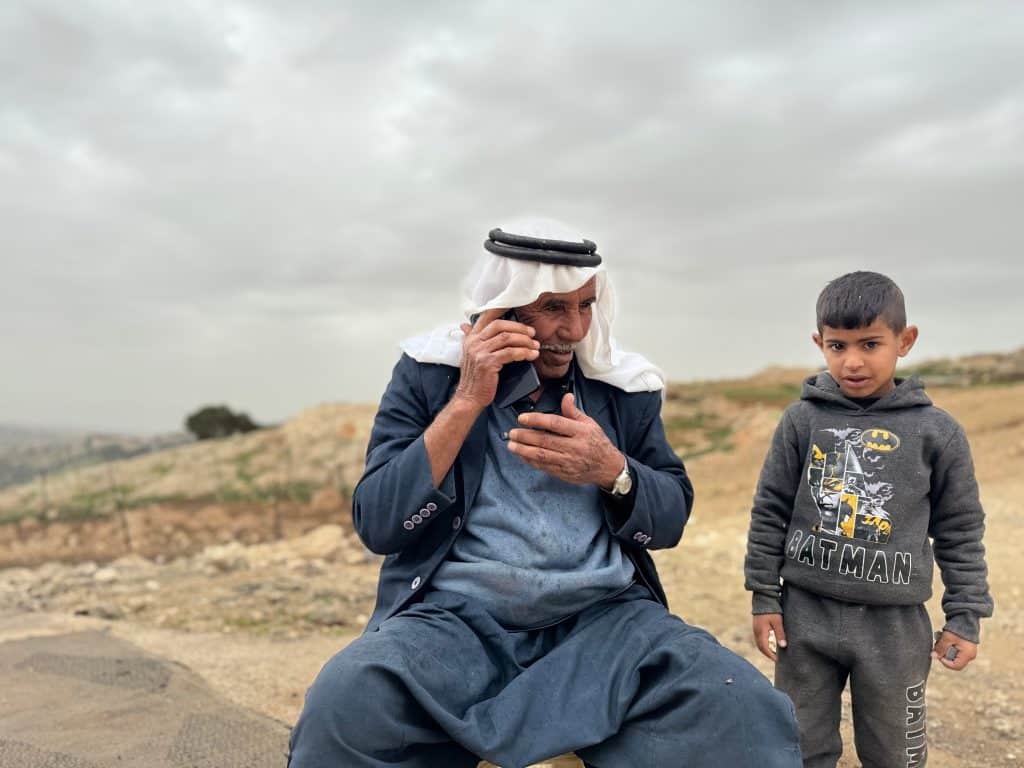
Throughout this period, members of the Jabal al-Baba community say that they’ve been forced to stand alone, without any international support. But more importantly, they say they haven’t received meaningful support from the Palestinian Authority either, even though leaving their lands would affect everyone in the West Bank, not just the Bedouins. Given the strategic location of E1 in connecting the two halves of the West Bank, the continued presence of Bedouins in the area maintains the demographic continuity of Palestinians between the north and south of the territory. Removing them would mean splitting the West Bank in two.
Before visiting Jabal al-Baba, our reporting took us to the Hathroura Bedouin community in Khan al-Ahmar. Getting there was difficult, requiring us to travel along rugged dirt paths known to be the site of ambushes by settlers who had established an outpost and a horse farm nearby. But when we arrived, we were met with a surprise: the people of Hathroura refused to receive journalists or any organization. They responded to us with one question: “What have we gained from all the talk? Why has no one helped us?”
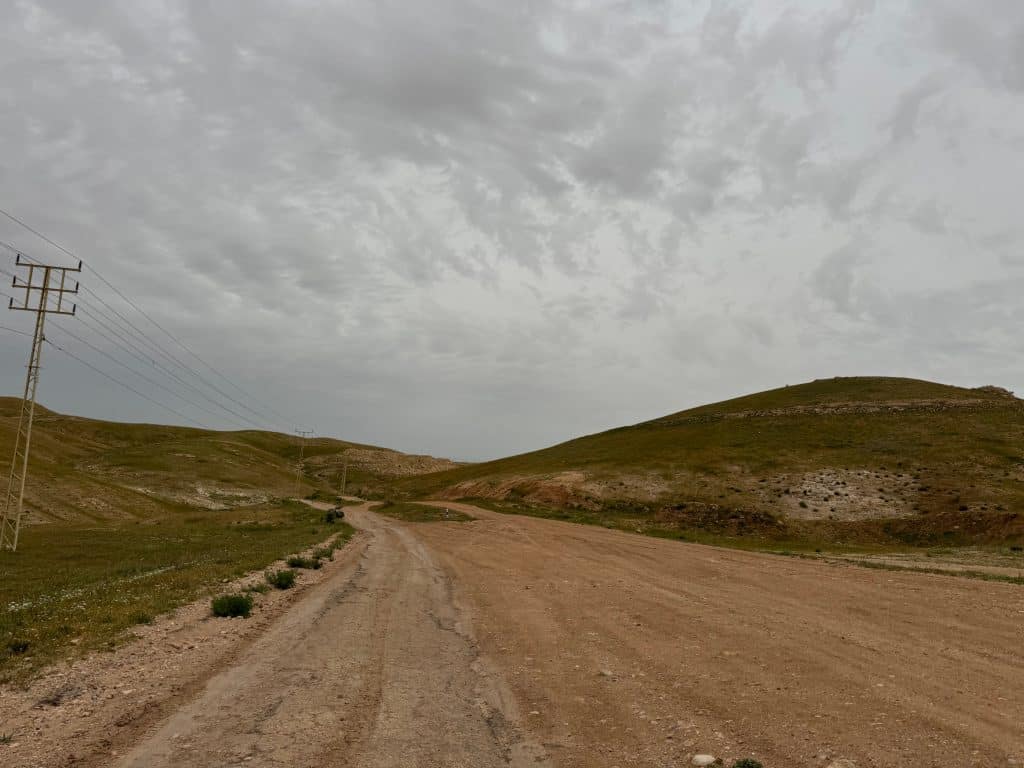
Despite the attacks, the Hathroura community is one of the few still standing. Yet braving settler attacks day by day without leaving has hardly made the news bulletins. “The homes suffered damage from the winter, and no one has compensated us,” one resident said, pointing to the failure to provide support to consolidate their presence.
We left Hathroura without conducting any interviews, instead carrying the questions that they posed to us: Where are the projects supposedly being put forward to help them?
Maruf al-Rafai attempted a halfhearted answer. “There is a joint committee from a group of PA institutions and international organizations working to provide food and fodder and free health insurance. But sometimes Israel blocks us. They prevented us from bringing steel sheets into the Khallet al-Sidreh community.”
Palestinians from the community say it isn’t nearly enough, and it also isn’t just an issue of humanitarian relief. “Framing it as a humanitarian issue, as the Authority claims, empties it of its true meaning,” Mleihat explained. “The Bedouin issue is a matter of politics, international law, international justice, and human rights.”
But the words of Atallah Jahhalin from Jabal al-Baba were the most scathing. “We were deceived by the Oslo Accords and by talk of a Palestinian state and Palestinian rights,” he said. “Today has exposed the falseness of it all — none of it exists on the ground.”
Shatha Hammad
Shatha Hammad is a Palestinian journalist specializing in in-depth features in the West Bank, where she has reported on the ground since 2011. She holds a BA in Journalism and Political Science and an MA in Contemporary Arab Studies from Birzeit University.

Settler colonial regimes have often claimed that the concentration or displacement of native populations was carried out for humanitarian or protective reasons, including in contexts where populations were relocated to areas with severely limited access to essential infrastructure such as healthcare, arable land, and other resources necessary for sustained civilian life and deliberately inflicting conditions of life calculated to bring about physical destruction. Lke concentrating them on sand dunes.
Btw. “relocate” is also one of their euphemisms.
Except of course, it does not split the West Bank in two.