

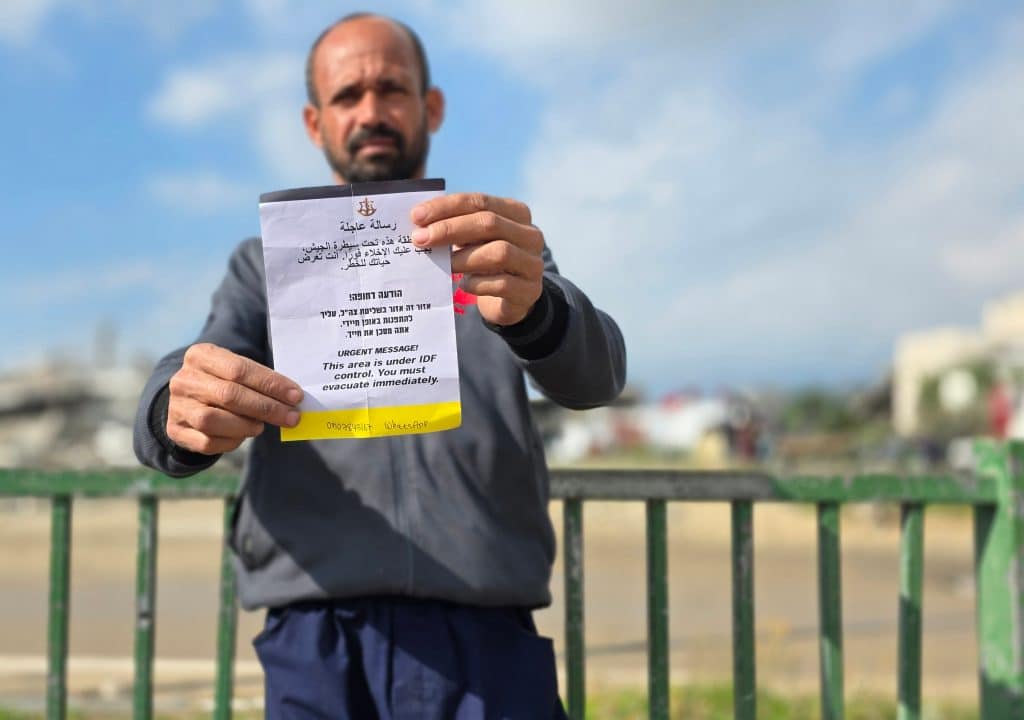
On the morning of May 13, residents near al-Hikma Mosque in eastern Deir al-Balah began receiving phone calls from someone claiming to be “Captain Abu Omar,” an Israeli army officer, ordering them to evacuate their homes and move more than 200 meters west of the mosque. He gave them less than one week to leave.
That same afternoon, armed fighters loyal to Shawqi Abu Nuseira, a militia leader in Gaza who residents say is armed and protected by the Israeli military, stormed the same neighborhoods the army had warned hours earlier. According to residents, they delivered the same message, telling them to evacuate.
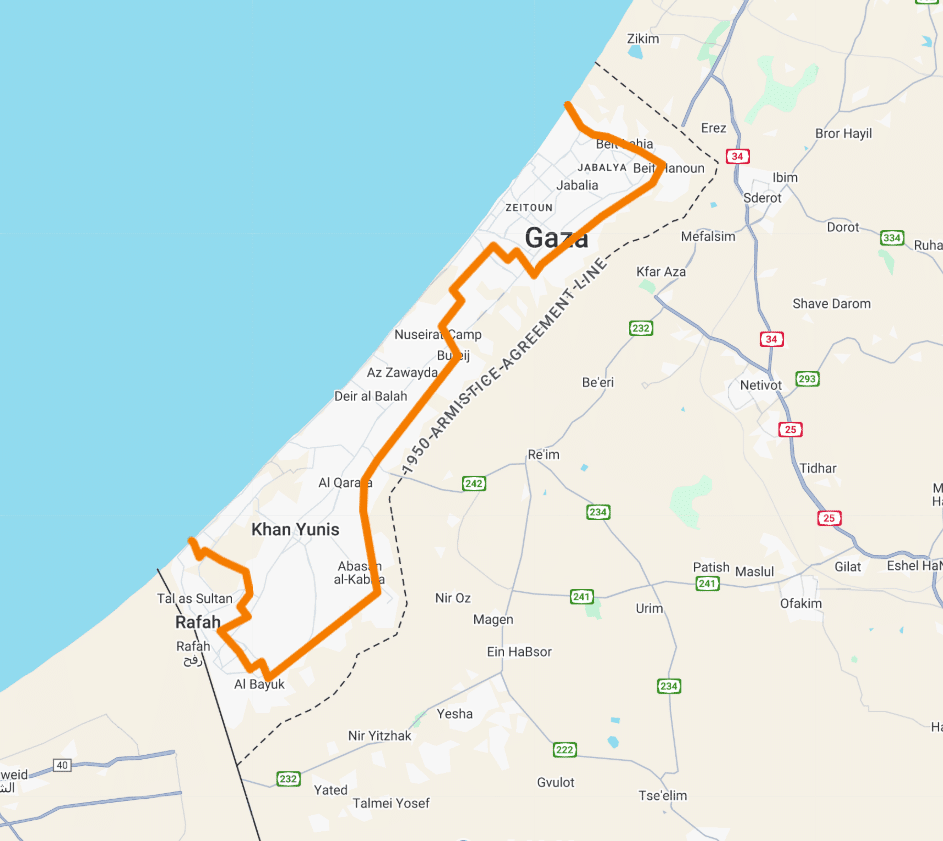
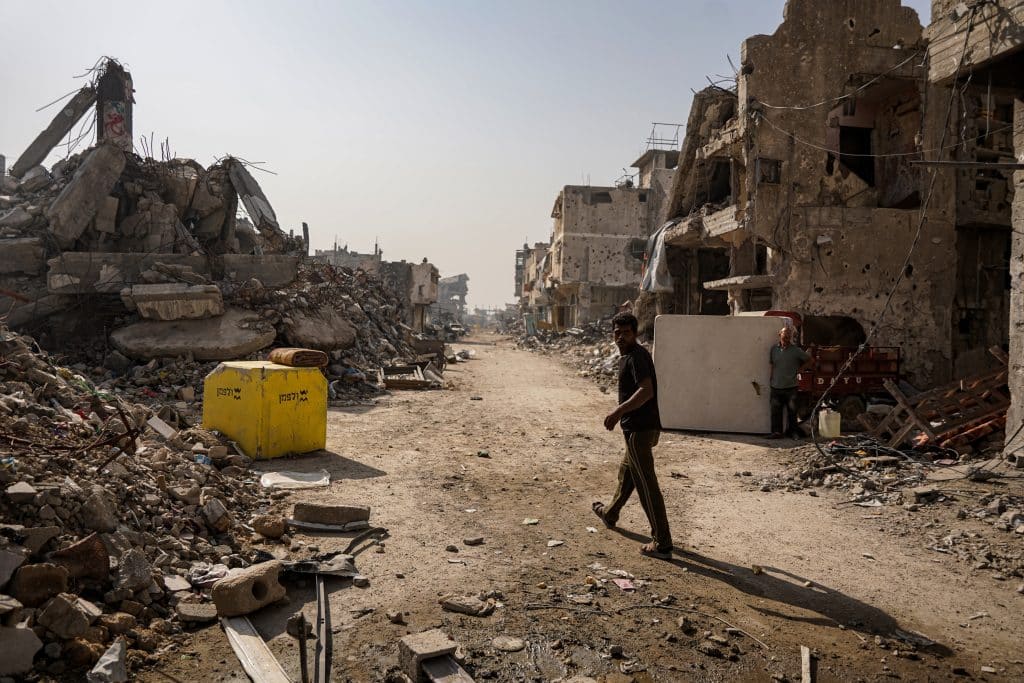
The scene in Deir al-Balah is part of a broader pattern unfolding across Gaza. Since the beginning of May, Israeli forces have been pushing the yellow concrete blocks that demarcate the so-called “Yellow Line” deeper into areas of the Strip nominally under Hamas control. According to Reuters, the line has seized an additional 11% of Gaza’s territory, bringing the total area under Israeli military control to 65%. At the start of the ceasefire in October 2025, Israel controlled 53% of the Strip, an arrangement that was supposed to be temporary and lead to a gradual Israeli withdrawal from the enclave. The new expansion has come to be known as the “Orange Line,” confining over 2.2 million Palestinians to what remains of Gaza.
Abu Nuseira, according to residents in central Gaza and Khan Younis, was once a longtime militant with the Palestinian Authority’s security forces in Gaza, with a long history of fighting against Israel. He lost a son in the early weeks of the 2023 war, after which he began to move more aggressively against Hamas. He and his militia now operate from an area under Israeli control, and they are widely regarded in Gaza as collaborators who receive arms and logistical support from Israel.
In a video posted to the militia’s Facebook page, Abu Nuseira appears surrounded by heavily armed and masked men. He says he is “protecting people’s lives,” and that their “continued suffering is linked to Hamas’s refusal to hand over the administration of the Gaza Strip.” When he finishes speaking, his men repeatedly chant, “Death to Hamas.”
Muhammad al-Amour, a resident of eastern Deir al-Balah, told Mondoweiss that some families received direct evacuation calls from the Israeli army, and that the militias arrived in those same areas on the same day, “notifying residents, including dozens of displaced people and homes near the Yellow Line in eastern Deir al-Balah.” Al-Amour said residents took the warnings seriously and began evacuating their homes, fearing they would be shot by the militias or bombed by the army if they stayed. “This has happened repeatedly to other families in different areas throughout the war,” he said.
Gaza’s new ‘Berlin wall’
In Khan Younis in the south, the Orange Line has moved to within approximately 200 meters of areas where displaced people are sheltering. Palestinians have compared the Yellow and Orange lines to the Berlin Wall and, at other times, to the apartheid wall that cuts through the occupied West Bank. This invisible boundary separates tens of thousands of families from their homes, lands, and property in areas where the army continues to demolish what remains standing.
Mahmoud al-Raqab, a displaced resident of Khan Younis living around 300 meters from the Yellow Line, told Mondoweiss that the line’s continued advance toward residential areas is “extremely dangerous.”
“Sadness, anxiety, and fear overwhelm us as this expansion continues toward what remains of our land, our neighborhood, and our tents,” he said. “It is shrinking the spaces available to us, preventing us from even walking near our homes, and increasing the likelihood of more land, homes, tents, and businesses being seized.”
Al-Raqab said he sees what is happening as identical to the land confiscation and movement restrictions imposed on Palestinians in the West Bank and buffer zones. “It is destroying any hope that the rest of my family and our neighbors will one day return to live alongside them again,” al-Raqab told Mondoweiss.
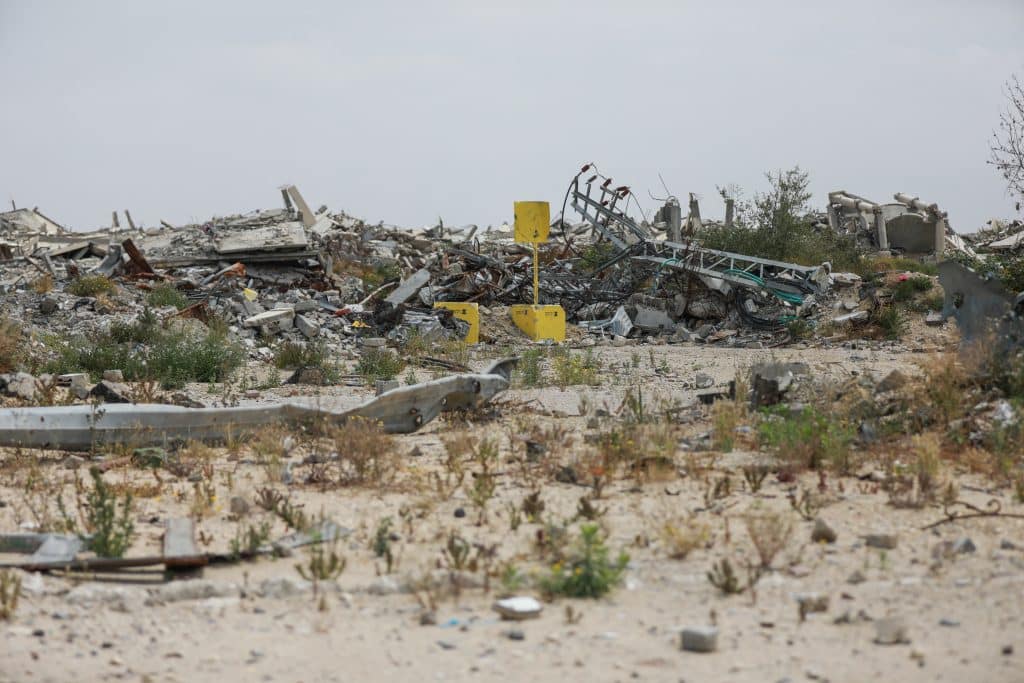
“The army is expanding its occupation over vast agricultural lands and open areas near Salah al-Din Street and the eastern regions, while digging deep trenches to prevent entry into the area and deny Palestinians the ability to cultivate it again,” he added. The eastern region is considered Gaza’s “vegetable basket,” home to farms, olive and citrus trees, and the livelihoods of tens of thousands of families who own land in eastern Khan Younis.
“This is a new apartheid wall being established in the Gaza Strip,” he said. “Today, they place concrete blocks. Tomorrow, they will build high walls. They are separating our lands, placing barriers between us and our homes, imposing restrictions on our movement to our houses, farms, and lands, separating people from their property and original areas, and gradually swallowing our land before our eyes.”
Al-Raqab said he has watched the line advance approximately eight times over the past 12 months, and that he personally witnessed the Orange Line’s most recent expansion. He said that it cut off new areas stretching from Dar al-Salam Hospital to the Bani Suhaila roundabout east of Khan Younis along Salah al-Din Street, as he lives in an area adjacent to the line.
“We have nothing to do with this line,” he said. “We can’t ignore it and go to our homes: we will get killed immediately. It’s not heroism to go get killed. It’s not a personal issue for me and my home and land. An occupation is stealing my entire homeland, not just my land. And if we can’t do anything now to get our land back, that does not mean we forget about it. We will keep it in our hearts and minds until we return.”
Tareq S. Hajjaj
Tareq S. Hajjaj is the Gaza Correspondent for Mondoweiss and a member of the Palestinian Writers Union. Follow him on Twitter/X at @Tareqshajjaj.

Definitely off topic, but give the importance of the recent Kristof article in the NYT about the sexual abuse of Palestinian prisoners I think this point is crucial, about 39:30 into an interview with Issa Amro and Sari Bashi:
( Beinart ) I wanted to ask about whether the Red Cross or other international lawyers or investigators are allowed into Israeli prisons in order to talk to prisoners…
( Bashi ) Since Oct 7 the Israeli government has blocked Red Cross and family visits to Palestinian security detainees…the government allowed the Red Cross to tour the detention centers but not talk to any detainees…the Red Cross said thank you but no thank you.
https://peterbeinart.substack.com/p/what-we-told-nicholas-kristof
Think about that for a moment.
This is a bit peripheral, but how is the U.S. media reporting on Gaza? The Intercept has attempted to do an objective analysis of U.S. reporting, and a few days ago they posted this:
“We Analyzed Thousands of News Articles: Here’s the Proof of Pro-Israel Bias in Mainstream Media….U.S. media outlets were crucial in helping Israel sell the Gaza genocide to the American public…For my new book “How to Sell a Genocide: The Media’s Complicity in the Destruction of Gaza,” I attempt to demonstrate, beyond a reasonable doubt, that U.S. media coverage of the war on Gaza was one-sided, racist, dehumanizing, and often veered into outright incitement….I examined over 12,000 articles from the New York Times, the Washington Post, CNN.com, Politico, Axios, USA Today, and The Associated Press, along with 5,000 TV segments that aired on CNN and MSNBC.”
Read on to see what techniques the press used to spin the war:
https://theintercept.com/2026/05/12/gaza-media-coverage-israel-bias/
How to Sell a Genocide: The Media’s Complicity in the Destruction of Gaza…As bombs rained down on Gaza in October 2023, images of mass death and destruction gripped the world, and openly genocidal statements from Israeli leaders foretold the magnitude of horrors to come. But the US media was quick to downplay, obscure, and repackage an emerging campaign of extermination into a slick “war on terror” framework.
How to Sell a Genocide: The Media’s Complicity in the Destruction of Gaza: Johnson, Adam H., Erakat, Noura: 9780745351650: Amazon.com: Books