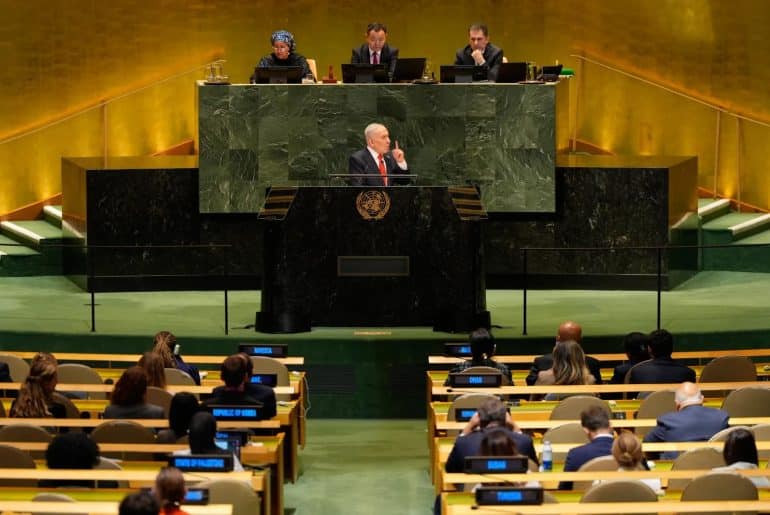
On March 15, 2026, the South African government formally acknowledged Israel’s response to the country’s written pleadings in the case of Application of the Convention on the Prevention and Punishment of the Crime of Genocide in the Gaza Strip before the International Court of Justice (ICJ).
Indeed, South Africa was the first country to use the Genocide Convention against Israel for its actions in Gaza, a benchmark that positioned itself at the forefront of an international movement to hold Israel accountable for its genocide in Gaza.
And yet just three days after the government acknowledged Israel’s response, a coal ship had left the country’s Richards Bay Coal Terminal (RBCT), with shipping data indicating that its destination is the Hadera port in northern Israel.
According to a new report, titled “Fuelling Genocide”, authored by human rights lawyer Sirhaan Che Khan for the SA BDS Coalition, South Africa has exported 2.99 million metric tons of coal to Israel since October 2023.
The 264-page legal document was delivered to the South African Department of Trade, Industry and Competition (DTIC), outlining the country’s obligations under both international law and its own constitutional framework to halt coal exports to Israel.
“We never actually sought to pursue legal action. [Since] July 2024, the SA BDS Coalition wrote to various ministers requesting engagement on these issues and was ignored. By September [2025], we realized that the government was not interested in engaging with us and we were left with no choice but to consider the legalities of this matter,” said Khan.
In January 2024, the ICJ found it “plausible” that Israel violated the Genocide Convention, which triggered obligations under international law for all states to prevent genocide and avoid complicity in aiding violations of international law.
Indeed, Khan’s report relies heavily on Article l of the Genocide Convention, which provides that states do everything within their power to uphold international law, to prevent and punish genocidal acts. Using the case of Bosnia and Herzegovina v Serbia and Montenegro, the report shows a preexisting obligation on states to prevent genocide when they have knowledge of the situation and the capabilities to act.
Through this judgment, Khan notes that South Africa has met both requirements, having engaged in international legal proceedings and having a regulatory framework to prevent the sale of coal to Israel.
Record of coal exports
In the first six months of 2024, South Africa was the second biggest exporter of coal to Israel, after Colombia, which accounted for 60% of Israel’s thermal coal imports.
However, after Colombia imposed a coal embargo on Israel, South Africa swiftly stepped in to fill the vacuum, with exports increasing by 87% within the last 3 months of 2025.
According to Khan, what’s most concerning is the speed at which these coal exports have ramped up. In August 2024, South African coal accounted for roughly 11% of Israel’s seaborne thermal coal imports. As published in “Fueling Genocide”, that amount had increased to 55% by May 2026. However, just a month after the report’s release, the Palestinian Institute for Climate Strategy had issued its own report in which they claim South Africa now supplies 88% of Israel’s seaborne thermal coal.
Between October 2023 and December 2025, the SA BDS coalition identified 22 vessels that loaded coal from the RBCT and departed for the ports of Hadera and Ashkelon in Israel, with some attempting to mask their destination.
“These shipments do this by setting other locations, for example, Gibraltar, and then before they get to Gibraltar, these vessels switch off their transponders. Once they turn them back on, and other shipment data becomes available, we find that these vessels have, in fact, berthed in Israel”, said Khan.
Researchers assisting the Palestine solidarity group have been able to confirm the unloading of coal in Israel through AIS position data, satellite imagery, and the South African Revenue Services (SARS) annual export report.
Coal fuels the Israeli war machine
According to the state-owned Israeli Electric Corporation (IEC), coal is imported for combustion at two primary coal-based power plants: Orot Rabin in Hadera and Rutenberg in Ashkelon. Since Israel possesses no domestic coal reserves, it is entirely dependent on imports to keep these power plants running.
These facilities don’t just supply civilian infrastructure. Once electricity enters the grid, its output becomes indistinguishable, enabling Israeli military operations, surveillance networks, and the maintenance of settler colonies in the occupied Palestinian territory (oPt).
As quoted in the report, “Electricity is the invisible backbone of Israel’s military machine”. AI-driven tracking software utilized in surveillance operations in the oPt requires an uninterrupted energy supply. The massive bombing campaigns in Gaza, Lebanon, and Iran require military communication hubs that draw massive amounts of electricity. Even Israel’s own security assessments confirmed that its energy infrastructure is critical in maintaining military systems.
These are the same military systems that have been extensively documented by journalists, international human rights groups, and the United Nations as committing numerous war crimes and genocidal acts throughout the MENA region. The most notable being the systematic destruction of civilian infrastructure in Gaza since October 2023.
And yet, despite South Africa’s opposition to these acts at the ICJ, its continuous supply of thermal coal has materially supported the Israeli military campaign as it looks towards a second genocide in Lebanon.
Public-Private complicity
Located in the province of KwaZulu-Natal, Richards Bay is where the majority of South Africa’s coal is exported from, with the RBCT being one of the largest coal terminals in the world. The coal terminal is owned by private mining corporations, with Switzerland-based Glencore acting as the largest exporter of coal to Israel.
Despite provisional measures made by the ICJ for states and corporate entities not to aid Israel’s illegal activities, Glencore has shown no aversion in its role in supplying critical energy capacity to Israel.
Glencore facilitates the sale of South African coal through ventures and partnerships with local mining companies. One such partner is African Rainbow Minerals (ARM), which, according to its website, owns a 20% stake in Glencore operations in South Africa. ARM is also owned by billionaire Patrice Motsepe, the brother-in-law of current president Cyril Ramaphosa.
Although corporations such as Glencore and ARM have complete control over the Richards Bay terminals, the export process is ultimately conducted and dependent on state infrastructure. Transnet, a state-owned rail company, is responsible for transporting coal from mines to port terminals, and the Transnet National Ports Authority oversees port operations and vessel access.
In other words, not only is the South African government aware of these private companies exporting coal to a country committing a genocide, but it is actively enabling it.
When questioned in parliament about the possibility of a coal embargo, Parks Tau, Minister of Trade, Industry and Competition, had said that there were no plans to review coal exports with Israel. He argued that if these exports were to be halted, it would violate South Africa’s obligations under the World Trade Organization (WTO) principles of “non-discrimination”.
However, as outlined in the report, the general understanding of the WTO jurisprudence explicitly accommodates targeted trade restrictions in the event of serious violations of international law.
When asked for comment by Mondoweiss about the report, Kaamil Alli, the spokesperson for Tau, said that the DTIC “had received the dossier and is currently reviewing the contents thereof…the department will respond once it has considered the document and taken it through the relevant government processes”.
“We were left no choice but to consider this a legal matter”
On March 23, 2026, a delegation from the SA BDS Coalition delivered the extensive legal dossier to the DTIC with formal demands that Minister Parks Tau use his existing statutory powers to halt planned shipments to Israel.
When the government failed to respond to the dossier, a meeting was scheduled between the DTIC and the SA BDS coalition for May 4.
“In the meeting, Minister Tau said he was unable to make a decision on the coal sales to Israel… his response was extremely concerning – we are literally committing a crime by continuing to power the Israeli electricity grid”, SA BDS spokesperson Roshan Dadoo told Mondoweiss.
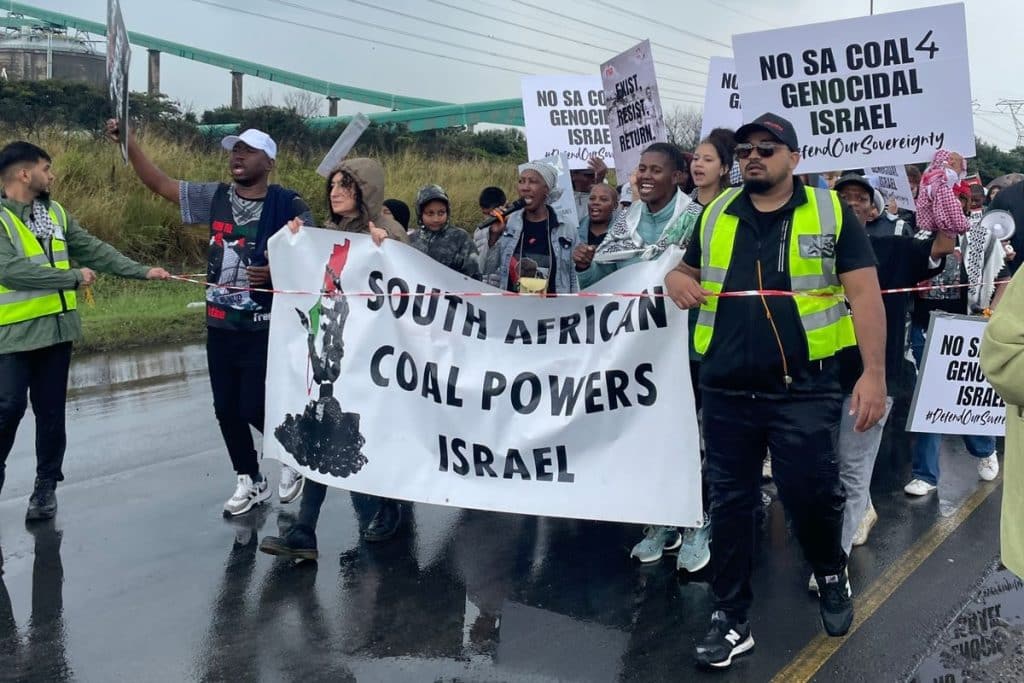
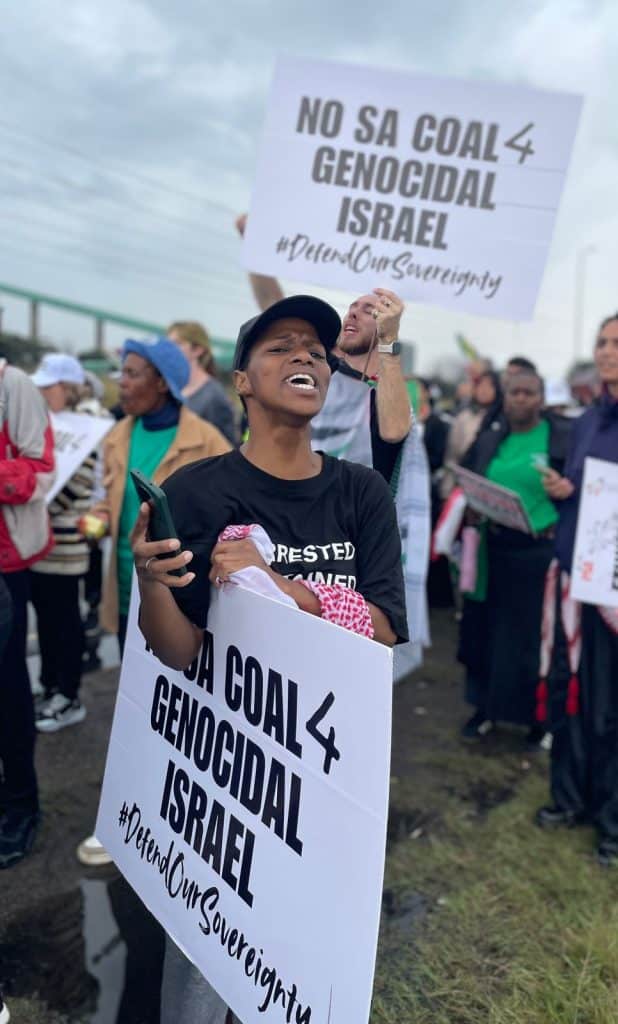
Dadoo added that the BDS coalition will escalate its campaign to ensure the government and corporations comply with their legal requirements in ending the sale of coal to Israel.
Riley Singh
Riley Singh is a political journalist and commentator based in Durban, South Africa.