

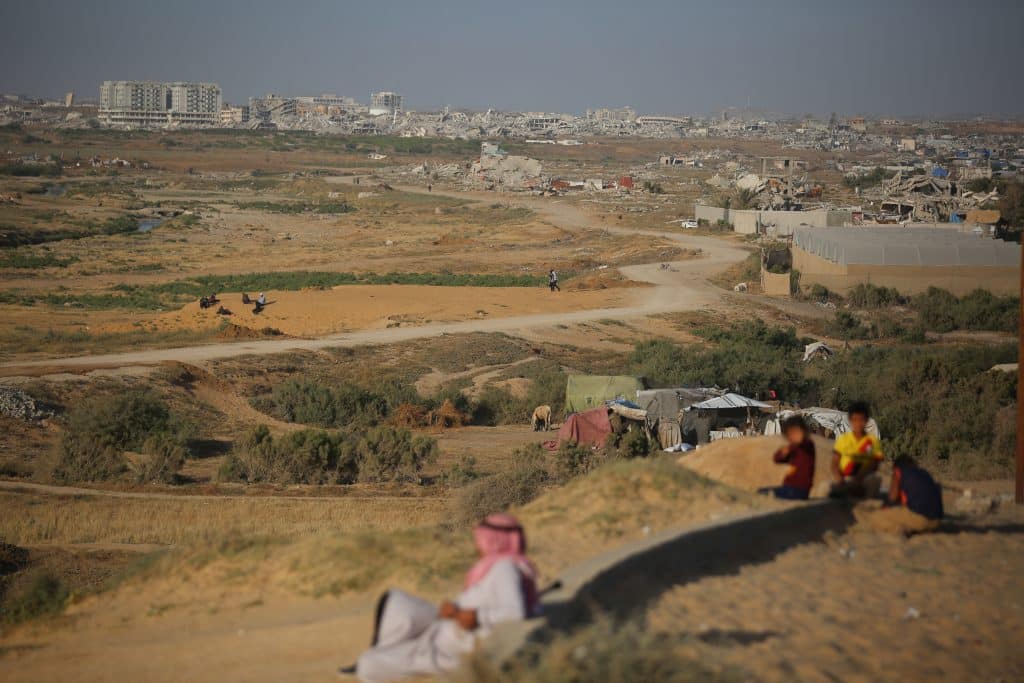
The two plots of land that Jalal Arafat has owned for decades sit on either side of the line that has redrawn Gaza’s map following the ceasefire in October 2025. One lies beyond reach, three meters from what is now known as the “Yellow Line,” which cuts Gaza roughly in half. The other, 800 meters further out, was used as the location for Israeli army barracks during the invasion of Gaza City’s al-Zaytoun neighborhood.
When the hostilities paused near the second plot, Arafat returned, despite warnings. The area had been reduced to what he described as “destroyed sand dunes.” Despite this abysmal state, he cleared the land with the help of his sons, leveled it, and planted fig and olive trees, which were chosen for their need for little water and for their ability to survive on what reaches them from underground.
Across the besieged strip, dozens of farmers are doing the same. They walk back to fields covered in rubble, tank tracks, and unexploded ordnance. They carry water on their shoulders across long distances. They do it because for many, this is all that remains.
Some are aided in this endeavor by Gaza’s Ministry of Agriculture, which launched an emergency land reclamation project in May in the southern Gaza neighborhoods of al-Mughraqa, al-Sheikh Ajleen, and parts of al-Zaytoun in partnership with the Palestinian Agricultural Relief Society, the Agricultural Relief Society, the Cooperative Association for Grape and Vegetable Producers, and Oxfam.
The aim is to bring 400 hectares back into production and support hundreds of farmers in the first phase, restoring between 60 and 70 percent of their pre-war productive capacity. The work begins with a de-mining clearance to ensure plots are free of unexploded ordnance, followed by leveling, plowing, fertilizing, and planting.
“The tree, when it has care, water, and the means to live, survives,” Arafat, who has signed up with the initiative, told Mondoweiss. “And so does the human being. From nothing, he can build a new life and rebuild everything the occupation destroyed.”
A coordinated salvage
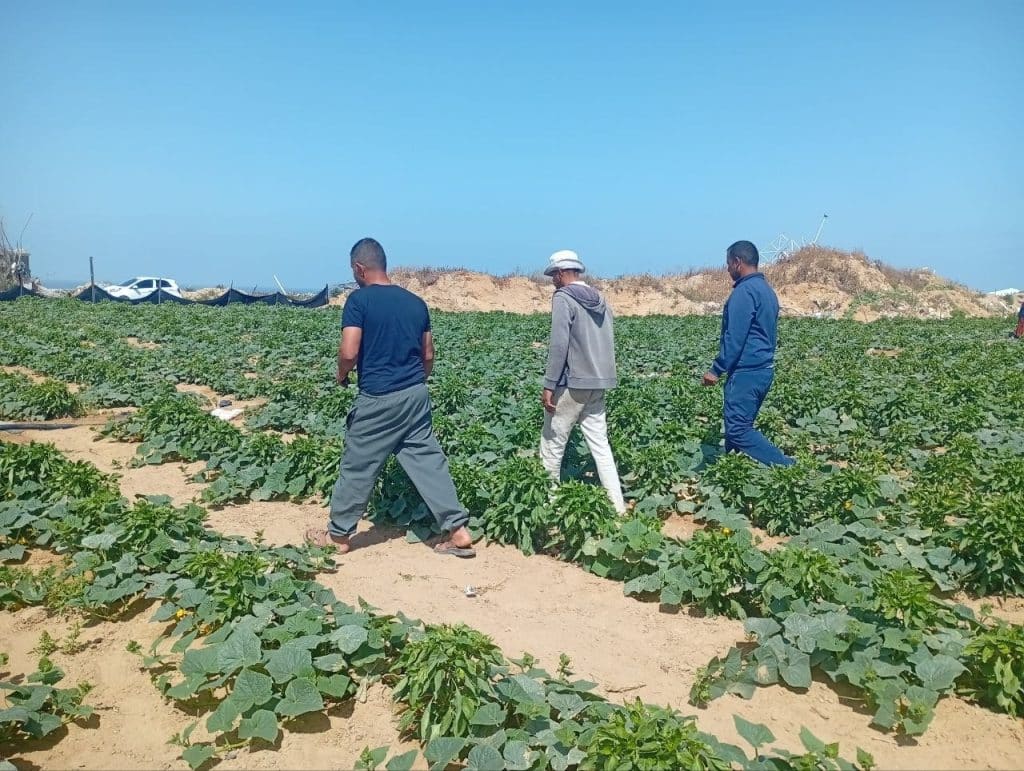
In al-Zaytoun, Palestinian Agricultural Relief Society teams cleared rubble from 66 dunams (6.6 hectares) of farmland where, at the start of the year, not a single seedling remained.
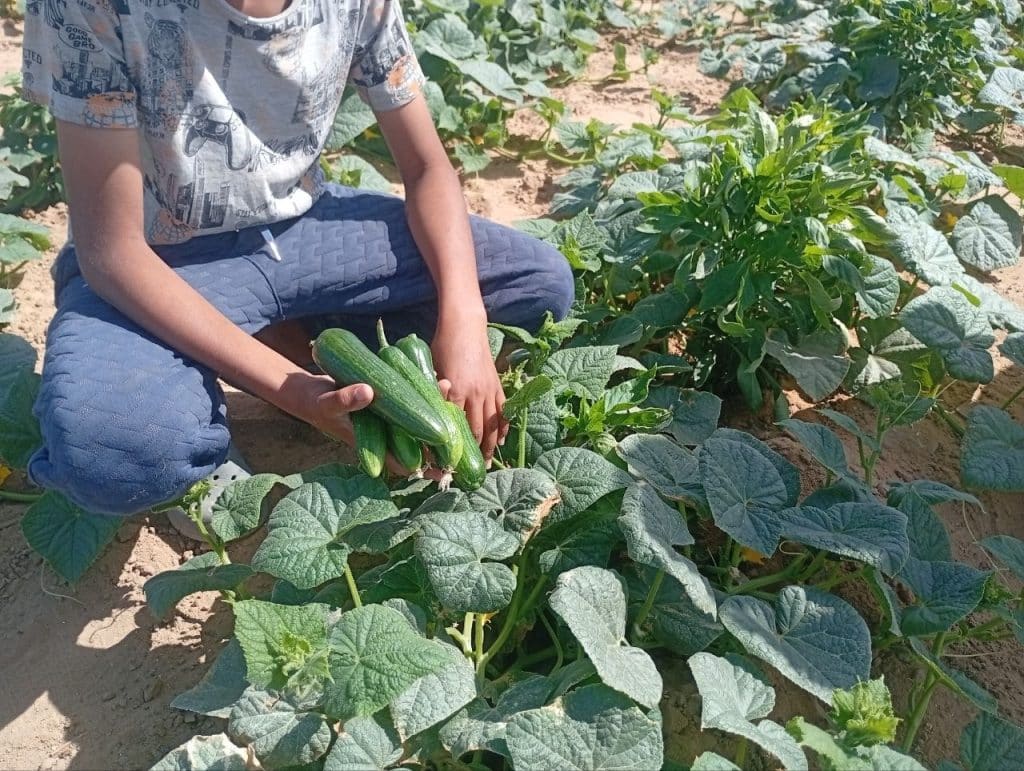
They reopened agricultural roads buried under debris, restored wells, and laid water lines, allowing farmers to return to plots they had abandoned during the war. Within months, zucchini and cucumbers were growing again on land that had been written off.
“The destruction was not limited to agricultural land. It reached the agricultural infrastructure, livestock, and fisheries, and it directly affected the productive capacity of the sector,” said Noha al-Sharif, advocacy and media officer at the Palestinian Agricultural Relief Society in Gaza.
The organization is also working in al-Sheikh Ajleen, the grape-growing district south of Gaza City.
“The destruction was not limited to agricultural land. It reached the agricultural infrastructure, livestock, and fisheries, and it directly affected the productive capacity of the sector.”
Noha al-Sharif
“In the first phase, we targeted no fewer than 150 farmers, and we are now expanding the project to include new ones,” al-Sharif said.
The society has been supplying locally sourced fertilizers, nutrients, and irrigation components, and grape seedlings are returning to land that had been stripped bare. Similar work is underway in the northern Gaza City in the areas of al-Zarqa and al-Amn al-Aam.
According to al-Sharif, the Palestinian Agricultural Relief Society has established roughly 240 household gardens inside destroyed houses where families have returned, providing seedlings, seeds, and water tanks so residents can grow vegetables and leafy greens for their own consumption.
“It has eased the economic burden on families by reducing their need to buy vegetables from the markets, with prices so high and goods so scarce,” al-Sharif said.
The group, with the help of international partners, is also bringing agriculture into the displacement camps themselves. They have planted plots near and inside camps across most of Gaza’s governorates, supplied residents with the tools and inputs to maintain them, and worked with camp administrators to integrate food cultivation into daily life.
Awareness workshops have been run for families whose children show signs of malnutrition, explaining how to use the produce most nutritionally.
“We wanted to transform the camps from places that are exhausting and psychologically draining into a more lively environment, by introducing green spaces and farming into them,” she told Mondoweiss.
The organization is planning broader interventions in the near future, but al-Sharif emphasized that the scale of recovery that Gaza’s agricultural sector needs cannot be achieved through local improvisation alone: “The success of these efforts requires urgent international action to pressure for the entry of agricultural goods into Gaza, including seeds, fertilizers, equipment, and irrigation networks, so that farmers can restore their ability to produce and preserve what remains of food security in the Strip.”
Beyond what local efforts can repair
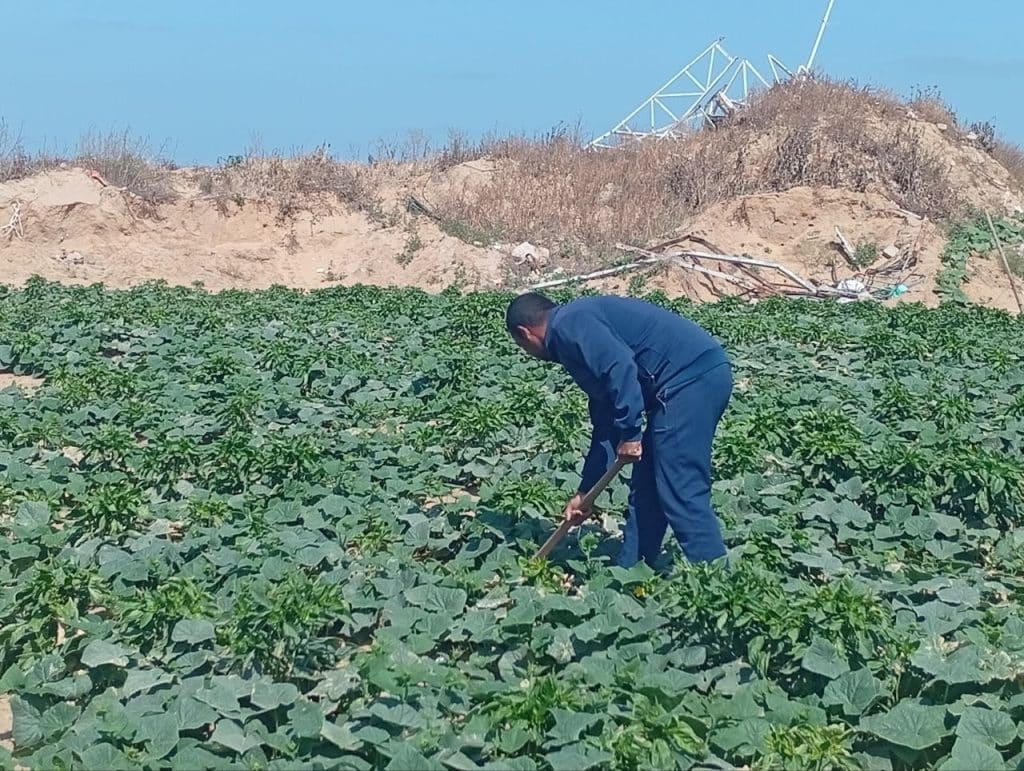
Israel continues to block fertilizers, seeds, irrigation networks, and machinery from entering Gaza, leaving recovery efforts dependent on whatever local resources can be salvaged.
Gaza has lost 96 percent of its cultivated farmland, with the territory’s planted area collapsing from 9,300 hectares before the war to 400 hectares today, according to the Gaza Government Media Office. Direct losses to the agricultural and livestock sector are estimated at $2.8 billion, with 94 percent of farmland damaged and 85 percent of greenhouses destroyed.
Farmers describe prices that have made independent recovery impossible. A 250-gram unit of pesticide has risen from 500 shekels ($172) to 3,000 shekels ($1,031). A truckload of fertilizer has gone from 1,000 shekels ($344) to 20,000 ($6,877).
Direct losses to the agricultural and livestock sector are estimated at $2.8 billion, with 94 percent of farmland damaged and 85 percent of greenhouses destroyed.
The recovery of Gaza’s agricultural and food systems alone is estimated to cost $10.49 billion, according to a recent World Bank-led reconstruction assessment, with much of that going to feed Gazans until local production is rebuilt.
Samaher Abu Jameh, a farmer, said the war has destroyed most of Gaza’s farmland and agricultural infrastructure, leaving large tracts unfit for cultivation because of unexploded munitions and hazardous debris. “The continuation of the war, farmers’ inability to access their land, and the lack of adequate support have led to a significant decline in agricultural production and left many unable to continue their work,” she said.
Israeli forces, Abu Jameh added, have taken control of vast areas east of Salah al-Din Road. Solar systems that powered water pumps have been destroyed alongside the wells themselves. Greenhouses, tools, pesticides, fertilizers, seeds, and seedlings are all in critically short supply. Many farmers are using old, broken equipment because nothing else is available.
FAO and UNOSAT satellite analysis shows 98 percent of Gaza’s tree cropland has been destroyed, alongside 90 percent of greenhouses and 82.8 percent of agricultural wells. Before the war, the agricultural sector employed about 560,000 people.
“The farmers in Gaza are living a real catastrophe that threatens food security and sovereignty,” Saed Ziada, who coordinates the agricultural sector at the Palestinian Non-Governmental Organizations Network, said. “Almost all are struggling to provide a source of income under brutal economic conditions.”
Ziada points to the recent initiative to support the sector through land reclamation, seed distribution, irrigation networks, and other forms of in-kind and financial support. But he said the scale of this assistance remains far below what is needed.
“The institutions are present in one form or another, despite limited funding,” he said. “But the needs are much greater than the available capabilities.”
The farmers who cannot start again
Rushdi Ayyad, a farmer from Al-Zaytoun, has 11 dunams (1.1 hectares) of farmland, now about 800 meters from the Yellow Line, that were destroyed. He has not been able to reach the area for nearly two-and-a-half years, having been forcibly displaced to Deir al-Balah in the central Gaza Strip.
“There are no foundations for life or for replanting,” he said. “There is no source of income to help us reclaim the land, and no real ability to start again.”
The land held trees more than 25 years old that he, his family, and several workers relied on as their sole source of income. Among the most painful losses was a three-dunam (0.3 hectares) ma’rish, a vine trellis, that had cost him roughly $40,000 to build.
Then there is the cost of return. Even cleaning the land of military debris, he said, is beyond the means of any farmer.
“We are already living below the poverty line,” he told Mondoweiss. “Today, we rely on a takiya [a communal soup kitchen] just to eat.”
Across six wars and incursions between 2008 and 2021, Rushdi Ayyad had managed to reclaim his land and start over each time. “It is completely different this time,” he said. “I cannot begin again.”
Across six wars and incursions between 2008 and 2021, Ayyad had managed to reclaim his land and start over each time.
“It is completely different this time,” he said. “I cannot begin again.”
Ziada said that the Palestinian connection to the land carries dimensions of identity, belonging, and steadfastness.
Most farmland still being worked, he said, lies in the areas closest to the Yellow Line, but “despite the danger of reaching it, any farmer who can get to his land and secure water and basic means will rush to cultivate it, because we urgently need a source of income for ourselves and our families.”
The visits his network has conducted reveal that many farmers have taken on debt or sold part of their property to buy agricultural inputs, in the hope of providing food for their families and a source of income to help them survive.
“And then there is the fear that hangs over every furrow turned,” he explains. “A farmer could plant, wait for the harvest, and then watch a fresh incursion or military operation force him to flee, losing the entire season.”
Despite all of this, Arafat keeps planting. He talks about the land of his “mother and father,” the place from which he draws his daily bread.
He sees the destruction as yet another chapter in what he called “a methodical plan to destroy the agricultural sector,” part of a longer pattern of displacement and settlement-building since 1948 that he said seeks to “uproot Palestinians from their land.”
But “the Palestinian farmer knows no path other than farming, which he inherited from his fathers and grandfathers,” he explained. “We want to invest in the land. The land, by its nature, gives birth. The tree bears fruit, and the fruit returns to us life and benefit.”
This story was produced in collaboration with Egab.
Ansam al-Qitaa
Ansam al-Qitaa is a Palestinian journalist from Gaza, working in print, radio, and mobile journalism. Passionate about telling human-interest stories and highlighting people’s struggles, she believes in the power of words and images to create change.

Part of the definition of genocide is the deliberate attempt to make life impossible for a particular group of people. From September of last year:
This summer, Israeli bulldozers rolled through the West Bank city of Hebron with ruthless efficiency, targeting not soldiers or weapons caches, but something deeply vulnerable: Palestine’s only surviving national seed bank….Within hours of the bulldozers’ arrival on July 31, 2025, the Union of Agricultural Work Committees’ seed multiplication facility lay in ruins – its propagation materials scattered, its infrastructure demolished, and with it, generations of Palestinian agricultural heritage reduced to rubble...What happened in Hebron fits the legal definition of ecocide — the deliberate destruction of ecosystems to undermine human survival. The Union of Agricultural Work Committees condemned this attack as “an act of erasure intended to sever the generational ties between farmers and their land.”
Israel’s Attacks on Seed Banks Destroy Millennia of Palestinian Cultural Heritage | Truthout