

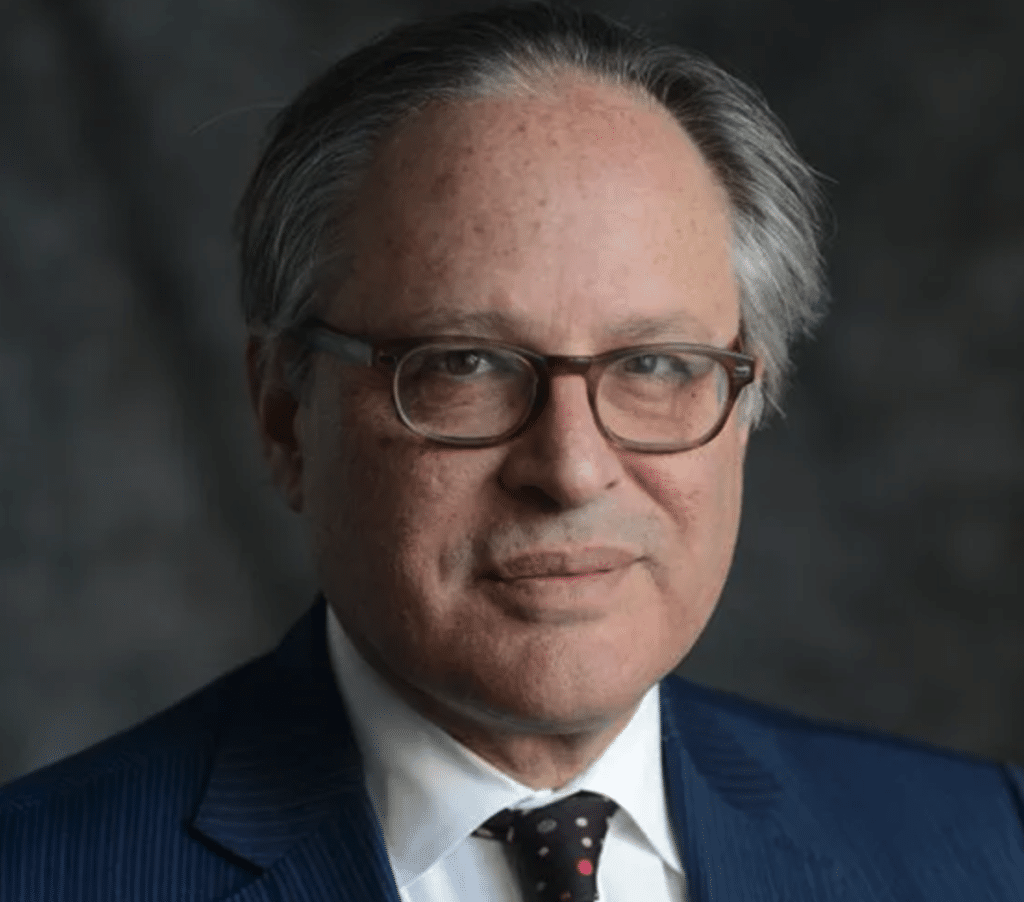
Nicholas Lemann recently published an essay in the New York Times about Jewish identity and Israel, titled, “A Profound Question Haunting Jews Today.” The article says that Zionism is embedded in the hearts and souls of liberal American Jews, and the bible too, so the progressive world’s move to anti-Zionism means that Jews must abandon their hope of belonging to the wider community.
Here are some excerpts:
“With jarring suddenness, it now seems no longer possible to be at once comfortably Jewish, and also Zionist, and also liberal, and also fully accepted outside the Jewish world.
“Jewish America is in a kind of collective identity crisis, as the new contours of our place in the world, since the Hamas massacre of Oct. 7, 2023, and Israel’s brutally conducted subsequent wars, have emerged. Open antisemitism has awakened from one of its periodic slumbers…
“Today, Israel is the pariah nation of the world, and ‘Zionist’ has become an epithet, something it’s unacceptable to be, at least in progressive circles.”
The chief feeling of the essay is aggrievement. Lemann, an old friend of mine and an accomplished historian and journalist, says that his Jewish identity is about to be “orphaned” because Israel has become a fixation for antisemitic zealots and their progressive friends—“ubiquitous conspiratorial and obsessively anti-Israel demagogues with mass followings.”
As many commenters at the New York Times pointed out, the essay never mentions Palestinians or Gaza. It is absent any expression of horror at Israel’s actions, something even Rahm Emanuel and Kamala Harris have managed to express.
It never mentions the view that Israel has committed a genocide. Though that view is held by the majority of Democrats, including now many candidates, such as Brad Lander in New York and Troy Jackson in Maine. Here, I’d point out that liberal opinion has long accepted the “genocide” description for Bosnia and the Rohingya, where the numbers killed/forced off their lands are lower or comparable to Gaza.
As a result of this blindness, Lemann’s argument has two holes.
First is the failure to acknowledge that Israel’s brutality is a driver of antisemitism. Second is its insistence that Jewish identity is inherently Zionist at a time when many Jews are fleeing that identity because it dehumanizes Palestinians.
As to the first point, it is a commonplace today, even in the Jewish community, to acknowledge that Israel’s hateful actions are fomenting antisemitism against Jews around the world. If you are going to build a religious identity over “ardent” support for a country that is widely understood to be perpetrating war crimes against a subject indigenous people, then you are endangering Jews.
Even Israel advocates say so.
“It is very clear that Mr. Netanyahu has not made us safer,.. and he’s endangered Jews here in America and around the world,” Rep. Haley Stevens, a darling of the Israel lobby, said two weeks ago in her Senate debate in Michigan.
Israel’s “murderous and illegal permanent war in Gaza” is undermining the battle against antisemitism in France, French President Emmanuel Macron wrote to Netanyahu last year. The forced displacement and starvation of Palestinians and the annexation of the West Bank “will only make your country more isolated, embolden those who use them as a pretext for anti-Semitism and endanger Jewish communities around the world.”
Macron and Stevens were surely aware of the antisemitic murders outside the Capital Jewish Museum in Washington in May 2025. The alleged perpetrator was a left-winger who said that violent action was needed to stop the Gaza genocide.
The dangers of American Jews’ organized support for Israeli war crimes have been emphasized over the years by many thinkers, including Hannah Arendt, Nathan Glazer, Ken Roth, and Eric Alterman. Tony Klug, a British intellectual, said at J Street in 2017 that Jewish lobbying for the hateful Israeli occupation could bring “infamy” to Jews and make Jewish life in the West “precarious.”
Earlier this year, J Street called on Jews to state their opposition to the Iran war “far more loudly”, so as to show the wider community that Jews were not pushing this war—lest Jews become scapegoated. The J Street ceo acknowledged the role of the right-wing Israel lobby in pushing the war. But he said it was urgent that Jews distance themselves from the lobby.
“If the policies that led to this war are allowed to be seen as expressing the will of the American Jewish community as a whole, the consequences will be felt by Jews everywhere.”
Lemann suggests that Israel has become a “pariah” because of antisemitism, but that word has been used to describe Israel in the last year by Rahm Emanuel and by Wes Streeting (then British health minister; he is now the new Defense secretary).
Israel is a pariah for good reason. Its only security strategy is lopsided war, assassination, and the indiscriminate killings of non-Jews. It has repeatedly been accused of apartheid by American leaders and human rights groups, a label never cited in Lemann’s article. Human Rights Watch long resisted that designation, but after Israel adopted its Nation State law of 2018, granting exclusive rights of self-determination throughout historical Palestinian lands to the Jewish people, it signed on. These conditions fostered the Gaza uprising and massacre of October 7 that I have condemned repeatedly here.
The second error in Lemann’s essay is its worry that Zionists cannot be “fully accepted outside the Jewish world.” But a Jewish identity based on support for Israel is also being rejected by young Jews. These young Jews see the same “crisis” in identity that Lemann does, but say that it is necessary. They must rid their institutions of anti-Palestinian racism.
“There is now an alternative Jewish power base that’s been built over three years that needs to be recognized,” Rabbi Alissa Wise, an anti-Zionist, stated on a recent J Street forum on the rise of political anti-Zionism.
That panel was dominated by Israel supporters, some of whom echoed Lemann’s view– they feel lonely today in American politics.
Without shaming them personally, Wise responded that there has been a “complete dehumanization” of Palestinians inside the organized Jewish community, with the result that Palestinians’ lives did not matter to politicians, and a genocide took place with the complicity of the Democratic establishment.
The fact that anti-Zionists have organized for years to revolutionize these politics is “life-affirming,” she said.
Today, many Jews reject a Jewish identity based on affiliation with Israel’s values. After I saw the occupation for the first time in 2006, I wrote that even if a majority of Jews claimed that the persecution of Palestinians is Jewish, I’d fight for an alternative. And I’m hardly alone. Our former publisher visited Israel many times as a youth but found his community’s misrepresentations of Palestinian history and conditions so “agonizing” that he needed to walk away, 20 years ago.
We see Jewish nationalism as inconsistent with the values we uphold in this country, the separation of church and state. Appalled that liberal Jewish institutions have deferred to a right-wing militarist country, some progressive Jews have lately founded a Jewish Diaspora Movement to uplift the universalist strains in Judaism.
“[T]he group says it aims to connect Jewish cultural and spiritual organisations that ‘reject ethnonationalism’ and affirm ‘the sanctity of all life’. The launch marks a growing rupture within Jewish communal life, particularly in the US, where legacy Jewish institutions have long treated support for Israel as a central pillar of Jewish identity,” Middle East Monitor reports.
Lemann mentions the divisive battles within Jewish congregations and families over Israel, but dismisses the anti-Zionists as fantasists. “[T]he idea that a psychological divorce from Israel is possible seems fanciful.” Zionism is “deeply embedded… in most Jewish hearts.” It is in the bible too, and touches “a deep collective yearning for self-determination, for self-protection, for freedom from perpetual outsider status.” Three-quarters of American Jews agree that Israel is “vital for the long-term future of the Jewish people.”
And yet there is a crisis, in which he feels orphaned.
The Jewish community is in crisis today for very good reason, because its leading organizations have built a Jewish identity upon support for the persecution of another people.
Great mistakes in collective identity can cause crises. In the American South, many white people had a great attachment to segregation. They had to be defeated politically, and the battle for hearts and minds continues to this day. I am reading Doris Lessing’s novels set in former Southern Rhodesia, which portray white national and ethnic identities founded on oppression that also had to be resisted and uprooted.
Liberal Zionism is being orphaned today because it has again and again sought to protect Israel from experiencing any consequences for policies that deprive Palestinians of a future. The dreams of young Palestinians have simply never meant anything to most Israelis, or their governments, or to the organized Jewish community here.
No wonder the next generation of young Jews is rejecting Zionism. Lemann is swimming toward a sinking ship.
Philip Weiss
Philip Weiss is the founder and senior editor of Mondoweiss.



Philip,
This is another excellent article.
So often the charge of antisemitism is used as a reflexive shield by supporters of Israel to disqualify anyone who believes zionism in Israel has failed. Such rigid thinking is a callous that makes stopping this madness against the Palestinians so much harder for everyone – including those so quick to dismiss the views of Mondoweiss and other such platforms crying out for peace and civility in the Middle East.
I find it truly mind boggling that Lemann’s essay doesn’t contain one single word about the other people living in the “Jewish homeland’. An uniformed observer might think the Jewish ancestral homeland was in Antarctica or some other uninhabited spot.
Nicholas who?
“The article says that Zionism is embedded in the hearts and souls of liberal American Jews, and the bible too, so the progressive world’s move to anti-Zionism means that Jews must abandon their hope of belonging to the wider community.”
Stating that “Zionism is embedded in the heart and souls of liberal American Jews” is basically saying ethnocentrism embedded in the “hearts and souls of liberal American Jews.”
The more Jews etc who can liberate themselves from Zionism makes it better for Jews etc.
https://www.google.com/search?q=zionism+is+ethnocentric&oq=zionism+is+ethnocentric&gs_lcrp=EgZjaHJvbWUyBggAEEUYOdIBCTIwMTM5ajBqN6gCALACAQ&sourceid=chrome&source=chrome.ob&ie=UTF-8#fpstate=ive&vld=cid:fa0877b7,vid:GFckhPstBtI,st:0
Relevant to this article by Phil: “The Wrong Jews”, video podcast with three leading British Jews: Michael Rosen, Miriam Margolyes and Alexei Sayle. It’s over an hour long, but thoroughly absorbing. And with Alexei and Miriam on board, it has plenty of laughs along the way.
https://www.youtube.com/watch?v=URpIy_pWthk
For years Morning Joe had Professor Jeffrey Sachs on regularly. No longer.
His latest at “Judging Freedom.”
https://www.youtube.com/watch?v=5tzP9hkY8ME