

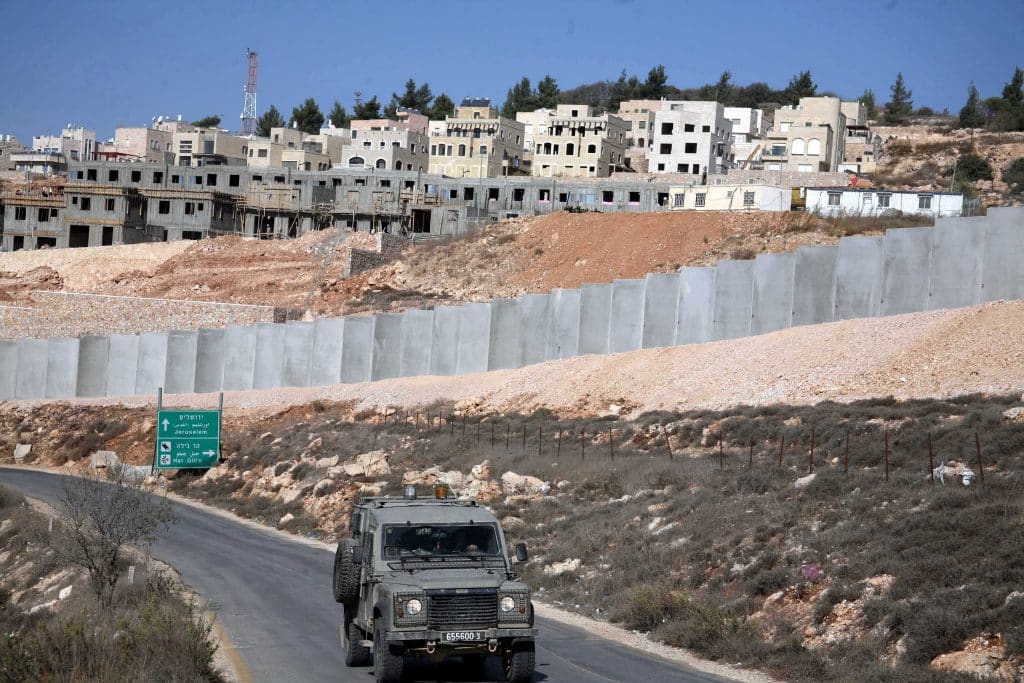
The Israeli settlement project in the West Bank is rapidly revealing its full colonial and annexationist dimensions. Last week, Israeli anti-occupation group Peace Now revealed that the Israeli government had approved $270 million for a network of roads to connect 20 unofficial settler outposts and official settlements across the West Bank, on Palestinian land.
The project is being promoted by Finance Minister Bezalel Smotrich and Transportation Minister Miri Regev, with an additional budget from the Finance Ministry. It is the latest in a string of settlement expansion projects approved by the government of Benjamin Netanyahu, which broke its own record of confiscating 12 square kilometers of Palestinian land in the West Bank in July 2024, with another 24 square kilometers confiscated in December of the same year, making them the two largest land confiscations by Israel in three decades.
Netanyahu’s government also set a new record by approving 22 new settlements in a single decision in June of last year, then broke it again by approving 34 new settlements last month. Under Netanyahu, the Israeli government has spent up to $7 billion building roads and other infrastructure for settlements in the West Bank.
This acceleration of settlement expansion in the territory is often discussed in terms of housing units, neighborhoods, and industrial areas. But the road network accompanying it is itself an enterprise of a scale equal to that of settlement construction. It, too, is accelerating under the current government.
The reasons for this acceleration are both internal to Israeli politics and external, driven by shifting strategic realities in the region and globally.
The infrastructures of segregation
The Israeli settlement project in the West Bank, which began shortly after the occupation of the territory in 1967, did not initially include its own road network. Although Israel built some strategic roads connecting the main areas targeted for settlement expansion to Israel proper, such as the Allon Road in 1980, most Israeli settlements were connected through the same road network used by Palestinian towns and cities. But in the 1990s, following the Oslo Accords, Israel began laying the foundations for full segregation between Palestinians and Israeli settlers in the West Bank.
In 1994, Israel began building a network of bypass roads to guarantee connectivity between settlements without passing through Palestinian towns. These roads cut through Palestinian lands, isolating many towns from their farming lands and future urban expansion areas, and seizing more Palestinian territory. Some of these roads remained partially open to Palestinians, particularly in areas where no alternative route existed, such as parts of the Allon Road and the road connecting the Maale Adumim settlement to Jerusalem. Since 2015, following Bezalel Smotrich’s “decisive plan” to complete the annexation of the West Bank, Israel has launched new infrastructure projects and poured more money into previously planned ones to achieve full separation.
Two examples are the “Fabric of Life” road connecting Jerusalem to settlements east of the city, and the “sovereignty” road, approved in 2007 and featuring an underground tunnel designed to be the only route for Palestinians traveling between the center and south of the West Bank. Both projects are part of a broader Israeli plan to cut off Palestinian communities around Jerusalem from the heart of the city, and to extend Israeli settlements into its eastern edges as a bridge between Maale Adumim and Jerusalem. This area is known as E-1, and the plan to settle the area and build roads through it has been years in the making.
Why now?
The current surge in settlement and road construction can be partly understood in the context of domestic Israeli politics, where Benjamin Netanyahu faces the real possibility of losing the November elections. Netanyahu and his allies are going into election day with the security failure of October 7 and the unfulfilled promises to dismantle Hamas, destroy Hezbollah, change the regime in Iran, and “redraw the map” of the Middle East, hanging over them. The only thing they have left to show for their time in power is the de facto annexation of the West Bank.
But there is more at play than election politics. According to Palestinian geographer, former negotiator, and settlements expert Khalil Tafakji, Israel “is laying the infrastructure for a full separation from the Palestinians, in case something is eventually imposed by the international community.”
Tafakji argues that the roads Israel is building not only “create an interconnected Israeli space for settlers while isolating Palestinian communities and cities,” but also ensure that West Bank settlements are simultaneously fully connected to Israel proper and capable of functioning as part of Israel, independently of the Palestinian population in the West Bank.
Tafakji told Mondoweiss that Israel is preparing for the possibility of an international decision imposing some form of Palestinian statehood or independence. “So Israel is planning ahead,” he said. By the time that happens, he explained, Israel would already have embedded itself across most of the West Bank through infrastructure that runs “completely independently from the Palestinian West Bank population, which it has, through the same process, cornered into isolated population pockets.”
Under this logic, Israel would be able to claim it has allowed Palestinians to govern themselves while ensuring that they have no geographical contiguity, no access to their natural resources or borders, and that its own settlements function as a full-fledged extension of Israel, including in terms of infrastructure.
Last November, Netanyahu repeated once more his pledge that “there will not be a Palestinian state.” This is the same pledge that Western governments, who continue to insist on the two-state solution, persist in treating as electoral rhetoric, hyperbole, or extremism. Meanwhile, on the ground, Israel continues to implement a clear ideological vision enshrined in its 2018 Nation-State Law: that the only national sovereignty between the Jordan River and the Mediterranean Sea belongs to Israel. It advances that vision, one settler outpost and one road at a time, over the crushed lives of Palestinian communities.


“Israeli-only” roads…. don’t you mean “Jewish-only” roads?
Thank you Qassam,
The pics shown of the bush-hogged grape vines (MiddleEastEye had pics) looked to be at least 50 years+ or older judging by their trunks. These farmers need legal representation; grapes from vines of that age command huge prices in California and worldwide.
Just before Reagan/Bush stole the 1980 election from President Carter, Begin strong-armed Carter into paying not just for the construction of “world-class” Ramon Air Force base, but for all of the roads.
Craig Unger reports: William Casey and “Bud” McFarland had already met with Gen.Yehoshua Saguy in the Sheraton hotel in Tel Aviv ‘at least three or four times a year starting in 1979’ and “to state the obvious, Casey and McFarland were NOT part of the reigning Carter administration at the time.” (p.131)
Den of Spies: Reagan, Carter, and the Secret History of the Treason That Stole the White House
Craig Unger, 2024
One solution: FPV drones find their way into the WestBank and “dispatch” the grand wizard and his sidekick.
All that Israel wants is peace, sorry piece.
The Land Registration Campaign Remaking East JerusalemUsing a revived colonial-era legal process, the Jewish National Fund is quietly transferring long-inhabited Palestinian property into Israeli hands.https://jewishcurrents.org/the-land-registration-campaign-remaking-east-jerusalem
“Support for Settlement of Lebanon Goes Mainstream in Israel”
What was once a fringe curiosity is now an organized movement with broad governmental and public support.
https://jewishcurrents.org/support-for-settlement-of-lebanon-goes-mainstream-in-israel
Israeli Settlements in Lebanon – a Movement Takes Shape
https://www.youtube.com/watch?v=q-a9ALJPEVo
It must be sheer coincidence that Israel is destroying Southern Lebanon and expelling its population.
And no, you can’t only blame its Kahanist goverment.
As I am sure you are aware, the nation state law says nothing about national sovereignty between the Jordan River and the Mediterranean Sea.
It does say: The right to exercise national self-determination in the State of Israel is unique to the Jewish people. What you claim is not even close. But again, you already know that.