

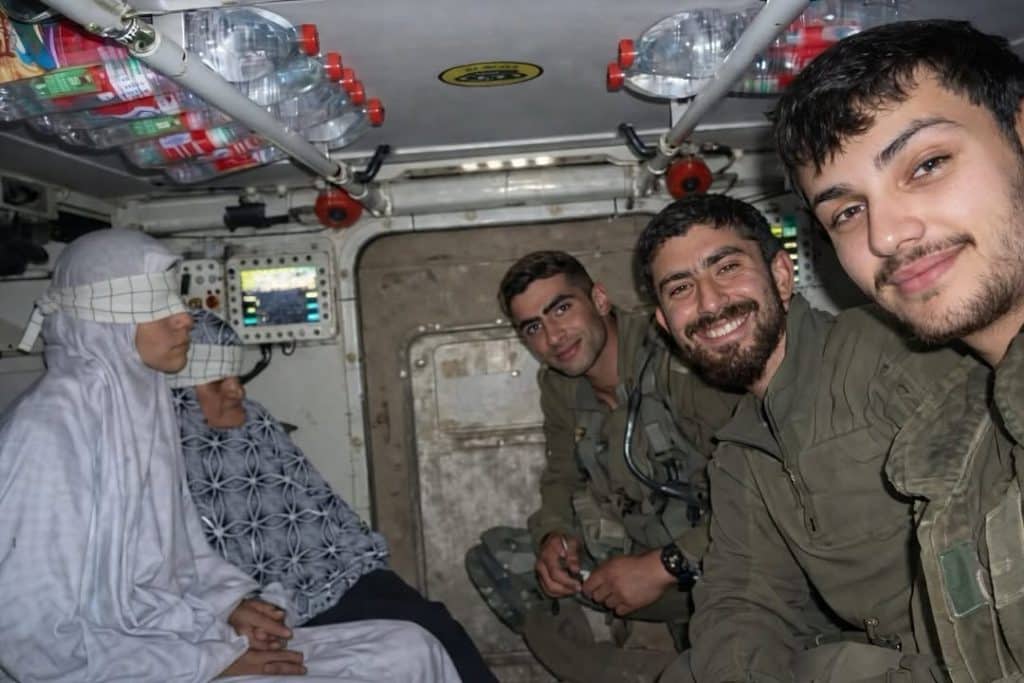
In an image circulated on social media, Israeli soldiers appear to be taking a selfie inside a military vehicle. On the other side of the frame, two Palestinian women appear with their hands bound and eyes blindfolded, clearly held captive by the soldiers. The photo eventually reached a phone in the hands of a family living in a tent in Gaza.
Aisha al-Aqqad, 78, and her daughter Huda, 41, are the two women in the photo. Their sons recognized them through Aisha’s clothing and some of the facial features they could make out from the image. Even though the photograph was taken at the beginning of Israel’s ground invasion of northern Gaza in late 2023, their families have only now seen it, receiving the first clue in over two years of what had befallen their missing family members. But the women were neither listed among the dead, as no bodies had been found, nor listed among prisoners held in Israeli jails, according to the family, who say they had contacted every humanitarian organization in Gaza without receiving answers.
According to a Sky News investigative report, the Israeli army responded to questions about the two women’s fate by saying it had no available information, claiming the women had been temporarily detained during military operations in the area and released after operations had ended. One of the soldiers, Dolev Mor Yossef, had originally posted the circulated photo on his Instagram profile in May 2024 — about half a year after it was taken — before subsequently deleting it, according to Sky News.
But to this day, the family in Gaza still has no further information concerning their fate, and is demanding that any leads that could shed light on what happened to them be disclosed.
“We lost contact two years ago with my mother, my sister, and my brother when the Israeli army stormed the al-Katiba neighborhood in Khan Younis in December 2023,” Ammar Al-Aqqad, son of Aisha, told Mondoweiss. “They refused to leave while we and some of my other siblings left. We remained in contact with them until communication was cut off and they disappeared.”
He said he happened upon the photo on social media by chance and immediately recognized his mother by her clothing. He recounted that his parents, his brother, and his sister — four family members in total — had refused to leave their house during Israel’s December 2023 ground invasion of Khan Younis. They remained for 13 days in their home, which Ammar noted was located roughly 200 to 300 meters from the house of Yahya Sinwar, the former Hamas leader in Gaza.
Ammar continued communicating with the four family members in Khan Younis until, during one phone call, he could hear the sounds of military vehicles approaching, after which communication was lost. By the end of those 13 days, not all of them were accounted for. Later, he found out that his brother had been arrested by the Israeli army and taken to an Israeli prison, while his father had been shot dead in his own backyard when he stepped out to pray. But the fate of Huda and Aisha remained a mystery, and it still does to this day.
The story of the al-Aqqad family is just one of thousands of Palestinians in Gaza who have been forcibly disappeared by the Israeli army or gone missing, leaving their family members in a constant state of limbo and uncertainty over their fate.
“I do not want to think of the worst — that he was killed somewhere and that stray dogs tore apart his body. I do not want to think of these things. I want to keep waiting. Maybe one day, I will hear that he is alive, that he is coming back, or that I will see him again.”
Diana Owais, whose husband disappeared in 2025.
In the final days before losing contact with his family after he had moved to another part of the city, Ammar had urged his brother to surrender to the Israeli army.
“I told them, go to the army and surrender yourselves so they do not hurt you, or move from one neighbor’s house to another until you can get out,” he said. “But my brother said the army had positioned itself on high buildings and was shooting at anything moving without distinction. After that, communication between us was cut off.”
Clinging to hope
When the al-Aqqads first saw the photo, their immediate reaction was hope and joy — the sense that the mother and daughter might still be alive, and that the image could be used to determine whether they were alive or dead. Either way, the family said they want closure.
“I left no stone unturned in contacting international institutions during the past two years,” Ammar said. “The Red Cross said they would follow up with the Israeli army, but they have received no response.”
Ammar added that the Israeli army had claimed that Huda and Aisha had been moved from the combat area to a safe zone, but no other information was provided. “We want to know where that safe zone is,” he said. “Was it the Abu Hamid roundabout, which is closest to where they lived in Khan Younis? Were they left in the city center? In the north? In the south? We want to know. They haven’t turned up anywhere for two years. If they were alive somewhere inside Gaza, they would have been able to reach us or get word to us.”
At the start of the war, official statistics in Gaza and from the United Nations indicated that over 11,000 people were missing in the Strip. Since the beginning of the ceasefire, however, specialized teams and residents have dug through the rubble and recovered the remains of thousands of people who had been registered as missing. Daily Ministry of Health reports continue to record bodies recovered from under the rubble, even in small numbers. But updated statistics published by the Government Media Office on its Telegram channel last April put the number of people still missing in Gaza at more than 8,100, with no indication of their fate.
‘He went for a walk and never returned‘
In eastern Gaza City, Diana Owais lives with her two daughters in a tent beside those of her parents and siblings. Her husband, Adam, disappeared when they were displaced to Khan Younis in 2025, near the European Hospital. He went for a short walk one afternoon and never came back.
Neither Owais nor her husband’s family knows anything about his fate. Some people told her he had been seen heading toward the Netzarim corridor, where military forces and vehicles separated northern Gaza from the south.
“But we do not know where he went or where he is now,” Owais said. “We contacted institutions and did not find his name on any prisoners’ lists. If the Israeli army had killed him somewhere, perhaps we would have found his body. I do not want to think of the worst — that he was killed somewhere and that stray dogs tore apart his body.”
She continued. “I do not want to think of these things. I want to keep waiting. Maybe one day, I will hear that he is alive, that he is coming back, or that I will see him again. I will stay alive through hope and wait for him until he returns.”
Owais said that after her husband disappeared, she heard stories of entire families who had been bombed and completely vanished without a trace — accounts that were confirmed by an Al Jazeera investigation last February which found that Israel has used U.S.-supplied thermobaric bombs in Gaza that made people “evaporate,” a common description of the complete incineration of the bodies of thousands of Palestinians.
Owais also heard that during sieges of certain areas, stray dogs had fed on the bodies of the dead who had been left for dead in the streets.
“When I heard these stories, I tried not to listen,” she said. “But I also wanted to know what was happening. I had a strange feeling: half of me wanted to know the truth, while the other half wanted me to keep waiting.”
Tareq S. Hajjaj
Tareq S. Hajjaj is the Gaza Correspondent for Mondoweiss and a member of the Palestinian Writers Union. Follow him on Twitter/X at @Tareqshajjaj.
Utterly sickening. If still alive, one can only imagine the horrors the mother and young daughter have endured. Look at the faces of those psychopathic soldiers. Did they rape the daughter? We know systematic rape is an Israeli specialty. Israel—and their army of Hasbara shills in the west whitewashing every ghoulish Israeli atrocity—is the number 1 driver of antisemitism.
The IDF once more proving that they are, in the words of the late British Middle East correspondent, Robert Fisk, an ill-disciplined rabble. It’s bad enough that these squaddies take pleasure in hurting and humiliating two women old enough to be their mother and grandmother. What’s worse is the total lack of any system for dealing with defenceless captives. They just disappear into Nacht und Nebel.
https://x.com/davidsheen/status/2059654592246276151
After tireless struggle by victims and finally a 1-hour TV documentary this week, settlements south of Jerusalem admit their leaders have long created child pornography by filming when they gang-rape kids in the community: “No longer in denial: Gush Etzion admits to ritual abuse”
Look at the trio of nice Jewish boys!
Gosh, I could plotz when I think about all that Zionism has done for us.
I mean, the courage required to arrest a 78 year old and her 41 yr old daughter!
Terrorists, no doubt.
Oh well, as I say: “That’s just the way the matzoh crumbles; into a half-baked cracker.