

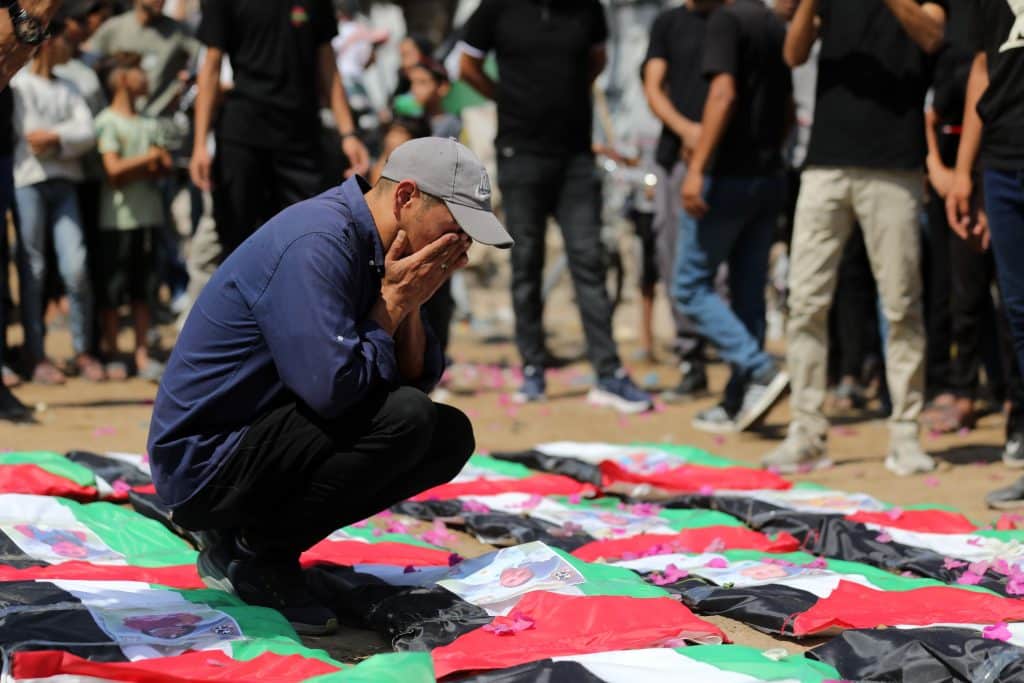
Nearly three years after they were killed, Palestinians in Gaza buried 112 loved ones whose bodies had been trapped beneath the rubble after an Israeli airstrike in November 2023, during the early months of the genocide. Over the past three weeks, Gaza’s Civil Defense crews recovered their remains after years of being inaccessible under collapsed buildings, while the bodies of 41 others who were killed in the same strike have yet to be found. The dead were laid to rest on August 4.
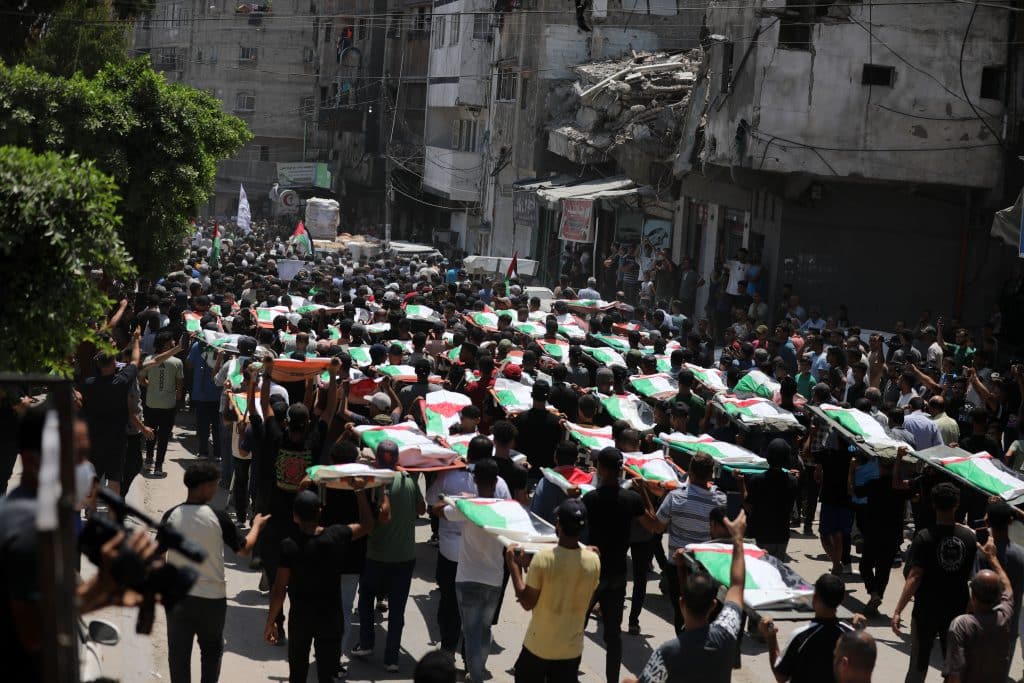
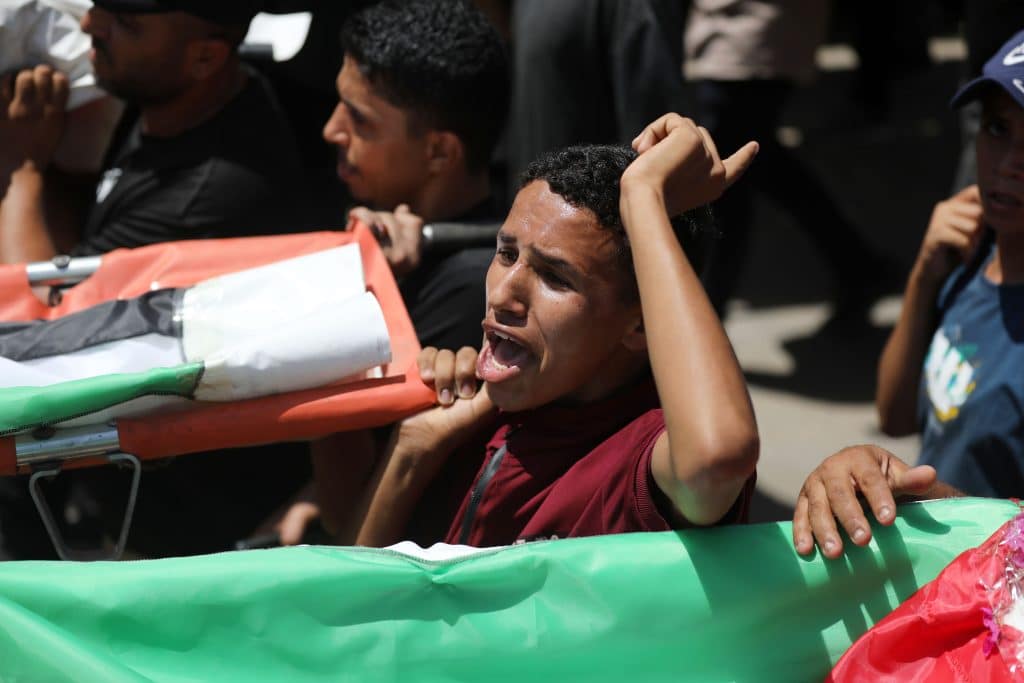
In what residents described as the largest funeral procession held in Gaza in its history, mourners carried 112 white shrouds wrapped in Palestinian flags, many containing little more than scattered bones, bringing together members of the al-Hassayneh and Abu Sharia families from Gaza City’s Sabra neighborhood. The victims had been sheltering inside the home of Mufid al-Hassayneh, a former minister in the Palestinian Authority government, believing the area would be safer from Israeli bombardment. Instead, 153 people were killed in the strike that inevitably came.
Mahmoud Basal, spokesperson for Gaza’s Civil Defense, said rescue crews spent 17 days searching the site using only limited equipment and resources before completing the recovery.
“The fate of the remaining victims is still unknown,” Basal said. “We do not know where their bodies are. We do not know whether they disintegrated over time, disappeared beneath the rubble, or were consumed by stray animals.”
The tragedy underscored the international community’s responsibility to respond to the humanitarian catastrophe in Gaza, Basal said, especially since well over 8,000 more bodies are estimated to be trapped under the rubble across the Strip.

According to members of the victims’ families, those recovered included 44 children, 37 women, 23 elders over the age of 60, and seven people with disabilities.
For relatives attending the funeral, the ceremony brought both closure and renewed grief.
Amer Abu Sharia, 49, a physician and a member of one of the affected families, said the funeral offered a long-deferred dignity to the victims. “The sorrow feels as though it is the first day of the massacre all over again,” he told Mondoweiss. “Our grief has returned with the same intensity.”
Abu Sharia said his extended family endured multiple massacres during the war, the deadliest of which was the November 2023 strike.
Abu Sharia recounts the eve of the bombing, which took place on the 22nd. As Israeli bombardment intensified in Gaza City, the al-Hassayneh and Abu Sharia families, who are part of the same extended clan and have long lived across large sections of the Sabra neighborhood, moved repeatedly from one house to another in search of safety.
“Every time a nearby house was bombed, we fled to another one,” Abu Sharia said. “In the end, everyone gathered in the home of a former minister from our family who had served in the Palestinian Authority, believing it would be a safe place. But the aircraft spared no one. They bombed the house with everyone inside.”
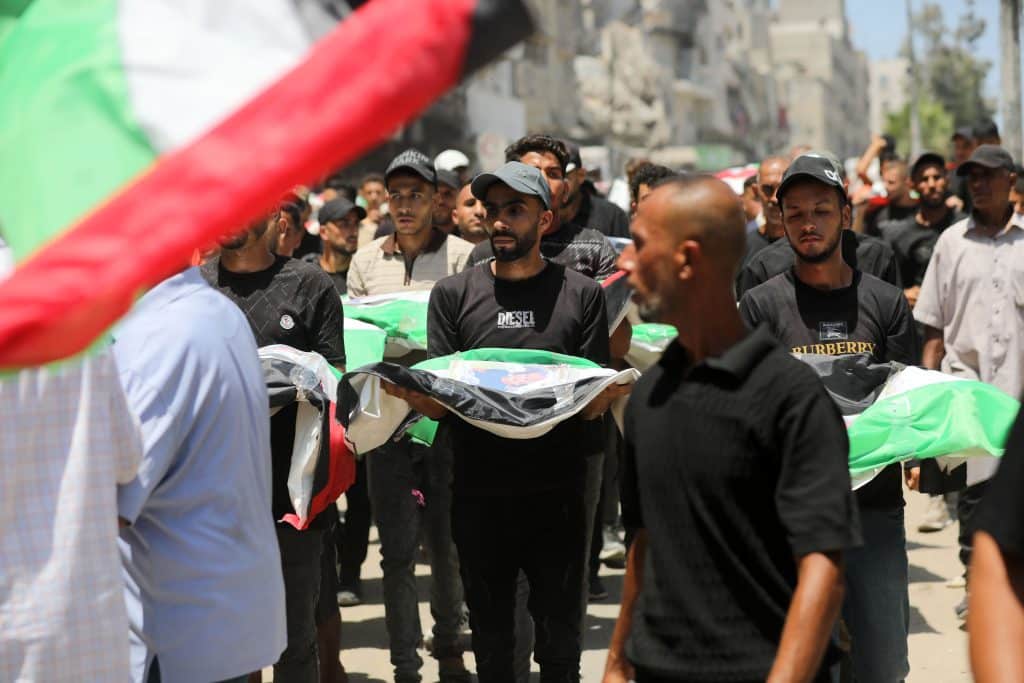
Embracing her children even in death
The funeral brought together parents and grandparents burying the generation that was supposed to outlive them, whose remains had only recently been recovered.
Among the bereaved was Zuhdi Abu Sharia, 51, who lost five grandchildren, their mother, and other relatives in the strike. Three years later, he finally stands at their graveside.
Recalling their final hours, Zuhdi said the family had spent the day moving between homes to escape the bombardment before taking refuge in the large house that was ultimately struck.
“When they arrived, they found dozens of relatives already gathered there,” he told Mondoweiss, saying they believed that they were safe.
He said the attack left many bodies so badly damaged that some could not be recovered, while others remained scattered beneath the rubble or were never found. “Of my five grandchildren and their mother, all we recovered were a few bones,” he said. “We identified them only through pieces of clothing that we recognized.”
Most of those recovered were women and children, a fact reflected in the mourners lining the funeral procession. Many had come to bury children, grandchildren, wives, mothers.
Ahmad Abu Sharia, 41, said that many women and children had been sheltering in the basement of the building when it was hit.
He recalled pulling the body of his daughter-in-law from the rubble with his bare hands.
“She was still holding her three children in her arms,” he said. “Their bodies had decomposed, but they remained locked together.”
“I saw with my own eyes how a mother continued embracing her children even in death,” he added. “They clung to one another out of fear. They were all civilians, women and children. There was no justification for bombing them.”
More than 1,000 days after losing them, he said, the grief is still fresh. “It is a layered form of suffering,” he said. “A pain that cannot be described or truly conveyed to the rest of the world.”
Despite his sorrow, Ahmad said recovering and burying the victims brought a measure of relief after years of uncertainty. “But that relief is inseparable from unbearable pain,” he admitted.
‘This should never become normal’
Ahmad said thousands of families across Gaza are still waiting for answers about relatives who remain missing.
“Imagine what it is like not to know where your loved ones are, whether they will ever be found, or whether you will one day be able to bury them.”
Ahmad Abu Sharia said he takes some comfort in the fact that every recovered member of his family was identified before burial, a circumstance he described as rare in Gaza.
He recalled numerous cases in which bodies recovered from beneath the rubble, or returned to Gaza after being held elsewhere, could not be identified, leaving families without certainty about the fate of their loved ones.
“That is another tragedy facing thousands of Palestinian families,” he said. “Many never had the chance to say goodbye to their children or loved ones because they still do not know where they are.”
Throughout the war, he said, families have watched unidentified bodies being buried in mass graves, while countless mothers have searched desperately for any trace of their children.
“The fact that people feel lucky just because they could bury their loved ones is itself an immense tragedy,” he said. “This should never become normal.”
Tareq S. Hajjaj
Tareq S. Hajjaj is the Gaza Correspondent for Mondoweiss and a member of the Palestinian Writers Union. Follow him on Twitter/X at @Tareqshajjaj.
I follow the English writer Michael Rosen on Facebook. He has chronicled the fate of his extended family in France during the Holocaust. He’s a witty and wise man. His search for information about the fate of his relatives is sobering, since wit is impossible and wisdom throws its hands up in helpless horror in the face of such inhuman depravity. He has no time for Israel. He sees parallel lines.