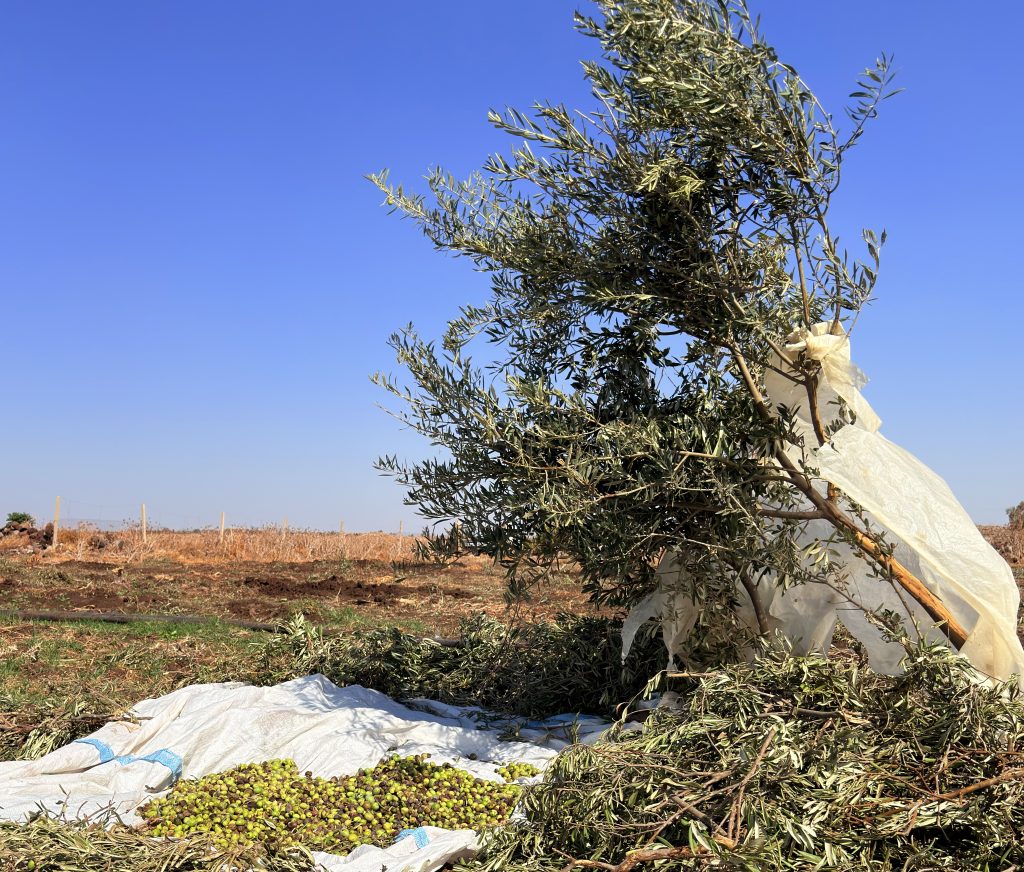
At al-Salam, the largest of the three olive presses in Quneitra, southwestern Syria, the harvest should be at its peak. So far this season, owner Ibrahim Moussa al-Moussa has received only 200 tons of olives, he told Mondoweiss. In 2024, his olive press handled 2,000 tons.
“Much of this year’s crop is still hanging on the trees,” al-Moussa said. “Israeli patrols prevent the picking, and land that is within sight of Israel’s new military bases is too dangerous to approach.”
When the farmers are let through at all, he explained, Israeli soldiers allow them only two hours on their land.
Israel has occupied parts of southern Syria since December 2024 in a military expansion that comes at a human and economic cost. Since mid-2022, the Israeli army has been building Sufa 53, a military road lined with trenches, berms, and other fortifications between 300 and 1,000 meters inside the UN-monitored demilitarized zone in some locations.
Israeli forces intensified their operations after Bashar al-Assad fell in December 2024, seizing the UN-monitored buffer zone set by the 1974 disengagement agreement, which ended fighting between the two countries after the 1973 war. In February 2025, Prime Minister Benjamin Netanyahu said Israeli troops would remain in the buffer zone “for the foreseeable future.”
Much of the land close to Sufa 53 has been seized or made inaccessible. Israeli forces have so far taken over or closed off 5,650 acres of farmland and destroyed another 1,670 acres of fruit trees, forest, and pasture, said Mohammad al-Hamad, director of the Provincial Agriculture Directorate.
The destruction of Quneitra’s olive groves could affect Syria’s economy as olives are one of Syria’s most important crops.The farmers who own the land are blocked from accessing it, and must seek special permission to do so. Those who try to enter their grounds without permission risk getting detained.
‘Now we ask the Zionists about our sons‘
On October 31, eight Israeli military vehicles set up an impromptu checkpoint on the road between Khan Arnabeh and Ufaniya in northern Quneitra. They detained four Syrian civilians who were harvesting their olives, according to Syria’s state news agency, SANA. Two were released, but the others were taken to al-Hamidiyah, a military post Israel set up after the fall of the Assad government.
This was not an isolated case. On October 17, Israeli forces detained four people as they were on their way to their farms near the village of Taranja, SANA reported.
Some have never returned.
Hassan Saad al-Din’s 2.7 acres of land lie directly in the path of Sufa 53. They held 500 olive, peach, fig, and walnut trees, along with a water well and a cattle shed. Saad al-Din, the father of six, worked the land every day with his 16-year-old son Saddam.
On April 25, 2024, an Israeli patrol arrived without warning and detained Saddam from inside the shed.
“He was still a boy,” his father said.
A month later, Israeli bulldozers returned and spent eight hours tearing Saad al-Din’s trees out from their roots. The land has since been seized by the Israelis for Sufa 53, leaving him unable to locate his plot under the road and berms.
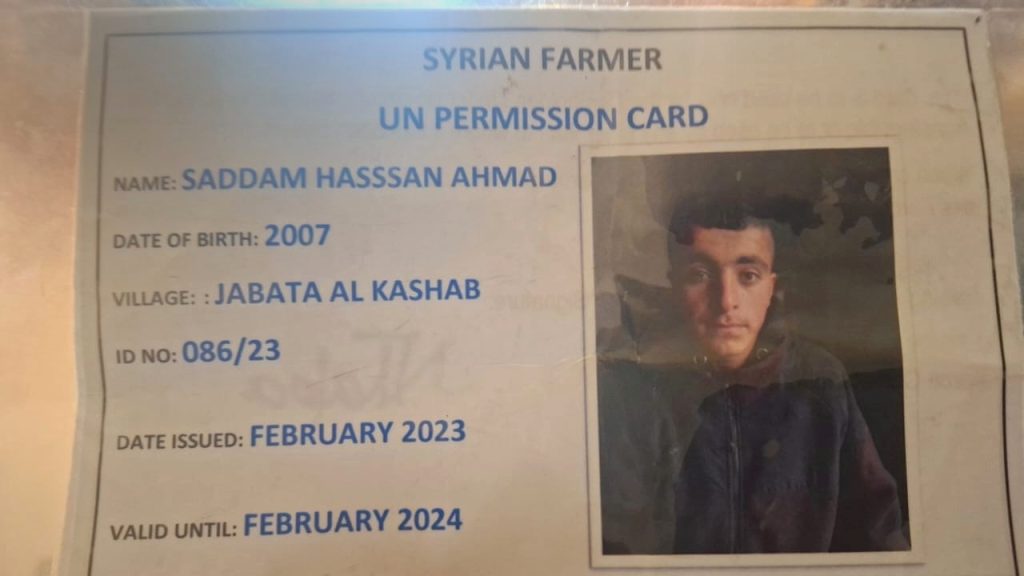
Saad al-Din’s family once lived comfortably from the fruits of his labor. Now, he has to resort to a daily wage job picking other people’s crops. Israeli soldiers come to Quneitra regularly to oversee the bulldozing and survey the land and villages. During one of these visits in early October, he asked them about his son, Saddam, and the other detained young men. The officers promised to locate Saddam and send word through local notables, and later said the matter was bigger than him. Saddam is still held in Israel with no clear charge. “None of the young men who came out of prison have mentioned him or recognized him,” Saad al-Din said. “So we still don’t even know which prison he’s in.”
Saad al-Din said 44 young men have been detained from Quneitra.
In September 2026, the UN Commission of Inquiry on Syria said that 49 Syrians, including two children, had been detained by Israeli forces in Syria. Some were transferred to Israel “where they reportedly remain detained incommunicado,” the commission said.
“Some detainees told their families they had been held in Sde Teiman, Ofer and Gilboa prisons [in Israel],” Saad al-Din said. “We have protested repeatedly at the positions of the UN peacekeeping force, but no one has brought us news.”
“My country used to defend the [Palestinian] cause and stand against the normalization [of relations with Israel]. Now we ask the Zionists for our sons,” he said.
A military line through farmland
Ali Sabra, from the village of Kudna, sold his house in 2023 to buy 2.5 acres of olive trees and farmland.
“It was the height of happiness when I began caring for the land,” he told Mondoweiss.
But in February 2025, an Israeli patrol pushed his family off the land and razed it — their home, trees, and farm were destroyed.
“The land was our whole life and our shelter,” Sabra said. Like Saad al-Din, he now harvests other people’s crops for a daily wage that “is not enough for anything.”
In Jubata al-Khashab, Mohammad al-Khabba, 48, earns $140 a month as an excavation worker for Quneitra’s water directorate. “I need about $200 for us to live without any luxury, just food and drink,” said the father of four. “Buying clothes for the children takes a plan, and every school season is a struggle.”
The 2.5-acre farmland he inherited from his father that had 200 olive trees, cherries and vegetables, used to fill that gap.
“The olive season gave us our pantry for the year,” he said. “We didn’t buy vegetables at all.” Each harvest used to give the family three 20-liter tins of oil to keep and six or seven more to sell. Last year, after poor rains drove prices up, a tin sold for $100, he said, and this year it goes for about $60. At last year’s price, his surplus would have been worth up to $700, or five months of his salary.
His land was seized and his farm was razed in September 2025. This autumn is the second olive season that al-Khabba’s family has spent without a harvest.
Al-Khabba’s grove is gone, but his family still lives in Jubata al-Khashab. Many nights, gunfire from the Israeli post in the village’s forest reserve rakes the area for hours, shattering windows and terrifying the children. Some days al-Khabba cannot get to his job at Quneitra’s water directorate. “[They are doing] all of this is so that we leave our homes,” he said.
“But we were determined to stay, and we forced our children to endure and adapt,” al-Khabba said. “I told my sons that if we left, we would live in tents, get water by the drop and food as charity, and die of cold. I showed them clips of how the people of Gaza live, and I explained that the reason they live like this is the Israeli.” His neighbors made the same pact, he said: no one would leave, and every family would talk to their children the same way.
A long road to recovery
The real cost goes far beyond the trees, said agricultural economist Murad Mustafa. It is decades of farm capital and years of lost income, and it spreads to farmers, drivers, presses, and traders who never owned land. A credible estimate, he said, must add the cost of rehabilitating the land to the income lost until the groves produce again, and follow it through the whole recovery period, not just one season.
“A new olive tree bears fruit after four or five years, but needs seven to ten or more to reach full production,” said Assem al-Dhiyab, a member of the Golan Association for the Preservation of the Environment and Heritage.
“The grass now returning to cleared plots is not recovery,” he said.
Bulldozers are not the only threat. Mohammad al-Hamad, director of the provincial agriculture directorate said that 449 acres have been bulldozed or closed off by Israeli forces in Taranja alone.
“Directorate staff cannot even enter to count the damage,” he said.
Trees still standing near the ceasefire line face another danger. In late January and early February 2026, Israeli forces sprayed herbicides there, al-Hamad said. The agriculture directorate sent samples for testing, and our lab report found the chemicals cause stunting and leaf and fruit drop in olive trees. The spraying damaged about 35 acres of fruit trees, 253 acres of winter crops and 921 acres of pasture, he said.
“Uprooting breaks the soil’s structure so it erodes faster and holds less rain, a serious loss for groves that depend on short, erratic winters,” al-Dhiyab said.
Water supply is under strain as well. The al-Mantara dam holds half of Quneitra’s 80 million cubic meters of storage and feeds five dams downstream. It has fallen to its minimum level, said Muwaffaq al-Sheikh Ali, a natural resources consultant. Israel has set up bases on both sides of the dam, in al-Adnaniya and al-Hamidiyah, and patrols have repeatedly blocked farmers from reaching it.
“Israel moves militarily on the ground according to the watercourses it wants to control,” al-Sheikh Ali said, with the aim of cutting them off from Syria and Jordan.
Even in drought-hit 2025, Ibrahim Moussa Al-Moussa’s press handled 1,500 tons of olives. This year, costs are rising as volumes shrink. Pressing now costs $0.46 a kilo, up from $0.35 last year, at a rate set by the Syrian state, al-Moussa said.
Agricultural workers are paid about $0.14 for each kilo they harvest. The press’s 15 workers, most of them displaced from Deir ez-Zor, earn $9.28 for broken shifts of up to 10 hours, he said. Every ton that never arrives is lost work for them, too.
For the families on the line, there is no recovery in sight. Al-Khabba and his neighbors are still in Jubata al-Khashab, hearing Israeli gunfire aroud them at night. They live in neither war nor peace, unsure who holds authority over the land they farm, and what will happen in the near future.
“We have no idea under which state’s mercy we will live with our children,” Mohammad al-Khabba said.
This report is published in collaboration with Egab.