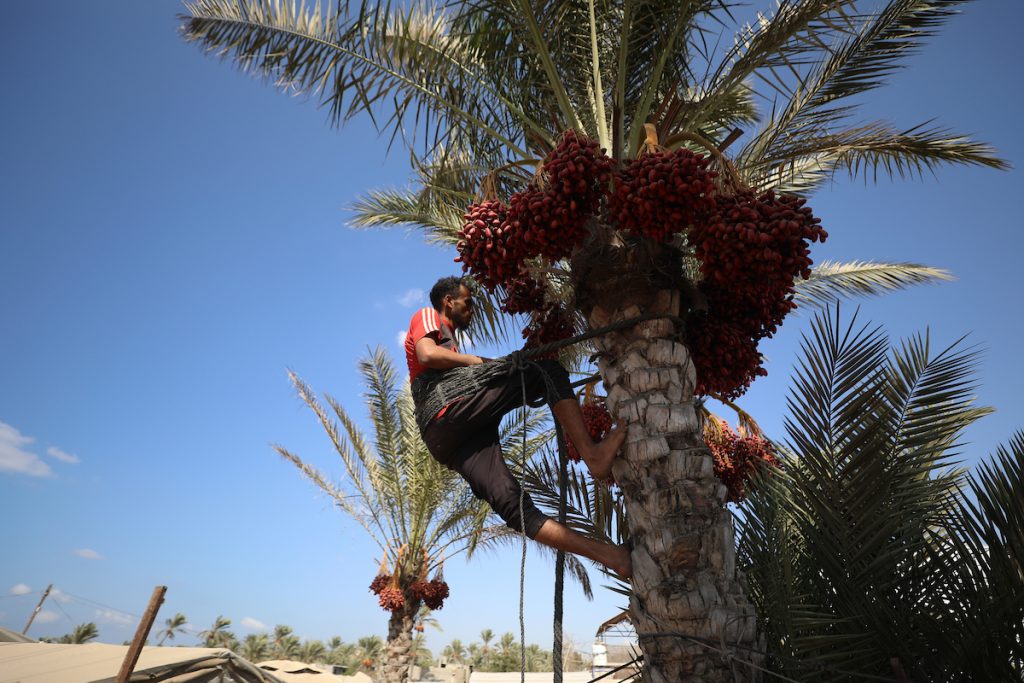
For 38-year-old Abdullah Baraka, harvesting date palms has been his livelihood for more than a decade. But this season, he only managed to harvest around 70 trees. Before the war, he would harvest approximately 5,000 palms during the harvest season in the Khan Younis area, working alongside a team of 14 other laborers.
Their work extended far beyond harvesting dates. Throughout the year, they visited farms and individual palm tree owners more than seven times, providing services such as pollination, pruning, trimming, and eventually harvesting the fruit.
Baraka says he has watched date palms become increasingly vulnerable to destruction with each passing year of the war. He fears that within the next three years, there may be no harvest season at all.
“By then, the date-palm harvest season will be a thing of the past,” he said.
During the war, the Israeli army destroyed approximately 4,500 dunams cultivated with date palms. Large farms in Khan Younis and Deir al-Balah were destroyed by bombardment, targeted attacks, or bulldozing, particularly those located inside the so-called “yellow line”, which divides the Gaza Strip into two parts.
In the Qarara area of Khan Younis, where Baraka used to work, some families owned plots with 100 to 150 trees. Their owners relied on these trees as an investment, while workers like Baraka regularly visited the farms to maintain them.
“There is no longer a date harvest season like what we had before the war. There aren’t even enough dates. The occupation is destroying everything that provides Palestinians in Gaza with a source of livelihood and prosperity.”
Deir al-Balah, located in central Gaza, is one of the Palestinian areas most closely associated with date palms. Its name itself reflects that connection: balah is the Arabic word for dates. Baraka says he now travels across the remaining agricultural land in the southern and central areas of the Gaza Strip in search of work. In Deir al-Balah, he could barely find two farms out of the dozens he used to visit and harvest from every season before the genocide began in October 2023.
“The only trees that remain in some places are those owned by residents who had planted a handful of palms in the courtyards of their homes. Some families had five or ten trees growing in their gardens.”
Yet the destruction of the farms did not discourage agricultural workers, who depend on the season to earn an income, from searching for whatever work remains. For many, even a handful of surviving trees represents a chance to earn money and provide for their families.
The disappearance of the farms has also meant the loss of an entire network of agricultural work that sustained families throughout the year, not just during the harvest.
Among them is Haitham Ftayir, 29, from Deir al-Balah. During the war, an Israeli airstrike left him with an amputated leg. During the famine, one of his children died from malnutrition. He is now responsible for supporting his three surviving children.
Climbing date palms is the only profession he knows. Before the war, it provided him with a decent income, allowing him to meet most of his family’s needs and cover expenses he had previously been unable to afford.
This season, however, he climbed only ten trees across the entire Deir al-Balah area, a dramatic decline, even considering his injury. Before the war, he would personally harvest more than 100 trees during the date season.
Ftayir says entire communities depend on the date harvest season to sustain their livelihoods. This includes both farm owners and the workers employed to maintain and harvest the trees.
“A single farm could contain at least 100 palm trees and employ between 30 and 40 workers on a rotating basis,” he said. They would take turns pollinating the trees, harvesting the dates, and selling the produce.
“My family consists of my wife and three children. If I don’t work, we don’t eat. Climbing palm trees and working on them is what I know. That’s why I wait for this season every year, hoping to support my family.”
At this time of year, before the war, red dates would hang on the walls of homes across Gaza. Almost every household had several bunches of dates suspended indoors, while markets were filled with fruit available at affordable prices.
“Even this season, which used to last around 40 days, has been targeted,” Ftayir said. “Today, we can barely find any.”
The loss extends beyond those who owned large farms or worked professionally in the harvest. Families that had only one or two palm trees in their gardens also depended on them and looked forward to their harvest every year. For these households, the trees were not simply a source of food, but part of the domestic traditions passed down through generations.
“We loved having fresh dates hanging from the walls of our home, wrapped up and left to ripen. Once they ripened, they became soft, sweet, and delicious. There was always something sweet from our harvest in the house,” said Mirvat Abdelsalam.
Abdelsalam, 51, a mother of seven who is now living in a displacement camp in Gaza City, once had three date palms growing side by side in the small garden of her home in al-Zaytoun.
The annual harvest provided her family with dates and date paste, which they would distribute to relatives and neighbors before storing the rest in their refrigerator to last them until the following year.
“We used to make ajwa (date paste) from the dates we harvested and store it for the holidays. We would use it to make fresh ka’ak, a Palestinian sweet made from flour and date paste. We also prepared a traditional makhtoum, a mixture of dates, olive oil, nuts, and sesame seeds, which we would store and enjoy for months.
“But our home is gone, and so are the two palm trees. Now we can only wish for and search desperately for some of what we once had in our own backyard.”
“We haven’t just lost the palm trees or the harvest season. We have lost everything associated with them, the occasions when we would bring out dates, fresh fruit, and rutab; the atmosphere of harvesting; and the care we gave to the trees,” Abdelsalam said.
“We have also lost a way of life. This season is no longer accessible to most of us because of the Israeli army’s destruction and killing of trees, people, and homes across the Gaza Strip over the past three years, a destruction that is continuing.”