


Among many buzzwords in diplo-speak around Palestine is the support for “a demilitarized Palestinian state living side by side in peace next to Israel.” This condition is repeated so often that it goes unnoticed most of the time.
That premise, and its inherent injustice, dysfunctionality, and lack of pragmatism, was highlighted this week by no less an entity than Donald Trump’s Orwellian “Board of Peace.”
On August 1, the Board released the full text of its plan, outlining the latest scheme to create an actual ceasefire in Gaza, begin rebuilding, allow a Palestinian body of technocrats to start assuming some small authority in Gaza, and, above all, to disarm Palestinian armed groups.
It is worth noting, briefly, that such a plan should not have been necessary, since such a plan was supposed to be part of the so-called “ceasefire” that was declared in October 2025.
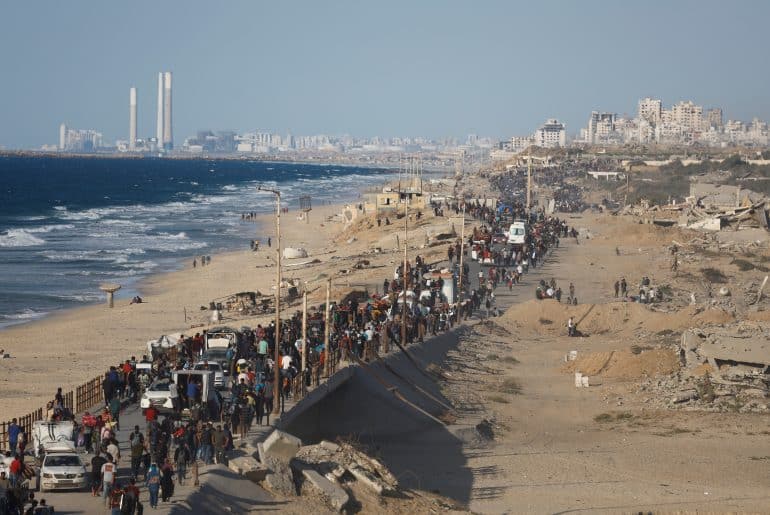
This new plan was presented as the second stage of the October plan, ignoring the fact that Israel has not fulfilled any of its obligations in stage one, and in fact, has never stopped killing Palestinians and has gradually occupied more and more of Gaza, pushing the survivors ever closer to the sea.
Palestinian factions reportedly had some very difficult consultations regarding this latest plan. In the end, they decided to accept the plan and put the ball in Israel’s court.
The key to that acceptance was one particular clause in the agreement, which tied Palestinian disarmament to Israeli withdrawal from Gaza, to be accomplished in phases, and stated that the Palestinian weapons would not be destroyed but would be handed over to the Palestinian board of technocrats.
Those conditions were in the Board’s plan. Article 8 described a “process to decommission and store heavy weapons, military production sites, depots of weapons, and tunnels, shall begin after completing the remaining commitments under Sharm Sheikh Protocol, the entry of NCAG and deployment of ISF.”
The NCAG is the proposed Palestinian technocratic board, and the ISF is the often-discussed “International Stabilization Force” that would handle security in Gaza. The “remaining conditions” that need to be fulfilled refer to Israel’s ongoing attacks on Palestinians and its advance beyond the so-called “Yellow Line,” which splits Gaza in two, with Israel occupying 53% of the territory. It has since advanced well beyond 60% and, by some estimates, is nearing control of 70% of the territory.
The Board of Peace clause continues: “…This process shall be linked to an Israeli withdrawal, in phases, from the areas under its control in Gaza and the decommissioning of armed militias in accordance with article 10 of this Roadmap. …The Palestinian factions shall take part in this process, and no weapons shall be transferred or handed to Israel or non-Palestinian parties.”
There’s no ambiguity there. All weapons would be held by the Palestinian technocrats, and the handover of weapons was explicitly tied to Israel’s withdrawal, not just from ahead of the Yellow Line—which is immediately required—but, in gradual phases, from all of Gaza.
Hamas and the other Palestinian factions called the American and Israeli bluff by agreeing to this. And, if they expected that it was a bluff, they were proven right very quickly.
Despite the clear wording of the agreement that linked Israeli withdrawal to Palestinian disarmament, Israel refused to accept the agreement, which should have come as no surprise to anyone. Yet almost immediately, the chair of the Board, Nickolay Mladenov, met with Israeli Prime Minister Benjamin Netanyahu and the Board sent out a “clarifying statement” which stated that Israel would only withdraw after the Palestinians had completely disarmed.
This swift reversal didn’t merely confirm that the Board of Peace is nothing more than a tool for continuing the project of crushing the Palestinians; it doubled down on it.
Palestinian self-defense is the core of the issue
The Board of Peace is a Trump initiative, and there is no more reason to expect it will ever seriously consider Palestinian welfare than there is from any American, much less Israeli, idea. Yet the speed with which the Board reversed itself so completely raises a more fundamental question about international diplomacy on Palestine in general.
Diplomacy around Palestine continues to focus on a two-state solution, and while many advocates for Palestine rightly argue that the two-state solution is not viable, it is necessary to examine some of the assumptions that undergird this failed pursuit.
The formulation for two states has been expressed as two states for two people, with an Israeli state living side by side in peace with a demilitarized Palestinian state. The idea that a Palestinian state would not have the ability to defend itself was long assumed, but officially unstated until U.S. President Bill Clinton described a “non-militarized Palestinian state” in his Clinton Parameters of 2000.
Clinton envisioned an international border force that would defend Palestinian borders and deter attack, but this was, of course, never realistic. What international force would actually repel an Israeli force if it decided to invade this hypothetical Palestinian state? The inability of UNIFIL to prevent Israeli infiltration in Southern Lebanon is a case in point.
As time went on, all allusions to such an international force were simply forgotten. But the idea that a Palestinian state would be demilitarized has endured and become an essential part of the envisioned two-state framework.
As we can see from the way the Board of Peace and the Trump administration are operating in Gaza, what this notion really means is that Israel and its allies will insist that Palestinians give up the means to resist Israel by force.
Few ask what Palestinians think of that idea, but when the Palestinian polling firm The People Company for Polling and Social Research asked in June 2026, it found that only 20% of Palestinians accepted the idea of a demilitarized state.
Indeed, when asked about not just this condition, but the sort of package that the two-state solution usually includes (such as Palestinian refugees only being allowed to return to the Palestinian state, with only a token number returning to areas within Israel), 59% were opposed to it, even though 51% still said they were supportive of the idea of a two-state solution in general.
But the issue is not the two-state solution itself; the real issue that has been exposed again in the past week is the idea that Palestinians, even in a post-genocide, post-occupation world, would be denied the right of self-defense.
Of course, Palestinians reject this, but no one, even the ostensible Palestinian leadership in the quisling PLO, debates the issue in the diplomatic arena. The notion of a “demilitarized Palestinian state” is repeated often and rarely, if ever, challenged.
It is, in fact, debated even less frequently than the right of return, another condition that it is simply assumed Palestinians will relent on, an assumption made seemingly by everyone except Palestinians themselves, who seem never to be asked about it.
But the right of return is so fundamental to Palestinian nationalism that many Palestinians have raised so loud a voice that it is more difficult to ignore, though much of the world still earnestly tries.
The issue of self-defense has been less prominent, in part because it is inherently associated with a two-state solution, so opposition to it is often subsumed under opposition to that solution in general.
The question of the right to resist has become more prominent, however, since October 7, 2023.
Right of self-defense
October 7 villainized Palestinian resistance even further than it had been in the minds not only of Israel and its western allies, but also in the Arab capitals that had been working to find ways to establish relations with Israel despite Israel’s refusal to compromise at all on its occupation.
Rather than learn the obvious lesson that occupation and the denial of basic rights inevitably lead to horrific days like October 7, and to even more obscenely horrifying responses like the genocide that has followed, Israel used the event as further proof that Palestinians had to be disarmed.
The cooperation in the Board of Peace process and the support not only from Europe but also from most of the Arab official leadership demonstrate the success of that effort.
That is a powerful consensus that either supports or at least acquiesces to the idea that Palestinians must be unable to defend themselves. It goes beyond the argument that October 7 somehow proves that Palestinians are, stereotypically, “too brutal” to be trusted with weapons, even while the far more violent and murderous Israeli government and settlers are never challenged in their “right of self-defense,” no matter how often that “right” is used to aggressively murder innocent civilians.
No, this is a much broader argument that says that Palestinians are so inherently and uniquely violent that they can never truly govern themselves. Even the patronizing “pathway to a Palestinian state” is always conditioned on someone else having both authority and the means of enforcing it above the heads of the Palestinians.
How can there possibly be any kind of Palestinian self-determination—regardless of whether that is in one state between the river and the sea, two states, a confederation, or any other arrangement—if Palestinians must trust that Israel, which has so brutally dominated, dispossessed, and denied rights to them for so long, will not decide to do so again?
Even before we consider the absurdity of claiming Palestinians must live next to or with their long-term oppressors in that state of naïve faith, there is the fact that self-determination is inseparable from the right and the ability to defend oneself against attack.
If the vision was to create some sort of magical, pacified region where Israel could no longer pose a threat to the Palestinians, it would be reasonable to argue that Palestinians do likewise. Given the history and the nature of the real world, neither side of that equation is realistic.
Those among Hamas and the other Palestinian factions who argued for calling the American bluff and accepting the initial offer from the Board of Peace recognized all of this, and that is why they insisted that their weapons be handed over gradually and only to other Palestinians. It’s possible they wouldn’t have even agreed to that much if they expected Israel to accept the deal, but they took the risk because, even if Israel surprised them and cooperated with the Board, the Palestinians’ weaponry would remain in Palestinian hands.
That was and is the problem, and not only for Israel. When confronted with that objection, there was no effort to push back on it from the various “Board of Peace” tools of the Trump administration. That’s because Hamas had been correct: this was not about disarming them, which, under certain conditions, they could accept, albeit reluctantly. But this was about disarming Palestinians permanently, which neither Hamas nor most Palestinians will acquiesce to.
It is just one more example of how the Palestinians are expected to accept terms that no one else would ever be confronted with. And it is another example of how international diplomacy—whether originating in Washington, Brussels, or Riyadh—remains in a hopeless quagmire of its own making, endlessly proposing new ways to dehumanize the Palestinians rather than trying to help chart a path to a better future for everyone between the river and the sea.
Mitchell Plitnick
Mitchell Plitnick is the president of ReThinking Foreign Policy. He is the co-author of Except for Palestine: The Limits of Progressive Politics and maintains the Cutting Through newsletter.

But Israel wants the right kind of Palestinians to have weapons – from last year:
The real reason why Israel is arming gangs in Gaza | Israel-Palestine conflict | Al Jazeera
For months, Israel and its defenders have insisted that Hamas is stealing humanitarian aid. They used that claim to justify the starvation of two million people in Gaza – to bomb bakeries, block food convoys and shoot desperate Palestinians waiting in bread lines. We were told this was a war on Hamas and ordinary Palestinians were just caught in the middle….Now we know the truth: Israel has been arming and protecting criminal gangs in Gaza that engage in stealing humanitarian aid and terrorising civilians. One group led by Yasser Abu Shabab, which is reportedly linked to extremist networks and has engaged in a variety of criminal activities, is directly receiving weapons from Israeli Prime Minister Benjamin Netanyahu’s government….And Netanyahu is proudly admitting to it....This strategy isn’t new. It’s colonialism 101: create anarchy, and then use it as proof that the colonised cannot govern themselves. In Gaza, Israel isn’t just trying to defeat Hamas. It’s trying to destroy any future in which Palestinians might govern their own society.
On the 2nd of August a Hamas representative in Iran explained “There is no question of surrendering or relinquishing weapons. What we specifically offered was to discuss the gathering or storage of heavy weapons under a Palestinian administrative authority – from Palestinian factions to a Palestinian authority. No authority other than a Palestinian one has any role in this matter,” he stated.
That step has always required the IDF withdrawal from Gaza . See the report on Press TV UK: No question of surrendering weapons; proposal only covers heavy weapons storage: Hamas representative
In Reid V. Covert the US Supreme Court explained that the President and the Congress are just organs created by the US Constitution. The Court explained the President or Congress had to obtain permission from the States to amend the Constitution before taking any step to violate its prohibitions. The Reid case held they have no power acting alone or in combination with themselves or with other governments even beyond US territorial jurisdiction to commit acts that are a prohibited by the Constitution. It is axiomatic that the 2nd Amendment prevents Trump from disarming everyone here in this country or anywhere else without amending the Constitution.
There is no source of power by which the UN Security Council or the Board of Peace can grant themselves permission to violate jus cogens prohibitions of law either.
In the Bosnian Genocide case (Bosnia and Herzegovina v. Yugoslavia), Judge ad hoc Elihu Lauterpacht issued a notable separate opinion addressing the UN arms embargo (Resolution 713), He thought it was necessary to explain that its continuous application to Bosnia impaired its inherent right to self-defense and conflicted with peremptory norms (jus cogens) against genocide.
FYI, Israel has formally been charged with violations of the genocide convention and the ICJ ordered provisional measures to prevent genocide from happening. To date, neither the Security Council nor the Board of Peace has prevented frequent massacres committed by the IDF.
No, it is not. It does not even make the top 10.
Incidentally, please describe a self-defense posture sufficient enough to counter Israel that does not simultaneously enable Hamas to attack once again.