

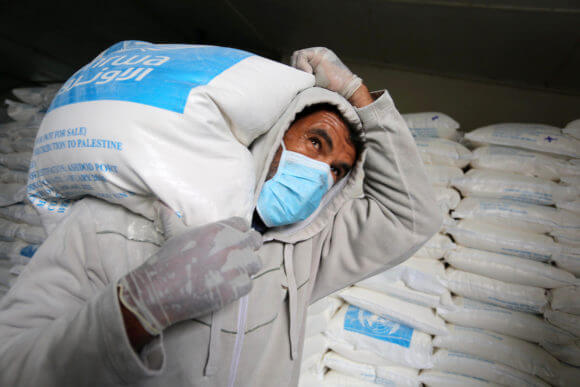
For decades, every attack on UNRWA (United Nations Relief and Works Agency for Palestine refugees) got filed under different headings: another manufactured and imposed crisis, another predicted funding shortfall, constant Israeli restrictions, and consistent American demands for more reforms complete with the usual United Nations (UNRWA’s parent organization) demure and acquiescence.
What’s happened since the Gaza war is a decision, arrived at gradually, and it has already been made in most of the corridors of power that matter. Washington no longer debates how UNRWA should operate. It debates whether it should exist at all — and that debate is now open, sitting in H.R.9680, a bipartisan congressional bill titled “Replace UNRWA with Real Humanitarian Assistance Act,” that instructs the State Department (the same department that had stopped all funding to UNRWA back in 2018) to identify who takes over UNRWA’s work once UNRWA is gone.
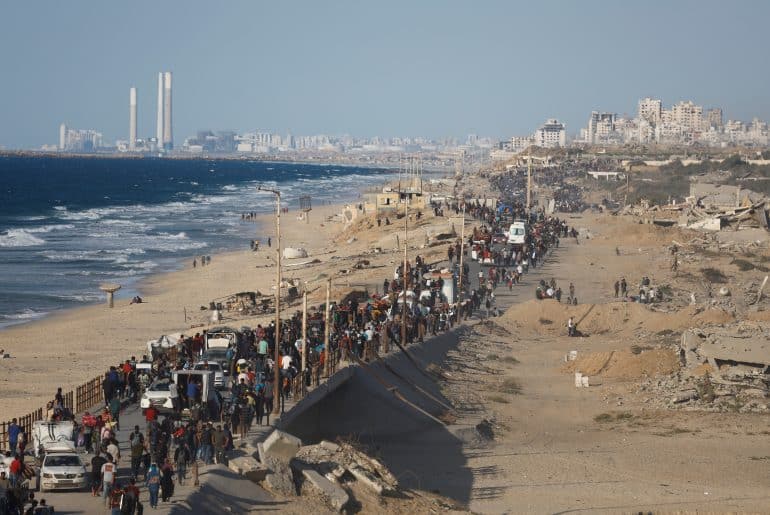
The end game is clear: dismantle UNRWA operations across its five fields of operation. Dismantle the refugee camps in the West Bank and East Jerusalem. Encourage forced exodus for the more than million and a half a million refugees in Gaza, having destroyed almost all of the refugee camps in the Strip. Work toward integration, resettlement or third-country immigration for the Palestine refugees still living in camps in Jordan, Syria and Lebanon.
The bill may never pass. Washington doesn’t need the law to act on the assumption behind it, and the assumption is already settled: a world without this agency is coming, and the planning for that world has begun.
In fact, the campaign against UNRWA in Congress is a campaign to retire the Palestinian refugee question all together.
Israel and its allies understand this quite well. Astoundingly, the Palestinian political and popular entities, including the refugees and their representatives, charged with defending that question, have mostly responded as though the whole grave matter does not involve them.
UNRWA occupies its central place in Israeli policy for reasons that have little to do with the schools, clinics or relief and emergency care it renders. Those services could, in principle, be handed to anyone. The Agency has been targeted because of what it represents. For more than 75 years, it has served as the institutional expression of an unresolved political reality: millions of Palestinians remain refugees because the circumstances that displaced them have never been resolved.
To be clear UNRWA did not create the right of return, and that right, enshrined and codified in international law, does not depend on the Agency’s continued existence. Nor was it created to resolve the refugee question. It was established to assist Palestine refugees pending the implementation of a just political solution. But no other institution has so consistently embodied the international community’s continuing responsibility toward Palestine refugees pending a just resolution of their plight. That political significance is what has made UNRWA the object of sustained unabated efforts to weaken, delegitimize and replace it. Another agency may eventually take over classrooms, clinics and relief programs, but the institutional acknowledgement that the refugee question remains unresolved dies with UNRWA.
The dismantling has moved on three fronts at once, and each reinforces the others. In Gaza, UNRWA absorbed the worst single assault ever directed at a UN agency — hundreds of its staff killed, dozens of its schools and clinics and warehouses reduced to rubble across the Strip — lazily logged by the world as humanitarian loss rather than being treated as an attack on a UN institution. In Jerusalem, Israel seized and demolished the historic compound that had served as UNRWA’s historic headquarters for decades, ending the Agency’s operational presence in the city outright. In the northern West Bank, military operations emptied the camps at Jenin, Tulkarm, and Nur Shams, displacing tens of thousands of refugees a second time. Each of these feeds the bi-partisan bill in Washington: clear the institution physically, discredit it politically, then legislate its succession. One campaign, three fronts.
UNRWA has mostly stopped fighting its own case. Facing an existential political assault, the Agency answered with a humanitarian one: it counted the dead, appealed for money, documented the damage. The leadership, that of the UN and UNRWA, fell far short of what the moment demanded. No sustained legal campaign has pushed for accountability over the killing of UN staff. No serious effort has pursued compensation for the destruction of UN property.
Over time, the Agency increasingly adopted the vocabulary common to contemporary humanitarian organizations — resilience (talk about an abused and overused term that insists on portraying Palestinians as super men and women), food security, cash assistance and timid, dull public information work. The Agency gradually displaced the language that once distinguished UNRWA from every other humanitarian agency: temporary protection mandate pending a just solution, international responsibility, Resolution 194 and, ultimately, return. UNRWA began redefining itself long before Washington and Tel Aviv set out to redefine it — quietly converting a political mandate into a humanitarian one, believing that would make it safer and appease donors and detractors alike. It made the Agency easier to replace.
The fourth party responsible for where this stands is the one most capable of changing course. Who today, from the Palestinian side, owns the UNRWA file? Which Palestinian institution is coordinating the international response? Where is the legal strategy? Where is the parliamentary strategy? Where is the diaspora strategy? Where is the annual plan against the institutional dismantling of UNRWA? The PLO Executive Committee has not answered. Neither has the Department of Refugee Affairs, the Popular Committees, the embassies, or the research centers that hold more expertise on Palestinian displacement than any government agency in Washington. And then you have a string Palestinian diaspora communities that are more educated and more globally embedded than at any point in Palestinian history watching this happen from the outside.
UNRWA’s historic archives raise the stakes further. Those millions of files are the documentary record of an exiled people: villages, generations, property claims, decades of accumulated memory that no successor agency can inherit, because institutional memory doesn’t transfer. Losing UNRWA means losing the one body whose mandate was ever to hold that memory as a political claim. Refugees can still receive aid, from whoever. The institutional insistence that their displacement remains unresolved is what disappears — the acknowledgement that the world owes them more than aid.
History rarely retires political questions through a single dramatic decision. It does so through a succession of administrative measures, legal changes, funding decisions and institutional rearrangements that appear disconnected until, weaved together, they produce a new political reality. That reality is already being written for UNRWA.
Palestinians are not in the room where it’s being drafted. Until that changes, no funding restoration and no diplomatic statement will matter — because the question being settled is not UNRWA’s budget. It is whether the Palestinian refugees will still exist as a political entity or not.
Sami Mshasha
Sami Mshasha is the former Spokesperson and Director of Communication with UNRWA (United Nations Relief and Works Agency) for well over three decades (retired in 2022). He writes on Palestinian refugees, Palestinian politics and the evolving role of the Palestinian American community in U.S. public life.

If you’re Jewish and your last biological ancestor lived in the region 2,000 years ago, Israel is still your ancestral homeland and you have the right of return. But if you’re a Palestinian whose grandparents were forced out of their home in the Nakba 78 years ago, tough luck.
Time for human writers to not sound like LLM-speak. Unfortunately, that is exactly what this article sounds like, at least in part, 2 paragraphs in particular. There is a framing, phrasing, and structure of LLMs, that is observable, and becoming ubiquitous. We owe it to humanity, and ourselves to not use, nor make our own words seem indistinguishable from, LLMs. What is likely to happen, is those who dislike LLM-speak will stop reading. A loss for everyone.
“ Astoundingly, the Palestinian political and popular entities, including the refugees and their representatives, charged with defending that question, have mostly responded as though the whole grave matter does not involve them.”
________________________________________________________
Political problems can be resolved poltically.