

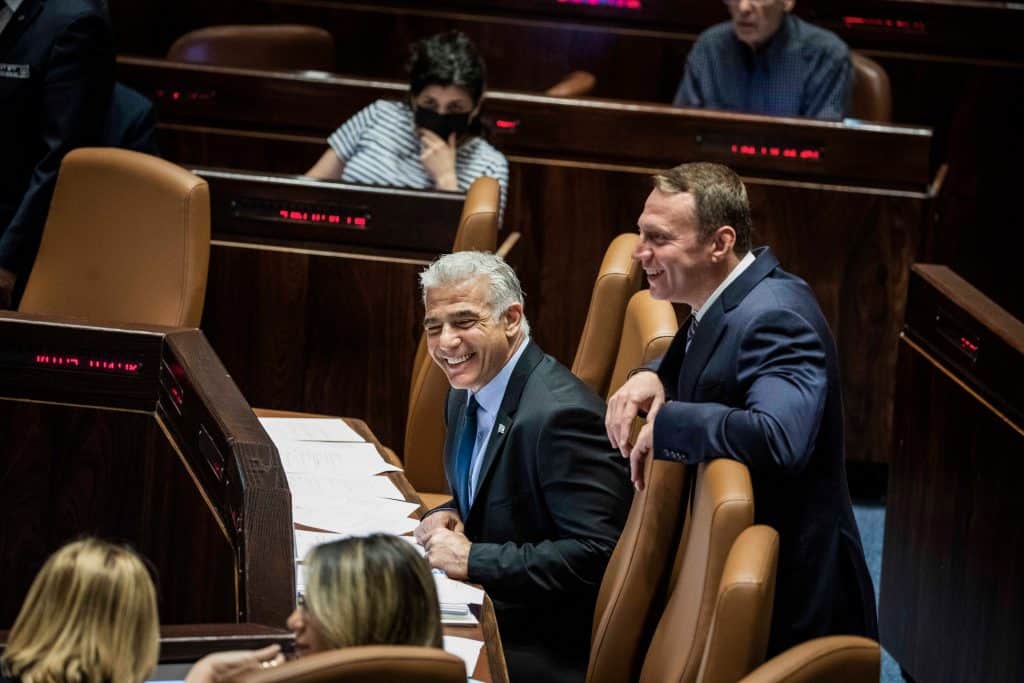
Israel might change its government sooner than expected after the Israeli Knesset voted to dissolve itself last week. The bill presented to the parliamentary body on May 20, which passed with a majority of 110 votes in favor and no opposing votes, could lead to early elections in September rather than November of this year. The vote was held in the absence of Israeli Prime Minister Benjamin Netanyahu and is set to be reconsidered at three more readings before moving toward implementation.
If passed, the current Knesset will expire, along with the government coalition based on its composition and the current cabinet led by Netanyahu. According to Israeli polls, Netanyahu’s main coalition allies, namely hardline ministers Bezalel Smotrich and Itamar Ben-Gvir, have low chances of winning. Although the two main opposition leaders, Naftali Bennet and Yair Lapid, joined forces in a new party, polls indicate that Netanyahu’s Likud Party would still win 56 out of 120 seats in the Knesset. This leaves the Likud as the main political force in Israel, but without enough of a majority to form a government on its own, forcing it to form a coalition with other opposition parties.
The vote came amid renewed controversy surrounding the military drafting of Orthodox Haredi Israelis to military service. Haredi leaders presented the bill after Netanyahu’s government failed to advance another bill to exempt the Haredis from military service.
The vote to dissolve the Knesset also comes amid mounting criticism of Netanyahu over his performance during the war on Iran and the security failure on October 7, 2023.
But what would the dissolution of the Israeli Knesset mean for Palestinians? And what does it say about the current state of Israeli politics that Netanyahu didn’t oppose the vote to move to early elections?
The short answer is: not much, or at least not for the better. Israel’s opposition parties have backed the war on Gaza, the expansion of settlements, and the war on Lebanon just as fervently as Netanyahu’s coalition, and in some cases have criticized him for not going far enough. Any new government will most likely pursue the same fundamental policies toward Palestinians. In the near term, the more pressing concern is what the current government will do to shore up its electoral standing before it leaves office. Precedent suggests that means further escalation.

Right-wing politics
Israeli politics has been dominated by its most extreme right-wing forces for almost two decades, but a common feature shared by past Israeli governments has been the lack of a simple majority by any single political party. In order to make up a majority government, any political party with the most seats in Knesset would have to form a coalition with other, smaller parties, such as Ben-Gvir’s Jewish Power and Smotrich’s Religious Zionism. When such government coalitions have formed, the junior partners have gained outsized leverage by the very fact that their presence keeps the government together.
Yet in all these varying combinations of successive government coalitions, Israeli policy toward Palestinians has remained largely the same.
Settlement expansion and the push toward the annexation of the West Bank have been constants of every right-wing Israeli government, as has the policy of siege and periodic military offensives in Gaza. So, too, has the escalating crackdown on Palestinian prisoners and the deterioration of their conditions, and the repeated attempts to alter the status quo in East Jerusalem and at Al-Aqsa Mosque — arenas where Israeli politicians have long competed to score political points, especially in the run-up to elections.
Netanyahu’s standing was already in decline before October 7, battered by his corruption trials, his attempts to overhaul the Israeli judiciary, and the Haredi draft crisis. After October 7, he faced additional backlash over his handling of the hostage negotiations and, later, over what many Israelis saw as unsatisfactory results from the war on Iran, particularly the way the U.S.-Iran ceasefire was reached without Israeli consultation. But none of this criticism has targeted the substance of Netanyahu’s policies, as reflected in the polls’ projections for the next election.
Both Lapid and Bennett, and most other opposition figures, have supported the war on Gaza, including actions that human rights organizations have characterized as genocidal. The Israeli opposition has also backed the war on Lebanon and the expansion of settlements in the West Bank — and has, in fact, harshly criticized Netanyahu for allowing the U.S. to constraint Israeli action in Lebanon and Iran. Whatever government emerges from the next election will almost certainly be composed of parties that support those same policies, with or without Netanyahu and his closest allies.
That said, the next Israeli government could bring a certain “cooling down” of some of the more aggressive policies, according to Esmat Mansour, a Palestinian journalist and specialist in Israeli politics.
Mansour believes that current regional conditions, including the reorganiztion of the region’s geopolitics in the wake of Iran’s newfound strategic advantage in its war with the U.S., might have an impact on the policy of the coming Israeli government. “The current situation pushes towards reorganizing the region geopolitically, and the ongoing wars that Israel is engaged in have taken a toll on Israel’s political credibility and on its social and military capacity, too,” Mansour told Mondoweiss. “This makes it necessary for any new government to focus on rebuilding and repairing damage.”
“This could lead the next government to ease its stranglehold on the Palestinian Authority financially, or to stop blocking its return to Gaza, and to allow aid and reconstruction materials into the Strip,” Mansour said. “It might also mean a reduction in settler violence against Palestinians in the West Bank, and some improvements to daily life, like allowing West Bank workers back into the Israeli labor market.”
More of the same
But Mansour clarified that “this doesn’t mean that the next Israeli government could be one of peace, but the internal conditions and Israel’s loss of international credibility impose new priorities.” He also stressed that “such a shift depends on Palestinians’ ability to restore their unity, and on the position Arab countries take once the war on Iran is over.”
The trajectory of any incoming Israeli government will also be shaped by the international community’s position and the pressure from global solidarity movements. In the meantime, the current Netanyahu government will do everything it can to improve its electoral prospects before the elections. At the earliest, that could be next September. Most alarmingly, this effort could include resuming the genocide in Gaza, as Israeli officials have repeatedly threatened to do in recent weeks.
As for Lebanon, the Netanyahu government already discussed expanding its war on Lebanon in a security cabinet meeting on Tuesday. Meanwhile, Smotrich has made moves to accelerate the annexation of the West Bank through a rash of legislation and unilateral orders, including the passing of the so-called “Antiquities Bill” that would transfer authority over West Bank antiquities from the Palestinian Authority to Israel, the unprecedented approval of settlement construction, and orders to erase numerous Bedouin communities around Jerusalem. All these drastic measures would stand to shore up popularity for Netanyahu’s right-wing coalition, especially among the younger right-wing voting bloc of Israeli settlers.
In other words, the way in which the Netanyahu government seeks to strengthen its electoral prospects will invariably come at the expense of Palestinians — and the other peoples of the region.
Qassam Muaddi
Qassam Muaddi is the Palestine Staff Writer for Mondoweiss. Follow him on Twitter/X at @QassaMMuaddi.
“Mansour believes that current regional conditions, including the reorganiztion of the region’s geopolitics in the wake of Iran’s newfound strategic advantage in its war with the U.S.”
Re Iran: Danny Citrinowicz** “served 25 years in a variety of command positions units in Israel Defense Intelligence (IDI) including as the head of the Iran branch in the Research and Analysis Division (RAD) in the Israeli defense intelligence” In this 11 minute interview he says the Iran war is a ‘strategic fiasco’ and furthermore, Israel has no strategy in Lebanon; Iran is now run by people who are more hardline than the previous leaders. He has interesting things to say about how Israel is perceived and how the Palestinian issue plays in the current situation.
Iran war is ‘a strategic fiasco,’ says former Israeli intel official | Watch
**
Danny Citrinowicz – Atlantic Council