

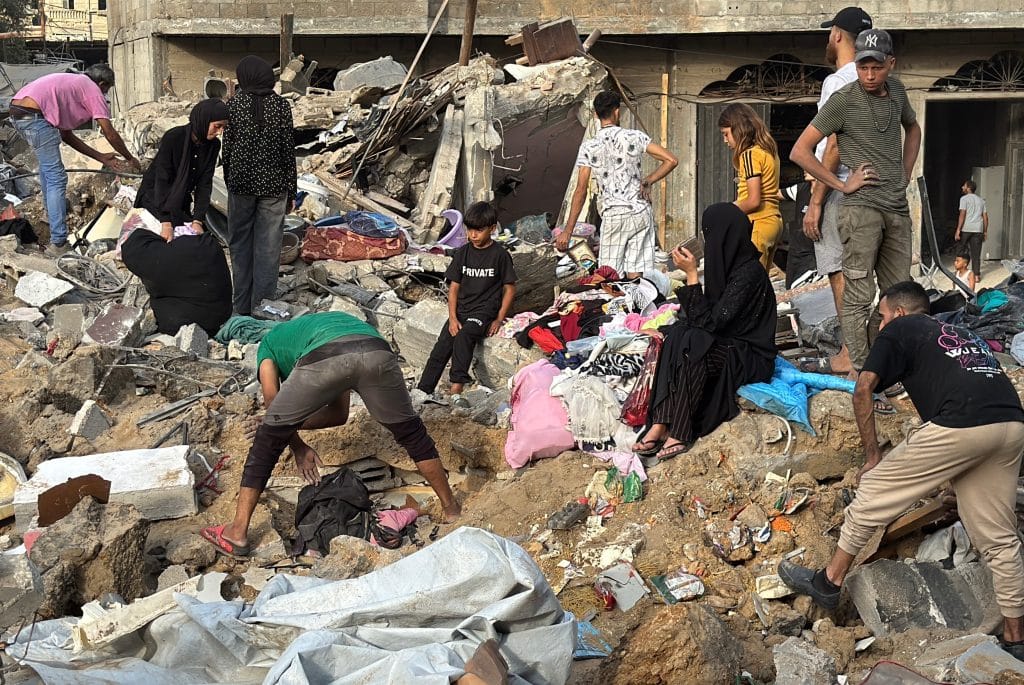
Despite Israel’s alleged ceasefire, news emerging from the Gaza Strip is no different from what it was before the agreement. Not only is the process of de-escalation, relief, and reconstruction stuck, but it is reversed — as if Israel’s genocidal war never stopped, but only lowered in intensity. Palestinians are killed by Israeli strikes in the Strip on a daily basis, while the closure of crossing points and the blockade of supplies continue to be a central part of the humanitarian crisis imposed on 2 million people in Gaza.
All of this raises the question: why is Israel’s war on Gaza continuing? The answer lies in a combination of shifting regional dynamics and the place of Gaza within Israeli politics.
Israel’s genocide in Gaza as a precondition
Since last Saturday, Israeli strikes have killed at least 61 Palestinians in the Gaza Strip. On Tuesday, nine Palestinians were killed, including the entire al-Masri family, made up of both parents and their four children, in the Sabra neighborhood of southern Gaza City. The family was asleep when the strike occurred at dawn, collapsing the apartment building and trapping residents inside. The UN High Commissioner for Human Rights said in a statement that Israeli strikes have killed 57 Palestinians in the Strip in the past week alone.
These daily strikes target the same 128 square kilometers where all 2 million Palestinians in the Strip have been concentrated — less than one third of the Strip’s surface. After the October 2025 ceasefire, Israel withdrew to the so-called “Yellow Line,” an invisible border that cut Gaza roughly in half, but in the following months, the Israeli army began progressively expanding the Yellow Line to bring more and more territory in Gaza under Israeli control, now encompassing close to 70% of the Strip.
Meanwhile, Israel’s closure of crossing points and restricted entry of aid and vital goods to the strip continues to cause shortages of basic supplies. On Tuesday, the Palestinian Health Ministry in Gaza announced that the lives of cancer patients in Gaza were at risk due to the shortage of medicine and other medical supplies.
Meanwhile, Israeli forces are moving to create new realities on the ground, solidifying their control of both Gaza’s territory and population. On Monday, Al Jazeera reported that Israeli forces installed iron gates on the al-Rashid road connecting the north and south of the Gaza Strip, restricting the movement of Palestinians between Gaza City, the central Gaza Strip, and Deir al-Balah. According to other media reports, Israeli forces also installed iron gates between the al-Mawasi area — where most displaced Palestinians are concentrated in tent encampments — and Rafah, which has been completely depopulated. This raises questions about other Israeli projects surrounding Rafah.
Israel and Trump’s “Board of Peace” have announced at various points that they plan to build a “humanitarian city” on Rafah’s ruins. Earlier Israeli permutations of the plan detailed how Palestinians would be “concentrated” in the area as a substitute for reconstruction, and would not be allowed to leave except for “voluntary migration.”
“Israel hasn’t been able to achieve its main goals in Gaza, but it hasn’t given up on them either,” Hani al-Masri, political analyst and director of the Palestinian Center for Strategic Studies, told Mondoweiss. “These goals are the complete occupation of Gaza and the displacement of its people, as part of a larger strategy to avoid Palestinian self-determination.”
For al-Masri, “all of Israel, and not only this Netanyahu government, is in a race against time to create facts on the ground which would be difficult to reverse or even discuss in an eventual political solution.” According to him, this explains the installation of iron gates across the Strip, and the further division of “an already divided territory.” Al-Masri added that since the war with Iran started, “the focus of the U.S. administration, and even the Board of Peace, has moved away from Gaza, which gives Israel a favorable atmosphere to escalate its project in the Strip.”
Netanyahu’s necessity for war
Last week, the Times of Israel reported that the Israeli army declared Gaza’s surroundings a “closed military area,” ahead of announced marches organized by Israeli right-wing groups demanding the resettlement of Israelis in Gaza. According to the outlet, these settler groups are backed by the Likud party, led by Israel’s Prime Minister Netanyahu, who is expected to lose the capacity to form a government in the Knesset elections next October.
The continuation of Israel’s war in Gaza, including the displacement of the population and the occupation of territory, is one of the most significant cards Netanyahu and his coalition hold in the upcoming election, given that the aim of ethnically cleansing the Strip is supported by 82% of Jewish Israelis, according to a May 2025 poll. The failure of the U.S.-Israeli war on Iran and the need to compensate for it with a local win also provides Netanyahu with a further incentive to escalate in Gaza.
Adel Shadid, former professor of political science at Hebron University and researcher on Israeli politics, points out that “Netanyahu and his Likud party need to maintain the atmosphere of war, to push away the eventual facing of internal accountability, both for the failure on October 7, and for the results of two and a half years of regional war.”
“The strategy of the current Israeli government is clear, and it is above all concerned with the political survival of the Likud and its political line, as well as that of Netanyahu,” Shadid emphasized, clarifying that “this doesn’t mean that if another leadership is elected in October, things will go back to being as they were before, because no Israeli government will reverse what the current one has done.”
However, Shadid expects that a different government could focus on repairing the damage done to Israel’s economy, social resilience, and international standing after close to three years of war, believing that another government might at least de-escalate certain war fronts across the wider region. But Gaza, he notes, will remain a front of escalation regardless of who is in power in Israel.
The Gaza exception
On the regional front, Adel Shadid considers that the U.S. has suffered a significant setback in its forces. “The fact that U.S. military bases across the region are targets in a regional war with Iran, which doesn’t seem to have an end without some sort of understanding with Iran, indicates that the U.S. projection of force in the Middle East isn’t the same as it used to be,” he said.
“This increases Israel’s need to advance whatever gains it can achieve in Palestine,” Shadid explained. “That need presents itself above all in Gaza.” According to Shadid, this “victory” is the displacement and definitive occupation of the Strip.
Shadid also notes that Israel’s victory in Gaza is meant to represent a counter-balance to Iran’s influence in the region. “It is possible that Israel, through advancing the erasure of Gaza, tries to eclipse any Iranian success in the region, but that is not necessarily a primary concern for Iran,” he said.
“Gaza is not, at this moment, a main field of confrontation for the Iranians, which means that Iran seems to be ready to secure an agreement with the U.S. without including Gaza, as it did with Lebanon,” Shadid added, stressing that, unlike Lebanon, Gaza has more strategic value for certain Arab countries like Egypt than for Iran, even though Arab countries aren’t capable, at the moment, of stopping the Israeli offensive on the Strip.
The result is that Gaza remains one of Israel’s only available arenas to continuously escalate without any significant international repercussions. And since any government that comes into power in Israel will have to face the same constraints on Israeli action, it will be pushed to claim a “victory image” by continuing the displacement of the people of Gaza, a wildly popular objective in Israel.
In other words, Israel’s war on the Palestinian people in Gaza remains a political necessity for any Israeli government in power. And Netanyahu will seek to outdo his competitors by offering up Gaza to his supporters ahead of the Knesset elections.
Qassam Muaddi
Qassam Muaddi is the Palestine Staff Writer for Mondoweiss. Follow him on Twitter/X at @QassaMMuaddi.

Re the use of the word ‘genocide’ for Gaza:
For the second time the New York Times has run an editorial by Omer Bartov, who accused Israel of committing genocide. He argues that we may be entering a new era of impunity for those who commit this crime:
“What we have seen unfold in Gaza, where Israel stands accused in the International Court of Justice of committing genocide in the aftermath of the Oct. 7 Hamas attacks, appears to portend a new future for the crime…..It is a future in which other nations or leaders may have an incentive to pursue genocidal policies knowing they will not only get away with murder but may even benefit from it….The Israeli political and military leadership conducted an operation in Gaza that killed at least 70,000 people (as admitted now by the Israeli military), most of them civilians; wounded close to 200,000; and caused vast numbers to die indirectly because of the utter destruction of medical facilities, housing and infrastructure, as well as the deprivation of food and clean water. As I wrote in July 2025, as a scholar of genocide, I believe this was a concerted attempt to destroy the Palestinians in Gaza, in whole or in part, and that the operation therefore reached the high bar of the 1948 Genocide Convention’s definition of this crime….Israel is unlikely to face a reckoning for its actions. “
Opinion | The Grim Lessons of Israel’s War in Gaza – The New York Times
I’m not sure. Are we having this war because Judaism demands it, or because the eventual attainment of “Greater Israel” will make the entire world afraid of us? I find it hard to believe all the ‘apocalypse as a prelude to the Second Coming’ the Evangelists proclaim, but as I said my religious education hadn’t reached the war crimes and genocide portions of the commandments.
Darn it, I knew I should ‘a kept going after my Bar Mitzvah.