

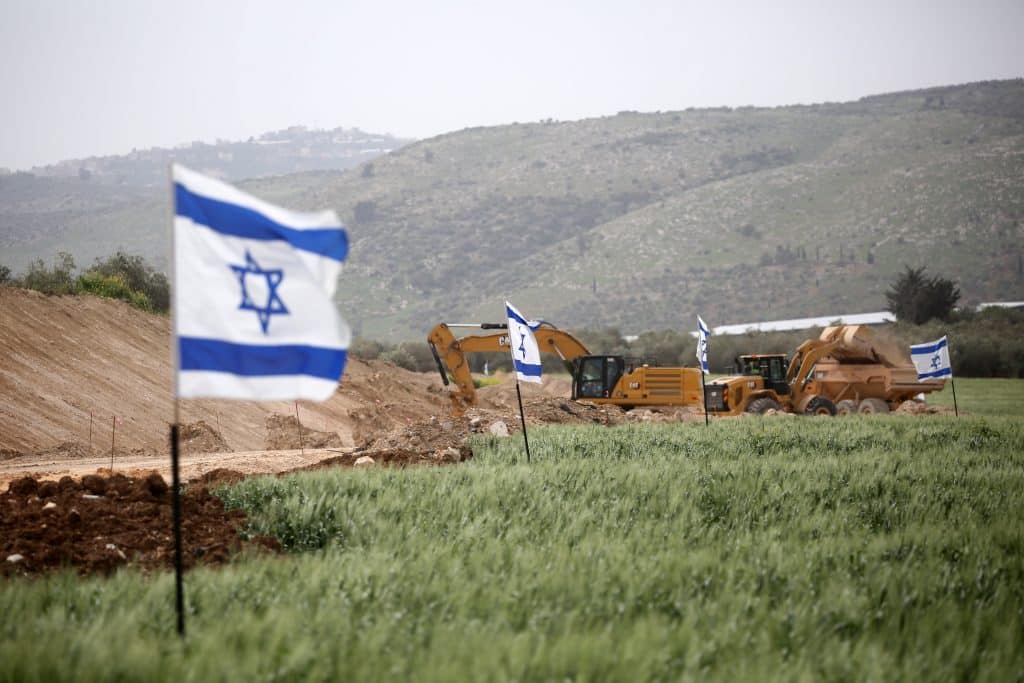
The Israeli cabinet approved the construction of 34 new West Bank settlements last week, bringing the total number approved by the ruling coalition led by Israeli Prime Minister Benjamin Netanyahu up to 103. The cabinet decision is the largest batch of new settlements approved in decades, breaking the record set by a previous landmark decision in June 2025, which approved 22 new settlements.
While the latest decision has been overshadowed by the regional conflagrations related to the U.S.-Israeli war on Iran, its timing indicates that Israel perceives a closing window for its ability to entrench its colonial project in its own backyard — the West Bank — in light of shifting realities that might see Iran emerging from the war intact and in a strengthened position regionally.
These developments come as Israel has reportedly been “coerced” to halt its onslaught against Lebanon by U.S. President Donald Trump, forcing it to accept a ceasefire with Hezbollah. Meanwhile, the very fact that the U.S. agreed to a temporary ceasefire with Iran was condemned by the entirety of the Israeli political establishment, both from within Netanyahu’s camp and from the Israeli opposition, who lambasted Netanyahu’s “failure” to overthrow the Iranian government.
While Israel will attempt to use the ceasefire in Lebanon to force the hand of the Lebanese government to accept the ongoing occupation of the southern part of the country, little military progress has been made against Hezbollah, which has reportedly rebuilt its military capabilities since it was bloodied by Israel in October 2024. Iran has also continued to show strength in the region through exerting control over the Straits of Hormuz, and has been described by analysts as an emerging “major world power.”
This is the crucial backdrop to Israel’s moves in the West Bank. It seeks to further cement its de facto annexation of the territory in a race against time to entrench its colonial project in the only geographic region where it can proceed with comparatively minimal resistance.
The closing window
The impatience of the Israeli decision is not only suggested by the magnitude and speed of the cabinet approval, but also by the fact that Israel is in an election year, with polls indicating that Netanyahu and his hardline allies, Finance Minister Bezalel Smotrich and National Security Minister Itamar Ben-Gvir, show a low chance of winning.
For Netanyahu, this is personal. The Israeli Prime Minister remains the face of Israel’s attempts to overthrow the Islamic Republic of Iran and its allies in the region, claiming that he is “changing the face of the Middle East” — an achievement he hopes would compensate for the security failure on October 7, 2023. The ceasefire with Iran, and now with Lebanon, signals a turn for the worse, giving rise to the need for a “victory” elsewhere.
For Israel as a whole, this is about rebuilding and reinforcing its own image of force and creating as many facts on the ground as possible during the Trump administration’s remaining years.
Although the cabinet decision is a continuation of Israel’s ongoing annexation plan, “this is an indication that Israel believes its annexation of the West Bank has not been achieved,” according to Jamal Jumaa, the coordinator of the Palestinian grassroots Stop the Wall campaign.
“Israel fears that it won’t be able to achieve what it wants in the future,” Jumaa told Mondoweiss, noting that a sweeping Democratic Party victory in the upcoming U.S. midterm elections might limit the Trump administration’s ability to continue launching indefinite wars in the region. “The next administration might not be as compliant with Israeli wishes,” he added.
This is made clearer by the nature of the settlement approval, which would drastically reduce the PA’s already limited jurisdiction. Jumaa emphasizes that eight out of the 34 settlements, which are spread across the West Bank from north to south, fall under Area B, which makes up the 22% of the West Bank that falls under joint Israeli-PA administration per the 1993 Oslo Accords. Only 18% of the West Bank, known as Area A, falls under exclusive PA control, and the remaining 61% of the territory, Area C, falls entirely under Israeli control.
Building eight settlements on Area B would “push Palestinians further into isolation, trapping them inside the main urban areas,” Jumaa explained. He believes that the aggressive nature of Israel’s settlement expansion is unprecedented, which suggests that the move is not being pursued due to internal politics alone.
“Taking such a drastic leap might not be as easy once the war in the region stops,” he said. “World attention would shift back to the unfinished Gaza ceasefire and the West Bank.”
Already, Spain and Italy have suspended military contracts with Israel over its war on Lebanon, Jumaa pointed out, expecting that “more countries will take similar stands in the future.”
Yet this doesn’t mean that the Palestinian territories will be included in any regional understanding after the war. In fact, according to Jumaa, the opposite motivates Israel’s leaps in the West Bank. “Israel is refusing to include Lebanon in the Iran ceasefire, so it is only logical to assume that the West Bank and Gaza will remain out of any regional talks, especially with the current weakness and division of the Palestinian leadership,” Jumaa said. “This is precisely why the issue of the West Bank and Gaza will remain open once the war in the region stops, and Israel will face pressure over it.” Once it does, Jumaa added, Israel wants to have already achieved a de fact situation of annexation, “before the Palestine question is bumped back to the top of the world’s political agenda, and under a different set of regional and international circumstances.”
Meanwhile, Palestinians in the West Bank continue to face closures, movement restrictions, daily raids by the Israeli army, and rising violence by Israeli settler groups. Last week, armed Israeli settlers killed a 23-year-old Palestinian man at the entrance of his hometown of Deir Jarir, east of Ramallah. On Thursday, Israeli forces killed another 28-year-old during a raid in Tubas in the northern West Bank. At least 1,000 Palestinians have been killed by Israeli forces or settlers in the West Bank since October 2023.

Re more settlements: Ami Ayalon says:
‘If we don’t divide the land we’re heading to apartheid’: Ex-head of Israel’s Shin Bet
‘If we don’t divide the land we’re heading to apartheid’: Ex-head of Israel’s Shin Bet – Tête à tête – France 24
Chatham House, ” an independent policy institute and a trusted forum for debate and dialogue. We aim to help governments and societies to build a secure, sustainable, prosperous and just world.”, says
While the world has been distracted by the US-Israeli war on Iran and its fallout, the Israeli government has accelerated the de facto annexation of the occupied West Bank. If this unilateral imposition of facts on the ground is not immediately addressed, it will become even more difficult to tackle the underlying causes of the Arab-Israeli conflict and could lead to dangerous scenarios for Israel, the Palestinians and the region….Annexation measures continue to shrink the space for Palestinian independence, undermine Palestinian agency and push the Palestinian Authority (PA) to political and financial collapse.
Israel’s accelerating de facto annexation of the West Bank has dangerous implications | Chatham House – International Affairs Think Tank
In a certain sense, these comments are ludicrous because Israel has achieved full apartheid status years ago, but let’s pretend it’s still possible to reverse the process.
Chuck Schumer … Hear it from the horse’s mouth:
“There’s no peace in the Middle East bc Palestinians refuse to believe in the Torah. The Torah says it’s our [Jews] land. And that’s why America must always stand with Israel.”
Wow. He just came right out and said it.
https://x.com/villgecrazylady/status/2045565144470618166
Apr 18, 2026
·
4.7M
Views
” Jumaa emphasizes that eight out of the 34 settlements, which are spread across the West Bank from north to south, fall under Area B, which makes up the 22% of the West Bank that falls under joint Israeli-PA administration per the 1993 Oslo Accords. Only 18% of the West Bank, known as Area A, falls under exclusive PA control, and the remaining 61% of the territory, Area C, falls entirely under Israeli control.
Building eight settlements on Area B would “push Palestinians further into isolation, trapping them inside the main urban areas,” Jumaa explained. He believes that the aggressive nature of Israel’s settlement expansion is unprecedented, which suggests that the move is not being pursued due to internal politics alone.”
Read the “Oslo Accords” years ago. Going to read again. Have always been amazed (well not really) at how often the Clinton’s and so many others promoted the Oslo Accords as such a great deal for the Palestinians? Endless promotion that they were a great deal.
How could any deal where internationally recognized land allegedly belonging to the Palestinians is divided up into “Area’s A, B,C. Did any part of what has been recognized as Israel by some in the international community get divided into “Area’s A, B,C?”
Qassam “Meanwhile, Palestinians in the West Bank continue to face closures, movement restrictions, daily raids by the Israeli army, and rising violence by Israeli settler groups. Last week, armed Israeli settlers killed a 23-year-old Palestinian man at the entrance of his hometown of Deir Jarir, east of Ramallah. On Thursday, Israeli forces killed another 28-year-old during a raid in Tubas in the northern West Bank. At least 1,000 Palestinians have been killed by Israeli forces or settlers in the West Bank
since October 2023.”
We know the public will not be hearing anything reported about what is taking place in the West Bank, Gaza etc on MS Now’s Rachel Maddow, Nicole Wallace and almost all of the other host on MS. Now. Only possibility is out of Ali Velshi. Even Ayman Moyheldin has been almost totally silenced. He seems to be walking on eggshells about the issues he used to report about regularly on his own show. Rebecca Kutler must be in the shadows with an ax and hanging it over Ayman.
A bit off this topic, the well known anti-semitic Israel hating PBS Newshour did a segment on Lebanon Friday: It’s worth watching but at around 3:15 we have this:
After weeks of fighting, ceasefire sparks cautious celebration in Lebanon | PBS News
…the ceasefire before this one, agreed in 2024, failed to end the war. israel violated the agreement on a near daily basis, bombing villages in the south even as Hezbollah held its fire.
Cont: Nothing on CNN, Cspan’s Washington Journal has also been shut down about reporting anything about West Bank, Gaza. Still callers on Washington Journal are bringing up violence Israel has and continues to commit.