

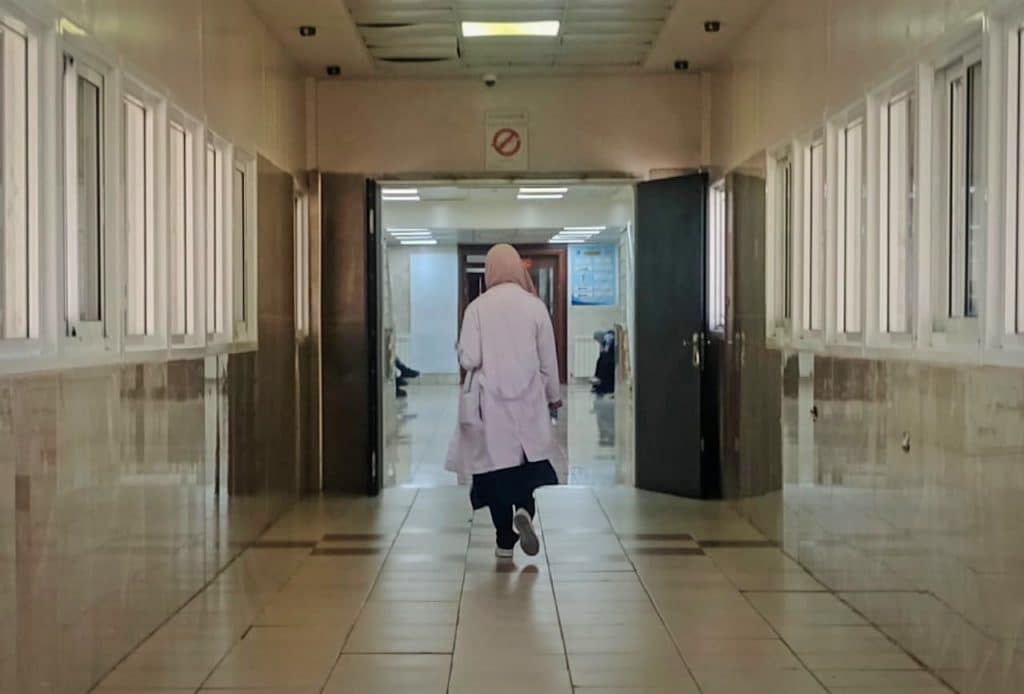
The emergency section of the Palestine Medical Complex in Ramallah seems too calm for the city’s largest public hospital. Fewer than ten people sit in the waiting hall, the floor tiles still shining clean as an employee mops the floor every five minutes. Inside the emergency hall, four nurses stand behind the central counter, while behind closed curtains, patients lie on beds, some waiting to be transferred to a specialized section or to be seen by the ER nurses. Three of the beds are empty.
Abeer, a woman in her forties, comes from behind one of the curtains and exits to the waiting area, where she sits. “My mother-in-law is inside, and they took some blood samples for a test,” she said. “We have to wait for the results and then go see a private doctor, because there aren’t any doctors here.”
For six months, Palestinian public doctors have been on strike, demanding that their salaries be paid in full in light of the Palestinian Authority’s (PA) budget cuts due to Israel’s continued piracy of Palestinian customs money, which it normally collects on the PA’s behalf as per the 1993 Oslo Accords. While the PA’s financial woes have cycled on and off for the past five years, Israel has been indefinitely withholding Palestinian customs money since October 2023, turning economic hardship into a full-blown crisis. As a result, the PA has been paying incomplete salaries to all public employees while simultaneously reducing service hours across several sectors, especially in healthcare.
Last week, the doctors’ union accused the PA government of reneging on several understandings it had reached with the union, and vowed that doctors would accept no less than “full salaries for full working hours.” In an interview with the local Raya FM radio station, the head of the doctors’ union said that the union was “not engaging in any communication with the government,” adding that the union had told PA Prime Minister Muhammad Mustafa that “medical service to patients cannot be reduced,” and that “doctors are ready to return to full service hours if their salaries are fully paid.”
Beyond the doctors, the nurses’ union also announced plans for protests against the ongoing crisis. In early May, the head of the nurses’ union told Raya FM that public sector nurses would begin reducing their service hours after “long months of salaries not being fully paid.” The PA had already reduced service hours for nurses since 2023, when Israel imposed strict movement restrictions on Palestinians across the West Bank. Since then, Palestinian public hospitals have been operating at only partial capacity, while Palestinian patients have been forced to turn to private hospitals for healthcare.
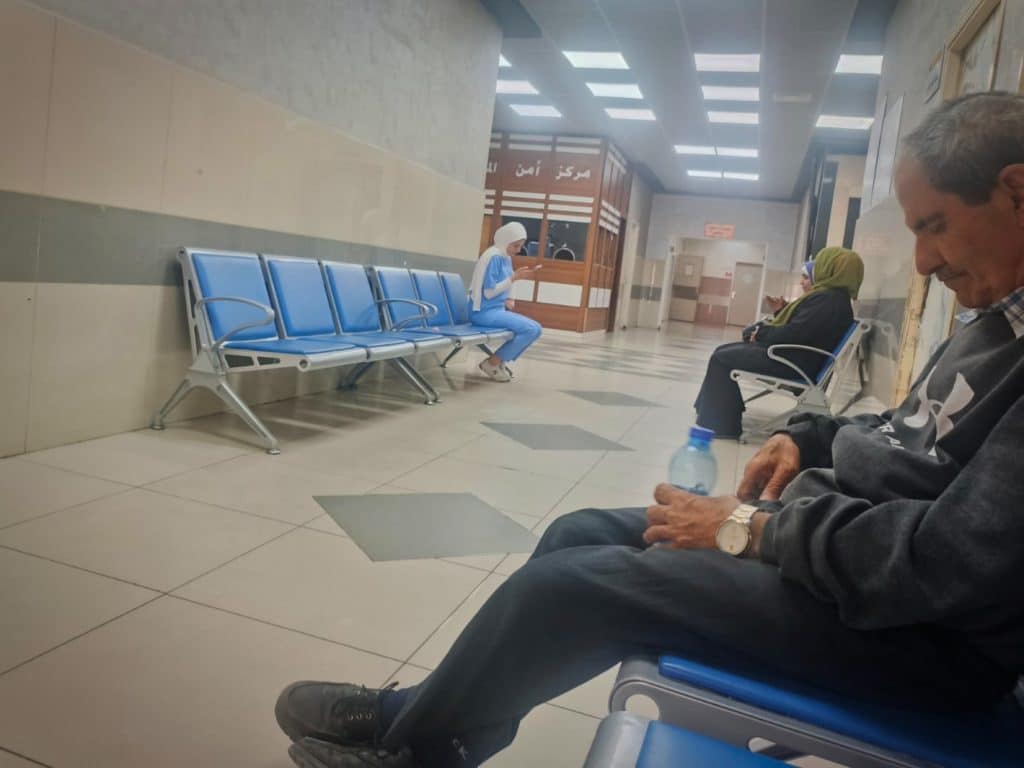
Inside the emergency room
At the Palestine Medical Complex, Abeer is joined by her husband, Jeries, who is also waiting for his mother’s test results. “The laboratory is right here, one corridor away, but it’s closed due to the strike,” he said. “We don’t know where the other laboratory is, or whether we have to wait or go look for the results ourselves, because nobody explained anything to us,” he said.
Later in the day, outside the hospital, Ayah (not her real name), a nurse in her early thirties, arrives at a coffee shop after a long day of work at the Palestinian Red Crescent Society (PRCS) hospital. Visibly tired, Ayah sighs as she speaks. “The crisis in public hospitals is just putting an extra load on private hospitals, and nobody knows how to manage it,” she said. Over the past year, Ayah had worked at the government’s Palestine Medical Complex until the beginning of the doctors’ strike, then at one of Ramallah’s prestigious private hospitals, before moving recently to the non-profit PRCS. She has witnessed the crisis unfold across all three branches of the health sector and lived through its implications as a nurse.
“Patients who come from public sector hospitals due to the strike expect private hospitals to be like public ones,” Ayah said. “They are mostly ordinary people who expect to be fully examined for a simple fever, and can’t afford the treatment they need.”
Ayah explained that many people come to private or non-profit hospitals only after exhausting all hope of being seen by a doctor at a government facility — and even then, only after their condition has already deteriorated.
“Yesterday, a 23-year-old man came to the PRCS hospital with a torn hand tendon after waiting to be seen by a doctor at the public hospital, and he ended up paying 600 shekels for his treatment,” Ayah said. “If he had come directly to the PRCS, his condition wouldn’t have deteriorated, and he would have only paid 90 shekels.”
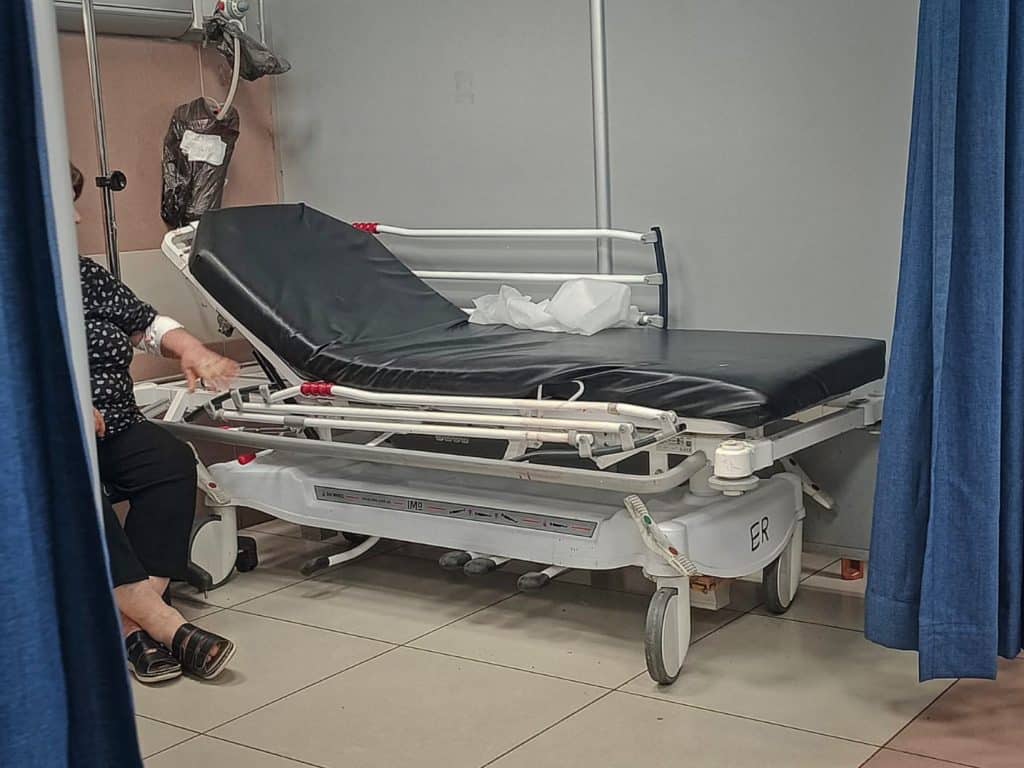
Back at the Palestine Medical Complex, Abeer and Jeries continue to wait for their mother’s test results. Inside the emergency hall, the mother, Fadia, sits on the edge of the bed and explains how the doctors’ strike and the broader health sector crisis have affected her.
“I come from the village of Aboud, just half an hour from Ramallah, where there’s a public health center. They had a laboratory that was open every day, and I used to have my tests done there,” Fadia said. “Since last year, the laboratory staff in Aboud’s health center has come only once every two or three weeks, and I’ve had to come here to do my medical tests.”
“I used to buy all my medicines with public health insurance, paying exactly five shekels for any medicine, but since last year, many of these medicines are no longer covered by the public insurance,” Fadia said. “Now I have to buy my blood pressure medicines myself, and some cost up to 60 shekels.”
Fadia had three doctor’s appointments scheduled over the past two months, and all were canceled. “I continue taking my medicines as usual, hoping the crisis will be resolved by my next appointment,” she said.
But the crisis doesn’t seem to be going away anytime soon. In late April, hardline Israeli Finance Minister Bezalel Smotrich announced that the April batch of customs money belonging to the PA would also be withheld — estimated at around NIS 740 million ($246 million). Smotrich, who in September of last year pledged on X to bring about the PA’s collapse through economic strangulation, is the public face of an Israeli policy embraced by the entire Israeli establishment. This policy has also been affecting even the private sector of health services in Palestine.
“When I was working at a private hospital here in Ramallah, many nurses like me were being paid only 70% or 80% of our salaries due to the public hospital crisis,” Ayah said. “The private hospital I worked at depended on cases transferred to it from public hospitals covered by the health ministry, and when the ministry went into crisis, private hospitals did, too.”
Earlier in May, the director of the non-profit al-Najah University Hospital in Nablus told Al Jazeera that the PA’s health ministry owes $255 million to al-Najah alone, and that the hospital depends on the health ministry’s transfers for 80% to 90% of its budget.
What’s worse, Ayah said, is that once salaries started getting slashed, the workload on nurses in private hospitals increased, too. “But even with all the challenges of incomplete salaries in private hospitals, it’s nothing like in public ones,” she said with a smirk, mentioning that one of her colleagues at the Palestine Medical Complex walks to work for an hour every day, leaving home at 5:30 a.m. to arrive at the hospital by 6:30 a.m. “He’d rather save five shekels to buy bread for his family than spend them on public transportation,” she explained.
Ayah noted that nurses in public hospitals had their service hours reduced from October 2023 onward due to the movement restrictions imposed by Israeli forces. And with the reduction of hours came a reduction in salaries — but the PA’s financial crisis had already been raging for three years, leading many to interpret the reduced service hours as a way to cope with the financial strain.
“Nurses in public hospitals have been understaffed, but doctors, too, came under incredible pressure,” Ayah said. “Some doctors had to work up to three consecutive 24-hour shifts, barely sleeping, while nursing staff became increasingly dependent on interns,” she said.
Back at the Palestine Medical Complex, Fadia continues to wait on her emergency bed while a young female nurse takes her blood pressure. “How old are you, my child?” Fadia asks gently, with a soft smile. “I’m 23, Auntie, I’m still an intern,” the nurse replies. I ask her how many of the nurses on shift are interns like her. “Anyone with this tag on their uniform is an intern,” she says, pointing to a shiny name tag on her chest.
I peek out from behind the curtain into the emergency hall; everyone in a uniform, except for the four nurses at the central counter, has the same tag. There are ten to fifteen of them, all in their twenties. “Most of us here are interns, and the same goes for the specialized sections upstairs,” the young nurse says.
Abeer and Jeries enter the emergency section to check on Fadia and ask about the blood test results. “Are you still waiting for the results?” the young nurse exclaims. “You should go to the laboratory in the cardiac section to look for them yourselves,” she tells the couple.
I walk with Jeries to the second floor of the hospital, then through a long bridge corridor connecting two buildings, then across another waiting hall, and finally into the cardiac section’s corridor, where the laboratory is open. Three staff members are present, busy with their work. One of them looks up Fadia’s name on a screen. I ask what the difference is between them and the closed laboratory in the emergency section. “We are the same hospital laboratory, but we’re operating at half capacity to maintain the strike without leaving the hospital without a laboratory,” he replies.
Jeries takes his mother’s results and heads back to the emergency section. The results are good, and the family can return home to Aboud. As they gather their things and prepare to leave, an elderly man approaches the central counter and addresses the head nurse: “Have my wife’s blood results come back yet? And will any doctor see her today?” Meanwhile, the cleaning employee passes by again, mopping the shining tiles once more.
Qassam Muaddi
Qassam Muaddi is the Palestine Staff Writer for Mondoweiss. He covers social, political, and cultural developments in Palestine, and has written for several outlets in English and French, including the Catholic Terre Sainte Magazine and other outlets. Follow him on Twitter/X at @QassaMMuaddi.
“… Israel has been indefinitely withholding Palestinian customs money since October 2023, turning economic hardship into a full-blown crisis.”
Wait a minute, you mean Israel completely controls the Palestinian economy in the West Bank and Gaza, but the Palestinians don’t get a vote in the Knesset? Not only does Israel control the purse strings, but nothing in the West Bank or Gaza can be exported or imported without Israel’s consent?
Is there a name for this type of arrangement?
Israel is engineering the collapse of the West Bank’s governing body—a key step on the way to full annexation.
The Palestinian Authority Is Being Strangled to Death | The Nation
It’s been 20 years since Mondoweiss was founded. It doesn’t bother me that there have been dozens of articles about the recommendation concerning the part of the resolution regarding the plan of partition. But inquiring minds still want to know why there have never been any articles about Israel’s Minority, Religious, and Linguistic treaty obligations and its irrevocable acceptance of ICJ jurisdiction to resolve any dispute through a binding decision. You really should correct that oversight as part of our efforts to avoid an unholy Armageddon. As usual, YMMV.
‘Implementing Our Sovereignty’ Israel Police Seek Far-right, Religious Jewish Cops for Jerusalem’s Al-Aqsa Compound:
Israel Police are recruiting Temple Mount activists to police the Middle East’s most sensitive religious site as its delicate status quo erodes under pressure from Minister Itamar Ben-Gvir. Rabbis are encouraging their students to be a ‘Jewish presence’ among police officers. — Haaretz
When will the General Assembly request an Advisory Opinion from the ICJ about the legal consequences of the damned compromissory clause pertaining to Chapters 1,2, and 4 of the UN legal instrument contained in Part C, Declaration of the UN Plan for the Future Government of Palestine? Israel submitted a corresponding acknowledgement of acceptance in its own Declaration of the Establishment of the State of Israel which terminated the British Mandate regime during hearings on its UN membership.
That customary two-part legal instrument implemented in the PCIJ era was required to terminate the British Mandate, It has never been revocable or become optional. Israel’s acceptance was required and noted in the text of UN General Assembly resolution 273 (III) and the procès-verbaux minutes of the membership hearings listed in the footnotes. The Secretary General report in 1950 on Minority Rights Legal Instruments discussed the problem of enforcement of LoN treaties, because its Council was defunct, and composed of opposing enemy states. But the UN legal instrument was discussed in a separate chapter, precisely because the UN is not defunct or unable to decide contentious legal disputes. Dapo Akande has explained that many treaty instruments with enforceable compromissory clauses are simply not cataloged by the ICJ, but are nonetheless still valid. If there is some part of this you don’t understand, contact me.
Everyday I pray for the Palestinian people and many others who are suffering so terribly. I pray and push our Reps, ICC, ICJ UN General Assembly holds the maniacal, barbaric Israeli government accountable for their war crimes, crimes against humanity.
Colonel Macgregor explains clearly the hold Israel has on the U.S.
Listen up!
https://www.youtube.com/watch?v=GjgYdurDEmA
This is also part of Israel’s genocide.
This is a very interesting Interview with Eyal Weizman, the Director of Forensic Archictecture.
He explains not only that what Israel is doing to the Gaza landscape shows an intent to genoicde, but also who the same methods have been implemented since 1948.
How Israel is engineering genocide and ethnic-cleansing in Gaza | Eyal Weizman
“I was raped by an Israeli soldier” Gaza Flotilla Survivor Breaks Silence”
Double Down News
235,252 views May 30, 2026
00:00: Intro 01:11: Terrifying Flotilla Account Israel Desperately Wants to Hide
https://www.youtube.com/watch?v=Xq6V8p55V80