

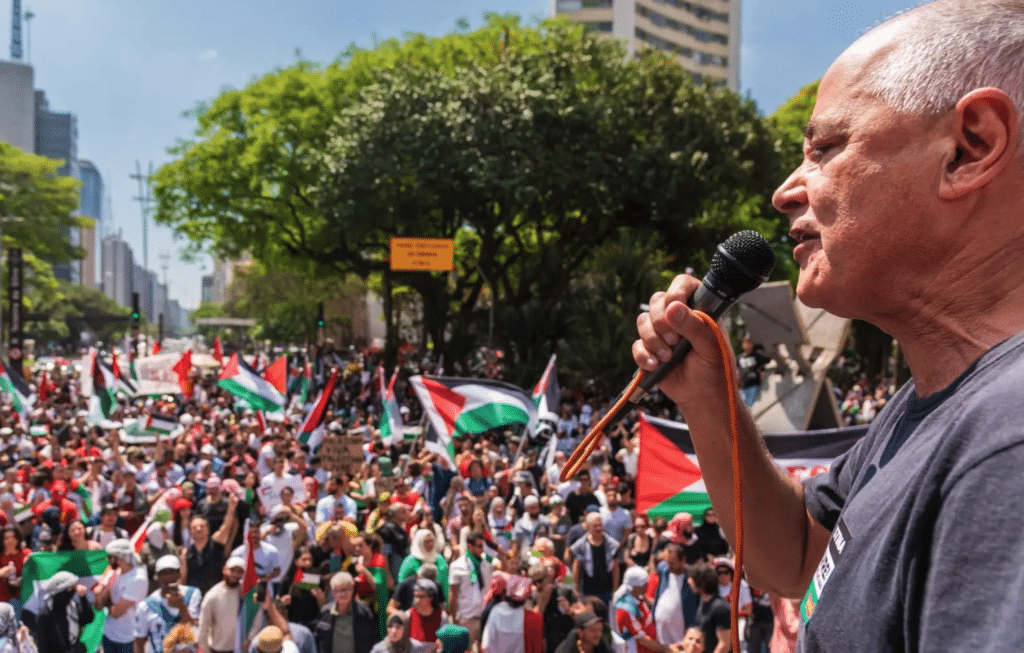
On April 28, 2026, a federal judge in São Paulo sentenced José Maria de Almeida—known as Zé Maria—to two years in open prison. His offense was a speech. The 69-year-old metalworker and lifelong union activist had denounced Israel’s genocide in Gaza and used the slogan “Free Palestine, from the river to the sea.” The lawsuit was filed by CONIB, the Israeli Confederation of Brazil.
Zé Maria is no stranger to prison or persecution. He was arrested in 1977 for handing out May Day leaflets under Brazil’s military dictatorship. He was detained alongside Lula during the historic ABC region strikes of 1980. He is a founder of the Workers’ Party (PT) and a leader on the national board of CUT, Brazil’s largest union federation. Later expelled from the PT for refusing to align with business interests, he helped build CSP-Conlutas, an independent federation representing over 2 million workers. Now, at 69, he faces prison for a slogan.
As he wrote in Folha de S. Paulo: “Saying that the State of Israel must end has nothing to do with preaching against the Jewish people—it’s the same as saying that the apartheid State of South Africa had to end. Accusing those who protest against this atrocity of being racist is the desperate resort left to Zionism.”
Zé Maria is not Brazil’s only target. In October 2024, journalist Breno Altman, founder of Opera Mundi, was convicted of racism and ordered to pay R$20,000 and remove five social media posts. The case was also brought by CONIB. Notably, Altman is Jewish—undermining the claim that opposition to Zionism is inherently antisemitic.
While Altman was fined, Zé Maria was sentenced to two years in an open prison—a significant escalation. The message is clear: the penalties are rising.
Similar cases have been seen in Argentina as well, and many countries in the region have adopted a controversial framework that conflates anti-Zionism with racism: the IHRA definition of antisemitism which is being used to press these cases. However, what is unfolding across Latin America is not a series of isolated legal cases. It is a coordinated offensive to criminalize solidarity with Palestine, using the IHRA definition as the legal backbone. The targets are specific: union leaders, left-wing politicians, journalists — the same actors who have historically been the backbone of Latin American social movements.
A legal weapon: The IHRA in Latin America
Zé Maria’s conviction is based on twisting the existing anti-racist Law 7.716//89, which criminalizes hate speech and acts of racism. It is one sign of the IHRA definition of antisemitism’s growing influence in Brazil. Adopted by the International Holocaust Remembrance Alliance in 2016, this definition has since been promoted globally by pro-Israel lobbies and since 2020, at least six Latin American countries have joined the International Holocaust Remembrance Alliance: Argentina, Guatemala, Costa Rica, Colombia, Panama, and Uruguay (as an observer member) under U.S. pressure. Brazil’s federal government withdrew in July 2025, but 12 of 27 states have incorporated it locally into law. Now, Brazil’s Bill 1424/2026 is attempting to codify it into federal law.
Colombia represents an interesting paradox. President Gustavo Petro, who broke diplomatic relations with Israel and called Netanyahu’s government “genocidal,” governs a country that has adopted the IHRA definition—likely under the previous conservative administration. The legal architecture is in place, even if the political will to use it remains unclear. Colombia’s large Palestinian diaspora community remains on alert.
Argentina was the first Latin American country to adopt the IHRA definition in 2020, following years of pressure from the DAIA (Delegation of Argentine Jewish Associations). Since then, the Zionist organization has filed numerous legal complaints against pro-Palestinian activists.
The first major case involved Alejandro Bodart, a left-wing politician from the FIT-U (Workers’ Left Front). In December 2024, Bodart was convicted of violating anti-discrimination law for tweets calling Israel “racist and genocidal” and using the slogan “from the river to the sea.” He received a six-month suspended sentence. In a public statement, he said: “This permanent anti-democratic attitude of seeking to silence every critical voice only strengthens our political conviction that authoritarianism is an intrinsic component of Zionism.”
A broad defense campaign—rooted in Argentina’s combative union currents—successfully argued that the IHRA definition has “no legally binding effect” in Argentina and that criticizing the State of Israel “cannot be prohibited.” Bodart was eventually acquitted on appeal. Yet the machinery of repression kept moving.
On April 17, 2026, police occupied the union headquarters of the State Workers Association (ATE) in Rosario. The trigger: another DAIA complaint against a scheduled event featuring Palestinian political prisoners. The Santa Fe Police arrived without a warrant, deployed riot squads, and shut down the event before a single word was spoken. ATE issued a statement calling the police action “a serious event that violates basic principles of democratic life.”
But Bodart is not alone. The DAIA has also prosecuted Ana Contreras, a teacher in La Pampa, for mentioning Palestine in a public school class, and Federico Puy, an educator disciplined by the Buenos Aires government for expressing solidarity with Palestinian children.
The most serious threat is still to come. In April 2025, federal judge Daniel Rafecas formally indicted Vanina Biasi, a national deputy and Buenos Aires City legislator from the Partido Obrero (also part of the FIT-U), for tweets comparing Israel’s actions in Gaza to Nazism and calling the state “genocidal.” Rafecas explicitly cited the IHRA definition—specifically the “double standard” and “comparison to Nazis” clauses—in his ruling. The Federal Chamber confirmed the indictment in August 2025, and in April 2026, Argentina’s Supreme Court rejected Biasi’s appeal, effectively clearing the way for an oral trial. If convicted, she faces up to three years in prison.
Biasi has refused to be silenced. Her defense team has presented a list of 50 international witnesses, including Israeli historian Ilan Pappé, to challenge the validity of the IHRA definition. In a statement to Página 12, she declared: “This is not a gag on me… I will say much more, and when the oral trial comes, we will launch a campaign for the Palestinian cause that will make them reflect on the purpose of the trial.”
Bodart won his case. But the DAIA has simply moved on to new targets. The Biasi case demonstrates that the legal offensive is not slowing down—it is escalating, with the threat of actual prison time.
Beyond the courtroom, Argentine artist and poet Dani Zelko has built a cultural critique of the IHRA framework. In his 2025 book Oreja madre — described by UC Berkeley as the work of a “Latin American anti-Zionist Jew” — Zelko writes from the intersection of personal tragedy and political clarity. His cousins were killed on October 7, 2023. Yet he has never stopped denouncing Israel’s genocide in Gaza. “The main promoter of antisemitism today is the State of Israel,” he told Clarín. Guided by Mapuche and Wichí elders, Zelko traces an anti-Zionist Judaism rooted not in state power but in solidarity with all colonized peoples — a living refutation of the IHRA definition’s attempt to criminalize such solidarities.
Labor fights back
Unlike Argentina, Brazil’s labor movement has rallied behind Zé Maria. On April 29, 2026, nine national union centrals — including CUT (7 million workers), Força Sindical, and CSP-Conlutas — issued a joint statement condemning the conviction as “a serious attack on freedom of expression.”
The Rio de Janeiro State Union of Education Professionals warned: “If today they seek to silence Zé Maria, tomorrow they may try to silence teachers, students, and workers who rise up against injustices.”
In contrast to Argentina’s more isolated legal battles, Brazil has witnessed a broad and vocal mobilization of intellectuals, artists, and academics in support of Palestine. Figures like sociologist Sabrina Fernandes, rapper Emicida, musicians Chico Buarque and Caetano Veloso, Indigenous intellectual Ailton Krenak, and cartoonist Carlos Latuff have all publicly denounced the genocide in Gaza. Many signed the manifesto “Intelectuais, artistas e acadêmicos brasileiros pelo fim do genocídio” — a collective document with hundreds of signatories. Latuff, internationally known for his pro-Palestine cartoons, has repeatedly defended that accusations of antisemitism are weaponized to discredit criticism of Zionism and the State of Israel. This distinction — antisemitism is a form of racism against Jews, while anti-Zionism is a political position against colonialism and occupation — has become a rallying cry for the movement against the IHRA definition across Latin America.
A hemisphere at a crossroads
International solidarity with Zé Maria and Biasi is building and sorely needed. As Soraya Misleh, Palestinian-Brazilian journalist and BDS Brazil coordinator, wrote: “They won’t silence us! […] We resist, we exist, we will not be erased from the map! They won’t silence us! Until Palestine is free from the river to the sea!”
Zé Maria’s appeal is pending. Bodart’s acquittal proves that the IHRA framework can be challenged in court. But Vanina Biasi’s impending trial, where she faces up to three years in prison, shows that the legal offensive is escalating. And the ATE Rosario police occupation proves that the offensive continues by other means — censorship before a word is spoken. Together, these cases reveal a coordinated strategy that spans borders, targeting anyone who dares to speak for Palestine.
As Zé Maria wrote: “They will not silence us. And Palestine will be free, from the river to the sea.”
The IHRA legal architecture is expanding and the threat is clear. What is needed now is not scattered resistance but the emergence of broad, united fronts — labor unions, student movements, social movements, and intellectuals — capable of rolling back this offensive against Palestine solidarity and all liberation movements before the damage becomes irreversible.
Blanca Missé
Blanca Missé is an Associate Professor of Cinema at San Francisco State University, a member of the San Francisco State University Chapter of the California Faculty Association, and of the Labor for Palestine National Network.
It appears that US influence and lobbyists money including that of the Christian zionist movement is playing a huge part in this change in Latin America. But I doubt it will be lasting or will organically change that continent’s core attitudes.