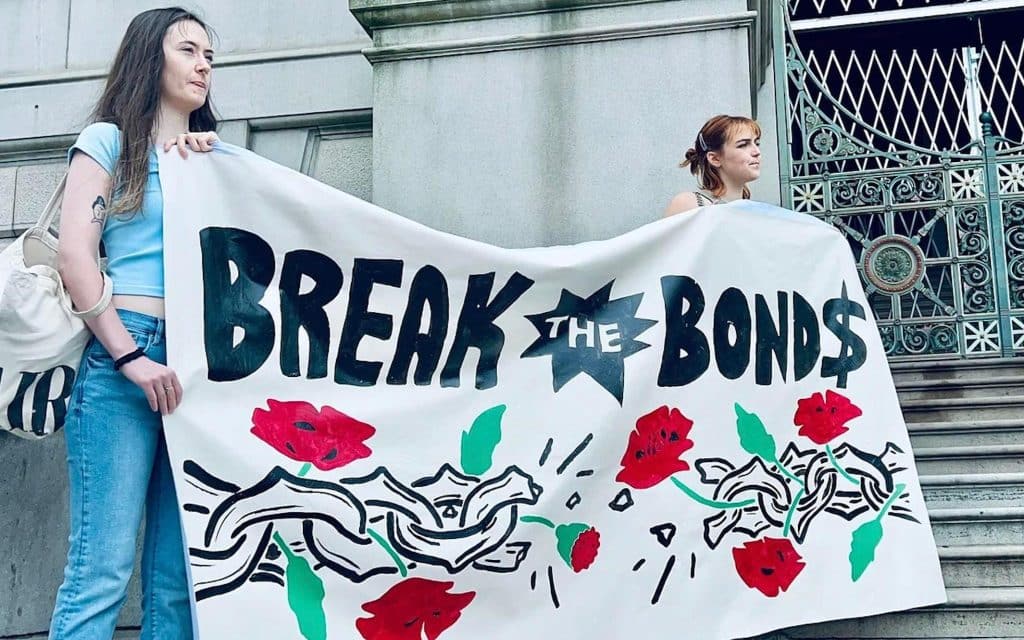
Last month the Maryland Break the Bonds Campaign, a local coalition of organizations and activists, announced that the Maryland State Retirement and Pension System has divested roughly 85% of its Israeli bond holdings.
The move represents a $62 million in divestment from Israeli sovereign bonds and is believed largest state-level divestment from Israeli bonds thus far.
Mondoweiss spoke with Zainab Chaudry, Director of CAIR Maryland, about the victory.
Can you talk about the organizing effort leading up to this divestment news? What did the divestment entail?
I’m with CAIR Maryland, the Council on American Islamic Relations, and we are a coalition member of the Break the Bonds campaign in Maryland. We’ve been working closely with Jewish Voice voice for Peace’s DC Metro and Baltimore chapters to hold our state’s pension and retirement system accountable and making sure that they are divesting state funds, pension funds, from Israeli bonds.
The campaign has been underway for a little over a year now in Maryland. We have tried different angles of advocacy and legislative routes to enact change and hold our state officials accountable. We are very excited to share that this historic victory, which is the largest state level divestment to our knowledge in the entire United States, has finally been confirmed.
Obviously, it’s not 100 percent divestment. It’s only 85 percent divestment. But that’s still momentous and it’s a very gratifying sign for members of the coalition, especially the leading organizations who are part of this effort, that the grassroots power and advocacy in holding these systems accountable is working.
It is effective and the power of the people and our voices cannot be ignored, cannot be discounted when we speak together as one, when we continue to demand accountability from our public officials, when we speak truth to power, when we stand on the right side of history and demand ethical investments from our elected officials. Change is possible even if it doesn’t happen as quickly as we would like for it to happen.
With this particular news, our research shows that Maryland Pension Fund has cut its holdings in Israeli bonds by more than $62 million. Again, as I mentioned, this is the largest known state-level divestment from Israeli sovereign bonds to date and it’s a major victory in the campaign’s statewide push to end um Maryland’s public investment in Israeli sovereign bonds.
We are holding an event on June 17th in Baltimore to celebrate this victory, but then also drive home the message that we want the remaining 15% funds to be divested as well and that we are calling on officials to help make that happen.
Can you talk a little bit about the coalition that organized around this issue? I know that union members and public employees are an important part of this fight?
I believe we currently have over 40 organizations who have signed onto this effort. One of the most most exciting parts of this campaign has been the fact that this is probably one of the most diverse, broad-based coalition of organizations, groups, and individuals representing a broad swath of public life.
We are very excited to have, for example, the Baltimore Teachers Union be involved in this.
Many of the organizations that are part of this coalition, they have been doing work locally within their own respective counties as well to make sure that county level government is also ethically investing funds as well.
There’s another entity, the Maryland Israel Development Center, that brings weapons manufacturers into the state of Maryland. So there have been many grassroots organizations on a local level that have been working to make sure that county executives are not not investing public funds into nonprofits and entities that are upholding the genocide, apartheid, settler colonial violence, and the horrific crimes against humanity that the Israeli government is committing with our public public tax dollars.
So we’re very excited about the broad-based diverse coalition, that includes union workers, including activists, advocates, lawmakers, and many organizations who are part of this campaign.
This was a significant victory without the passage of a investment bill, but there is a related House bill that you’ve been organizing around. Can you talk about that legislation?
That legislative push actually helped to galvanize this victory. House Bill 1455 was introduced by Delegate Kaelin Young um and co-sponsored by a few other delegates as well. It was endorsed by and supported by many Jewish, Christian, Muslim organizations and activists and advocates and faith leaders who came out to the rally before the day the bill hearing was scheduled to take place.
We had a rally at 11 o’clock that morning, on March 19th, and then the bill hearing began at 1 o’clock, and over 100 witnesses submitted oral or written testimony in favor of this legislation, before the committee calling for divestment of state pension funds.
It just really powerful to see Holocaust survivors, for example, Palestinian advocates, Christian advocates, Jewish advocates, Muslim advocates, people from diverse walks of life who were coming together with a very simple and very unified message. They were demanding accountability from elected officials.
The witness testimonies were just incredibly powerful. It was very moving to hear, especially retirees, who were speaking to their personal impact stories and how they themselves are strongly opposed to investing funds into Israeli bonds for ethical reasons.
That hearing was actually one of the longest hearings this session because of the amount of people who testified.
The bill itself was not brought forward for a vote in committee, but there were a large number of people who also sent emails because we had an action alert targeted to members of the committee. There were hundreds of phone calls, if not thousands of phone calls made in support of the bill.
So think the message that our coalition wanted to convey got across loud and clear, and that was that this is not the ending, this is just the beginning of this movement. It’s just the beginning and there’s a lot more work to be done, but it is also really important to also celebrate the historic wins. It signals to our supporters and advocates that even though it feels difficult and frustrating at times, at the pace with which change is happening, that change is happening, and that we’re committed to continuing to make that push.
We’ve covered a lot of Israel Bonds victories in recent months, across multiple states. I am wondering if you have been in contact with activists who have worked on this issue in other states and how you see Maryland fitting into that wider battle?
JVP National is the initial orchestrator of the Break the Bonds campaign, so the Maryland campaign is modeled after similar campaigns that are underway in different states across the country.
Absolutely, there have been conversations happening amongst many of the different organizers on the local level and state level. I think one of the things that probably makes Maryland’s campaign a little bit more unique is, not just the diversity and the depth of the different scope of organizations, but that we have unions and labor groups involved. The American Federation of State, County and Municipal Employees (AFSME), Baltimore Teachers Union, and several other organizations that historically may have been supportive of Palestinian human rights but may not have necessarily been actively involved in the fight to push for ethical investments. These are organizations that, in some cases, have tens of thousands, if not hundreds of thousands of members and that has been really powerful in moving the needle.
I think just the public is waking up, people are paying attention and they no longer find the status quo acceptable and they’re willing to speak out about that. Lawmakers are hearing from more and more people and more and more organizations. I think that this will hopefully inspire other states and other organizations to redouble their efforts to pursue ethical investments on a state, local, and federal level.
Mahmoud Khalil appeals to Supreme Court
Mahmoud Khalil, the former Columbia student and Palestinian activist targeted for deportation by the Trump administration, will appeal his case to the Supreme Court.
Khalil’s attorneys made the announcement last month, after a federal appeals court declined to rehear the case challenging his 104-day detention. In January 2026, the appeals court issued a 2-1 split decision overturning a lower court’s order that released Khalil on bail and prohibited him from being deported or detained.
“By ruling against Mr. Khalil..the Third Circuit set up the possibility that the remaining barriers preventing him from being deported could be dissolved,” notes the New York Times.
“Today’s decision is not the final word, and we still strongly believe in our arguments going forward,” said Brett Max Kaufman, senior counsel at the American Civil Liberties Union, after the case was denied. “Federal courts must have the power to step in when the government exploits our country’s immigration system to punish people for their constitutionally protected speech. If the Trump administration can target, arrest, detain, and deport Mahmoud for his speech, they can do it to anyone expressing an opinion they disagree with.”
“We hope the Supreme Court will recognize how dangerous the Third Circuit’s decision was, not just for Mahmoud but for other non-citizens the administration has its vengeful sights upon,” said Baher Azmy, legal director of the Center for Constitutional Rights. “That ruling greenlights holding someone in prolonged, brutal detention conditions without access to meaningful judicial review in order to punish them and deter others from dissenting from U.S. foreign policy. We are honored to continue to stand with Mahmoud as he keeps fighting for Palestinian rights, the rights of immigrants brutalized by DHS policies, and the right for people to speak out against injustice.”
A federal appeals court panel has allowed Khalil to remain free while he takes the case to the Supreme Court. A Department of Homeland Security told The Hill that the panel’s decision “does not change the facts: immigration laws will be enforced, and this Department will not be intimidated by lawsuits, media pressure, or activist campaigns designed to obstruct enforcement operations.”
Further Reading
- The Guardian: Storied New York food co-op votes to boycott Israeli products after contentious campaign
- KQED: Activists Defend Golden Gate Bridge Shutdown in Gaza War Protest Trial
- Jewish Currents: With “Fighting Factions,” IfNotNow Zeroes in on Mainstream Synagogues
- Democracy Now: NJ State Police Join Crackdown Against Supporters of Hunger-Striking Immigrants at Delaney Hall
- The Intercept: How Trump’s New Counterterrorism Strategy Puts You at Risk