

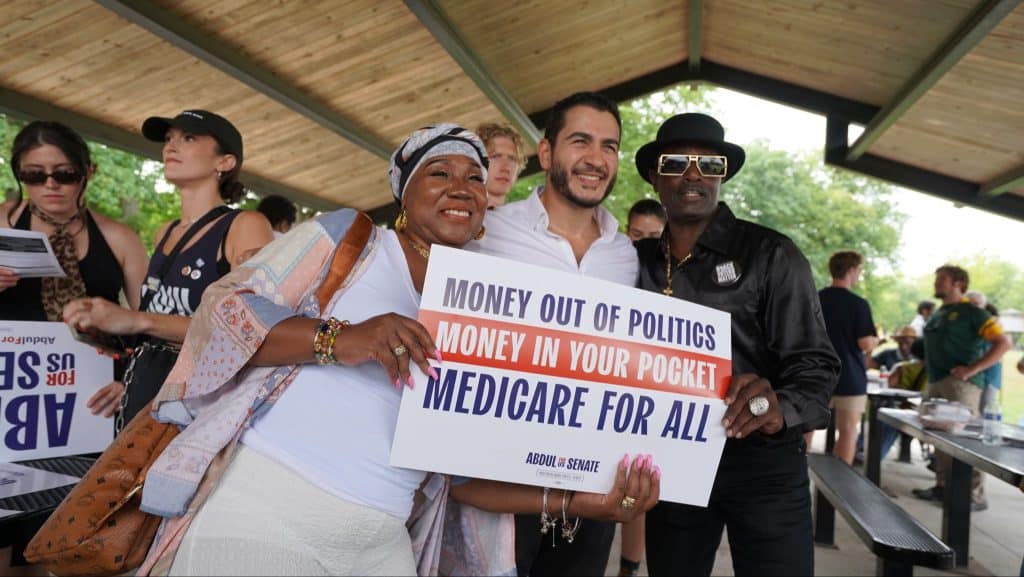
Former public health official Abdul El-Sayed has won the Democratic Senate nomination in Michigan, defeating Rep. Haley Stevens in the primary.
In the general election, El-Sayed will face GOP nominee Mike Rogers, who ran unopposed in the Republican primary.
The primary race was viewed by many as a referendum on the political influence of the American Israel Public Affairs Committee (AIPAC), which spent over $30 million backing the centrist Stevens. Stevens has been a staunch supporter of Israel throughout her four terms in the House, once claiming that the country appeared in her dreams. In contrast, El-Sayed highlighted Palestinian human rights on the campaign trail and called for an arms embargo on Israel.
Overall, Stevens was the beneficiary of roughly $62 million in ad spending from six outside groups, resulting in a 9-to-1 spending advantage according to the ad-tracking service AdImpact.
In a Responsible Statecraft article last month, Quincy Institute’s Eli Clifton showed that money spent on Stevens by AIPAC’s Super PAC, the United Democracy Project (UDP), was disproportionately donated from Republicans and individuals from outside the state.
“AIPAC can try dumping millions of dollars into propaganda, but at the end of the day, American voters don’t want our tax dollars to go toward bombing families abroad,” said US Campaign for Palestinian Rights Action Political Director Iman Abid. “We want to fund healthcare, not warfare. Dr. Abdul El-Sayed led his campaign to victory on that powerful vision, and USCPR Action is proud to endorse him.”
“The victory in Michigan is a political earthquake. Voters in one of the most consequential states for the 2028 Presidential race have just sent a clear message: they want candidates who will fight for working families at home while unapologetically speaking out for Palestinian freedom. This cycle, AIPAC is being relegated to the dustbin of history.”
Beth Miller, Political Director at Jewish Voice for Peace Action
“The victory in Michigan is a political earthquake,” said Beth Miller, Political Director at Jewish Voice for Peace Action. “Voters in one of the most consequential states for the 2028 Presidential race have just sent a clear message: they want candidates who will fight for working families at home while unapologetically speaking out for Palestinian freedom. This cycle, AIPAC is being relegated to the dustbin of history.”
“AIPAC spent over $30 million to stop Dr. Abdul El-Sayed in this race, and that record-high sum wasn’t enough because Democratic voters have had it with the fringe and extremist view that our tax dollars should pay for Israel’s bombs, wars, and genocidal ambitions,” said IMEU Policy Project’s executive director Margaret DeReus in a statement.
At a rally in support of El-Sayed, Senator Bernie Sanders (I-VT) declared that the race would “show the nation whether AIPAC and other billionaire-funded Super PACs can buy a U.S. Senate seat or whether the people of Michigan can prevail.”
“I’ve never seen one single issue external to candidates’ platform and campaign become so central,” Omid Memarian, a Michigan political analyst and director of communications at Democracy for the Arab World Now, recently told Haaretz. “Even voters unfamiliar with El-Sayed came to see rejecting AIPAC as proof he was ‘clean.’”
The pro-Stevens ads bankrolled by UDP predictably omitted any mention of the country, as Israel has become deeply unpopular among the Democratic base. An April Pew poll found that 80% of Democrats and Democratic-leaning independents now have an unfavorable view of the country, up from 69% last year and 53% in 2022.
El-Sayed victory follows a wave of progressive electoral wins across the country, in races where AIPAC spending became a focal point, including contests Pennsylvania, New York, and Colorado.
That wave continued throughout Michigan this week, as pro-Palestine candidate and AIPAC targets Donavan McKinney and Rep. Rashida Tlaib won their primaries, and Uncommitted co-founder Abbas Alawieh was elected to the Michigan State Senate.
However, Tuesday night wasn’t a total wash for the Israel Lobby.
In Missouri, AIPAC-backed incumbent Wesley Bell defeated a challenge from activist Cori Bush, who was fighting to reclaim the 1st district seat that he won from her in 2024. The United Democracy Project spent just $3.1 million on that race, which is a small sum compared to its Michigan effort, but according to AdImpact, Bell’s campaign and outside groups outspent Bush by a margin of 27-to-1.
“What we’ve seen over and over is talking about an issue that is not impacting folks right here in St. Louis, and while we take those issues seriously, you know, the M in Missouri doesn’t stand for Middle East. It stands for Missouri,” said Bell on Election Day.
The debate over Israel and Palestine will undoubtedly carry over to the November race between El-Sayed and Rogers, where lobbying groups are expected to spend heavily yet again. “Our members remain determined to ensure that voters reject Dr. El-Sayed and his radical anti-Israel agenda in November,” said AIPAC in a statement.
Whereas other progressive primary winners face an easy path to victory in their solid blue districts, the polling in Michigan suggests the Senate race will be narrow.
Speaking to POLITICO, El-Sayed predicted he would beat Rogers solidly and explained why his left-wing platform was generating broad appeal among voters.
“I don’t know what a normie Democrat is,” said El-Sayed. “I think most Democrats want to see money out of politics, money in your pocket, and Medicare for all. I think this factional thing that we’re talking about just is not consistent with what I’ve been hearing on the ground for the better part of 15 months where I’ve traveled. People are sick and tired of not being able to afford their groceries or pay their rent or believe they could ever own a home. I think that’s true of all Democrats.”
Michael Arria
Michael Arria is Mondoweiss’ U.S. correspondent. He is the author of Medium Blue: The Politics of MSNBC. Follow him on X at @michaelarria.
The Forward has some commentary on El-Sayed:
El-Sayed’s most articulate statement of his views came midway through an interview with New Yorker editor-in-chief David Remnick published the day before the primary….Remnick asked: [I]t seems that you get very prickly when you’re asked the question: Does Israel have a right to exist? You come from a country that, in the late seventies, made its accommodation, a kind of rough peace, between Egypt and Israel…. But what is your hope for a resolution in the Middle East? Is it two states? Is it one state? What underlies your sense of the situation there?….El Sayed concluded: So here’s what I believe. I believe we have a responsibility to uphold international law. I believe we have a responsibility to treat every single state the same way, around international law. I believe in a process that offers a free Palestinian people the equal rights to peace, dignity and self-determination that a free Jewish Israeli people ought to have. And then I will support whatever the outcome is that a free Palestinian people and a free Jewish Israeli people decide is the right outcome. …[ his views are ] roughly, the view of non-anti-Zionist progressive organizations like the New Israel Fund, J Street, T’ruah, and others: there should be a negotiated solution between Israelis and Palestinians, whatever form that takes, but that the current government in Israel is squarely opposed to finding one, as they have been since the 1990s when it was still a realistic possibility. Traitor, they called Yitzhak Rabin at the time.
Abdul El-Sayed is right about the future of Israel and Palestinians – The Forward
This is the New Yorker interview with El-Sayed:
Abdul El-Sayed’s Argument for America—and Against His Own Party | The New Yorker
When I checked earlier still to close to call. So great to hear about this fantastic, righteous outcome here at Mondoweiss!
Five pertinent questions for El-Sayed:
https://forward.com/opinion/843647/5-important-questions-for-abdul-el-sayed/?utm_source=Mailchimp&utm_medium=email&utm_campaign=afternoonedition_20260806&utm_source=The+Forward+Association&utm_campaign=6ca0902671-EMAIL_CAMPAIGN_2025_07_23_02_11_COPY_01&utm_medium=email&utm_term=0_-8233cb7494-288541822
Opportunity for self-determination widens.
Some Israelis seem open to equality.
https://www.youtube.com/watch?v=rQEhKOpmtSY
.