

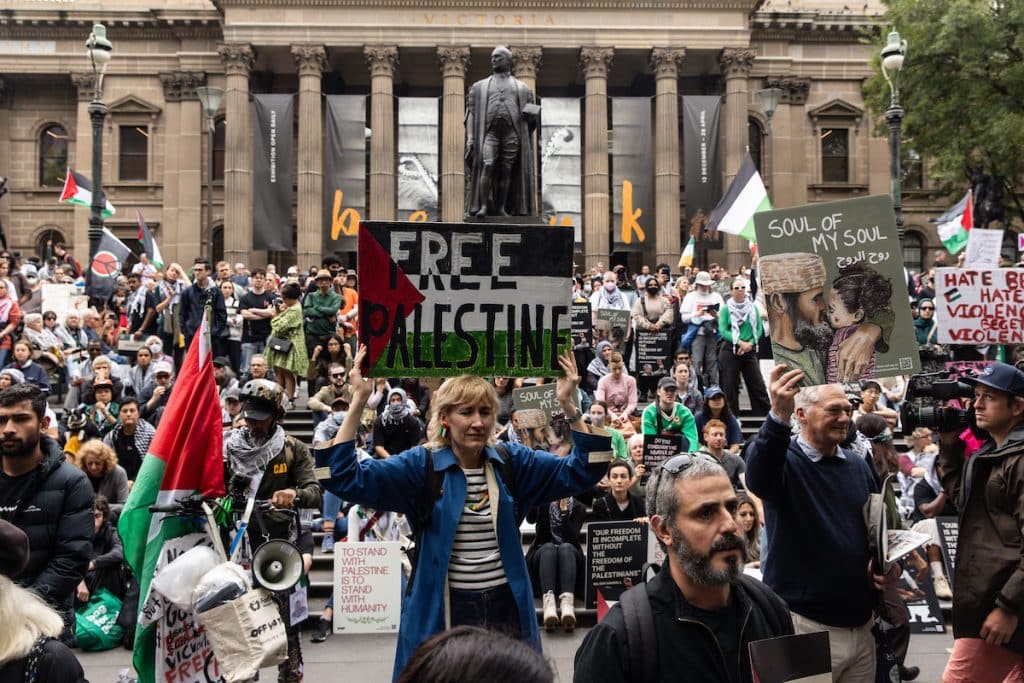
Australia is currently holding a Royal Commission into Antisemitism and Social Cohesion to make recommendations in response to the attack on the December 2025 Chabad Hannukah by the Sea event, which resulted in the murder of 15 people. The hearings so far have been dominated by people whose ‘lived experience’ of antisemitism is based on its conflation with anti-Zionism or support for Palestinians.
Against the backdrop of the Royal Commission, the Australian government announced that “universities will be required to develop their own definitions of racism towards Aboriginal and Torres Strait Islander peoples under new national standards aimed at strengthening responses to racism on campus.” The government’s declaration of what it calls “a new anti-racism standard” ties this mandated definition of anti-Indigenous racism to the adoption of “definitions of antisemitism and Islamophobia.” While, to date, universities have been allowed to choose whether to adopt antisemitism definitions such as the IHRA working definition (IHRA-WDA) or not, the packaging of anti-Indigenous racism, Islamophobia, and antisemitism under a new mandate to devise definitions of all three removes the autonomy universities have enjoyed until now.
The government’s apparent concern for the egregious racism experienced by Indigenous students is particularly perverse as a mechanism to install what the Palestinian sociologist Ihab Shalbak calls “mandatory Zionism” across the institutions. The Australian Human Rights Commission’s Respect at Uni: Study into antisemitism, Islamophobia, racism and the experience of First Nations people report, published in February 2026, found that “81 percent of First Nations respondents had experienced direct or indirect racism at university.” Importantly, it did not conclude that adopting definitions of racism was a necessary or adequate response to the gravity of its findings. On the contrary, it noted First Nations participants “expressed concerns about prescribing definitions without broader structural change” and recommended that, instead of adopting racism definitions, universities should “prioritize building racial and religious literacy and intercultural capability, ensure procedural fairness and address racism holistically.”
It appears clear that, despite commissioning the study, it is the report’s rejection of definitions of racism that has led the government to sidestep its recommendations and instead mandate them. Antisemitism was prioritized in the announcement, with Education Minister Jason Clare stating, “there is no place for antisemitism or any type of hate in our universities or anywhere else.”
In the final chapter of my 2025 book, The New Racial Regime, ‘Against Definitions’, I argued that, faced with the adoption of Zionist instruments such as the IHRA working definition of antisemitism, the last thing we should do is demand that institutions such as universities adopt definitions of other types of racism. Such demands represent a failure to understand the terms of what Anna Younes calls “the war on antisemitism.” The aim of mandating the IHRA-WDA is anything but dismantling antisemitism. Rather, as I wrote in The New Racial Regime, its “role is to generate the antisemite the west requires for its own reproduction” by displacing antisemitism from its European Christian roots and tying it to Arabs and Muslims (Palestinian in the first place) and then to anyone who resists Zionism.
As a repressive tool, the IHRA-WDA’s role, together with anti-hate legislation, is to define Zionism as a protected identity category and to criminalize anti-Zionism, which is naturalized as a racial property embodied by Arabs and Muslims. It is important to understand the racialized symmetry of this transmutation of politics into identity: Zionist identity is naturalized in the legitimate, rational Jewish body and opposed to the illegitimate, irrational, and violent anti-Zionist.
An additional blurring of the boundaries of the identity category of anti-Zionist mirrors the Zionist refutation of Palestinian identity, thus extending its categorial boundaries to Arabs in general. In the context of global Islamophobia, moreover, the importance of Islam as a driver of the resistance to Zionism and the racist identification of this form of anticolonial resistance with the “reactionary Islam” of Isis and Al Qaeda, allows these boundaries to be extended further still to incorporate Muslims as the longstanding internal and external enemies identified by the West as in need of containment and collective punishment by any means necessary.
The response to the government’s definitions mandates should be a refusal to be co-opted into the agenda of mandatory Zionism as envisaged by its Special Envoy on Antisemitism, Zionist lobbyist and funder of the far-right, Jillian Segal. Sadly, we are already witnessing capitulation with the foremost progressive Jewish organization, the Jewish Council of Australia, appealing to its members to call on university Vice Chancellors to adopt definitions of antisemitism that adopt a ‘middle ground’ position, such as the Jerusalem Declaration on Antisemitism (JDA). The JDA has been exposed by Palestinian scholars, including Samer Abdelnour, for failing to entirely disconnect speech on Israel and Zionism from antisemitism, conceding points to the IHRA-WDA. In my view, the JDA is a Zionist definition of antisemitism whose primary aim was to help its almost entirely Jewish and Israeli signatories from being identified with the ‘extremes’ of Zionism. Before 2023, this may have been understandable, as Abdelnour remarks; after the commencement of this phase of the Zionist Entity’s genocide in Gaza, it should be seen as unconscionable.
The Australian government’s agenda of mandatory Zionism has less to do with the power of the Israel lobby or a special concern with antisemitism in whatever way it is defined. Rather, the problem can be summarised in simple terms: Zionism = Australianism and vice versa. The Bondi killings provided the tragic opportunity to further the settler colonial project whose exploitative and extractivist aims require the capacity to criminalize dissent, be it in Australia or Palestine. For that reason, it is extremely perverse to use anti-Indigenous racism as a vehicle for further mandating Zionism as a tool of colonial domination. We cannot both applaud the government’s admittance of the existence of racism against Indigenous people and critique its increasingly draconian actions against those who stand up for Palestine. We must see clearly through what Dylan Rodríguez refers to as the “counterinsurgency machine.” In solidarity with Indigenous peoples resisting ongoing colonization, staff and students at Australian universities should refuse capitulation to the colonial state’s racism definitions mandate.
Alana Lentin
Teacher and writer Alana Lentin is a European anti-Zionist Jewish woman who is a settler on Gadigal-Wangal land. She is the author of “The New Racial Regime and Why Race Still Matters” and a founding collective member of the Institute for the Critical Study of Zionism.



I am truly mystified about how this is going to work – there are any number of prominent Jews who are anti-Zionist. Omer Bartov, Dean’s Professor of Holocaust and Genocide Studies at Brown University, says
“I Don’t Believe Zionism Can Be Repaired”
Omer Bartov: “I Don’t Believe Zionism Can Be Repaired”
And
‘Zionism Led to Genocide. It Must Disappear’
‘Zionism Led to Genocide. It Must Disappear’: Omer Bartov’s New Book Explores Where, Exactly, Israel Went Wrong – Jewish World
Agree or not, that’s not the question I want to deal with. The question is: how is Bartov going to be classified in whatever scheme for defining anti-semitism the Australian government adopts?
And the cartoonist Eli Valley has drawn some pretty rough caricatures of Jews – here’s one of the gentler ones:
Eli Valley — Passover From Generation To Generation
Will Valley be able to take a vacation in Sydney?
Palestine and Australia are both member state parties of the ICJ Statute and ICC Statute. Mt. Zion has been located in occupied Palestine since time immemorial. The modern descendants of the Amorite Kingdoms, like Jerusalem, in the Land of Canaan mentioned in the Chabad scriptures pre-date the birth of Abraham. That fact has been established by ancient cuneiform texts, ancient DNA, monumental inscriptions, and the recorded findings of archeological and scientific testing.
From the outset Article 23 of the Hague Convention established it is especially forbidden – To declare abolished, suspended, or inadmissible in a court of law the rights and actions of the nationals of the hostile party. Special Agreements obtained without consent or by threat or use of force – before withdrawal of the occupying power – are also prohibited by the Geneva Conventions and rendered null and void by the Vienna Convention on the Law of Treaties. The latter contains an ICJ dispute resolution compromissory clause to which Australia and Palestine are both state parties.
In short, no Royal Commission has the power to abolish or declare the rights of Palestinian and anti-Zionists to be inadmissible in an Australian court. Mt. Zion has belonged to the inhabitants since the days of the Canaanite Amorites whose descendants still live there today. They were illegally denied self-determination since 1920 when they were subjugated by the British and Zionist Organization who were wrongfully granted a Colonial Charter. Palestinians have been denied liberation, restitution, and reparation ever since. According to the 2024 ICJ findings of fact regarding violations of the prohibition of apartheid and ICC Pre-Trial Chamber prima facie evidence of persecution and extermination by Israeli officials were confirmed. Complaints from Chabad officials about racism should only be investigated by Royal Commission officials who agree objections to superstitions about extra Jewish souls or Divine sparks are not evidence of racism. One of the Chabad murder victims had written the Prime Minister an open letter demanding he refuse to recognize the State of Palestine. He falsely implied God would bless the PM if he complied and that recognition would violate a Holy Covenant.
Funny, for 2141 years we never heard of anti zionism (measuring from mid 3rd century BCE when monotheistic judahistic faith, later Judaism, assumed born). Now, almost everyone is assumed anti zionist though anti Semitism has greatly declined when compared to what it was in those 2141 years. What has changed? Judaism? Can’t be.