Family members form a circle around the center table, taking seats on the surrounding chairs and couches as afternoon tea is served. Fall is at hand, and the olive harvest season starts in two weeks. Every October, without prior planning, an ordinary family gathering turns into a discussion about the approaching harvest. Everyone usually gets excited about preparations, but this year, the gathering is silent, permeated by an anxious dread.
For the third year in a row, the conversation reaches the same deadlock: we can’t reach the family’s olives in the east of the village. My uncle, the one who has been taking care of the groves for decades and who remained a full-time farmer his entire life, takes a long sigh and exclaims, “‘aadi” (Arabic for “normal” ). A way to say, “it is what it is.”
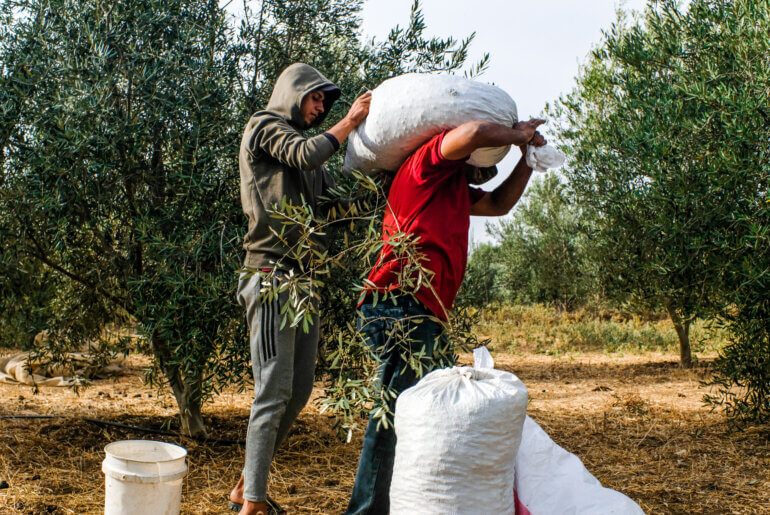
The olive harvest in Palestine is more than an agricultural season; it is a social ritual that brings the entire community together. Schools, universities, and institutions give students and employees one or more days off to participate in the harvest. For many, it’s a yearly practice of reconnecting with their families, with their heritage, and with their land — one that is centuries old and central to Palestinian culture. This practice, violently disrupted over the years as part of Israel’s offensive on Palestinians, escalated dramatically after October 2023.
Aadi. Normal. Palestinians have been telling themselves this word for decades, and not only during the olive harvest seasons, but at every turn since 1948 — whenever the space that they have left to build a normal life has shrunk.
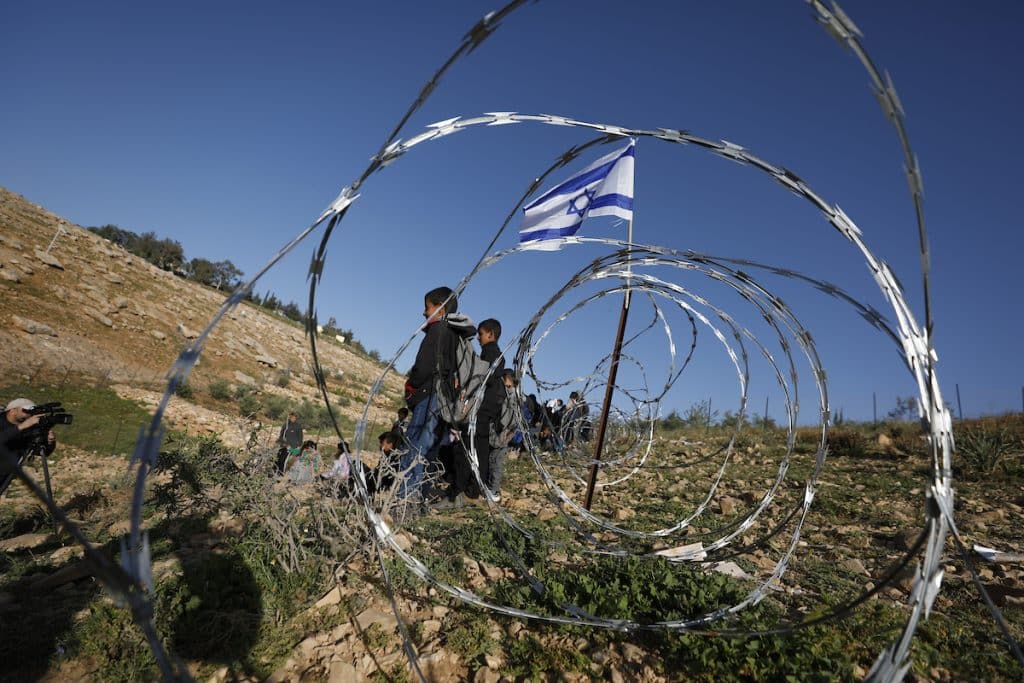
Three years ago, nobody in the West Bank would have imagined that it would become normal to wait for four hours, a couple of hundred meters away from their homes, until the Israeli army opened an iron gate blocking a road. Nobody would have considered it “normal” for the olive harvest to come around but not to be able to reach the groves. It took a shocking wave of the most horrifying atrocities, for three straight years, without the chance to process them properly, for us to reach this point. In the West Bank, the past three years were so condensed with so many disruptions that we almost lost track of them. But one thing remains clear: it all started on the olive harvest of 2023.

It was the end of September, and as with every year, my father told me about how my grandfather had conceived of every olive tree in his mind before he planted it. It was in the early 1940s, and the olive groves inherited from previous generations were no longer enough to sustain the growing family. My grandfather was somewhere in Latin America, selling cheap clothes door-to-door in broken Spanish, before returning at night to the tiny room he shared with other immigrants. Before going to sleep, he spent hours thinking of his farmland in Taybeh, our village in Palestine, planning each olive tree and the precise location where he would plant it upon his return. Little did I know, as I listened to my father tell the story, that it would become a bitter reality in the coming weeks, months, and years.
Two weeks after that evening, the October 7 attacks happened, and Israel’s destruction of Gaza began. Many of us spent many sleepless nights, expressing our shock online, unable to willingly take a rest knowing that not far away, thousands of people were fleeing from bombs or being buried under the rubble. But in my village in the West Bank, someone in every home was staying awake all night to watch out for settlers who unleashed a spree of attacks on Palestinian communities.
On October 12, 2023, settler mobs attacked the Bedouin community of Wadi Siq, near Taybeh, and forcibly expelled 40 families from their homes at gunpoint. The next day, I was interviewing some of the Palestinians who had been expelled and were staying in empty plots of land in neighboring villages. One woman described how she fled to the valley in the middle of the night and walked her way to the village with her young child before reuniting with her family. She told me that she didn’t even have time to grab her identity card or phone; she was mostly concerned about the chicken she had been raising. Her husband said that settlers took dozens of his livestock, and in the middle of his narration, he stopped, took a deep breath, and exclaimed, “’aadi.”
Days later, settlers descended on the olive fields near an Israeli road, where farmers from Taybeh had started the harvest early. One settler beat an elderly couple and stole the olives they had picked. The man, in his seventies, had a broken arm. His wife, almost the same age, had an injured knee. At their home, I asked them how they felt. The woman said that the olive season was over for them. Her husband turned his eyes away, staring off into space, and said, “’aadi.”

Months passed by. I joined Mondoweiss and began writing daily dispatches, reporting on the developments of the genocide. Despite the renewed shock at each new act of carnage, an involuntary numbness began to set in. None of the daily news ever felt “normal,” but at the beginning of each news day, when realizing the disgusting reality I was about to put into words — and in order to bring myself to do it effectively — I told myself, “‘aadi.”
That year, Israeli forces invaded Rafah, after the U.S. president had declared it a “red line.” Another red line was crossed when Israeli forces invaded and destroyed the al-Shifa Hospital, and disabled the beating heart of Gaza’s health system. By the end of the year, Israeli forces were besieging the north of Gaza, and food entering the area dropped to less than 6% of pre-war levels. It was too much to normalize, and it didn’t stop there.
In October 2024, a full year of brutality and madness had come full circle. My brother and I decided to have our olive harvest in our garden. We harvested the few trees beside our house while an Israeli surveillance drone flew over the area. On the horizon, a new settler outpost shone under the sun, in the exact spot where a Bedouin family had lived until a year ago, overlooking the valley of olive trees that we could no longer reach.
One evening, in search of some peace and quiet, I visited the centuries-old Byzantine church in my village. I looked at the candles that grandmothers usually placed between ancient stones, and I noticed that they were dipped in plates of olive oil to keep them burning. I remembered what my friend Hamza Aqrabawi, a researcher of Palestinian folklore, told me once about the religious significance of olive oil. He explained that for a peasant, olive oil was the most exhausting substance to produce, as it takes a whole year of hard labor to get a single gallon. This is why our ancestors, since Canaanite times, offered the most precious thing they produced to their gods, a practice inherited by Judaism and later by Christianity and Islam. I was looking at a 4,000-year-old practice, one that was materially being threatened with erasure.
The following summer, that same church was the scene of a fire that started outside its back wall. Israeli settlers were present at the location, and according to those who were there, the fire started shortly after they had arrived. The villagers considered it a settler attack. A few days later, a dozen foreign diplomats and church leaders poured into Taybeh and held a press conference to condemn the attack. In the statement read by church leaders, the word “Palestinian” wasn’t mentioned even once. I wondered whether, when these bishops used olive oil during religious rituals, they thought of the history, the sweat, the sacrifice, and the centuries of culture that went into it. How can they not bring themselves, then, to name it? I shared this thought with a colleague who covered the press conference with me. She nodded, with a sarcastic smile, and then said, “’aadi.”

In October 2025, we were beginning to comprehend the new layer of dystopian reality imposed on us over the summer. Earlier in June, the U.S. and Israel started their 12-day war against Iran. The very same day, the Israeli army imposed new iron gates on Palestinian roads. Now, there was a new gate at the entrance of the neighboring village, turning three villages, which would be a 20-minute drive from end to end, into an effective cage that could now be closed at any moment at the will of the Israeli army.
When the olive season came around, it was clear to everybody in the community that there wasn’t going to be a harvest for another year. Not only did Israeli settler raids get closer to the villages, making new areas too risky to try to access, but the climate had also been too dry. Normally, most families would hope to produce their yearly olive oil needs, but that year, many families were looking to purchase olive oil in the market.
The school year was delayed for two weeks after Israel’s economic strangulation of the Palestinian Authority (PA) left the Ministry of Education without enough money to print textbooks. One afternoon, I was buying groceries at a local store where villagers go to kill time and talk over drinks. One man was describing how he snuck into his own land when the settlers were away and found that his olive trees hadn’t borne fruit. “At least there’s nothing to be sorry about this year,” he said.
“Aadi,” he added, before shifting the subject. “So, are the kids going to learn anything this year or not?”
The school year has always been linked to the olive season in my mind. Since Taybeh is a Christian village, the Jerusalem patriarchate maintains a church-run school rather than a local public school. In its early years, it was meant to be free of charge for the community, but the church began charging for education over the years. When I was in primary school, many working families, including my parents, waited until October to pay their children’s school fees, selling olive oil to cover tuition costs. I was accustomed to the scene of olive oil jerrycans stacked alongside the school corridors every October. Now, both the education and olive oil economy are at stake for Palestinian families. How much more can a small community’s life be disrupted, disfigured, and dismantled, before it is no longer “aadi?”
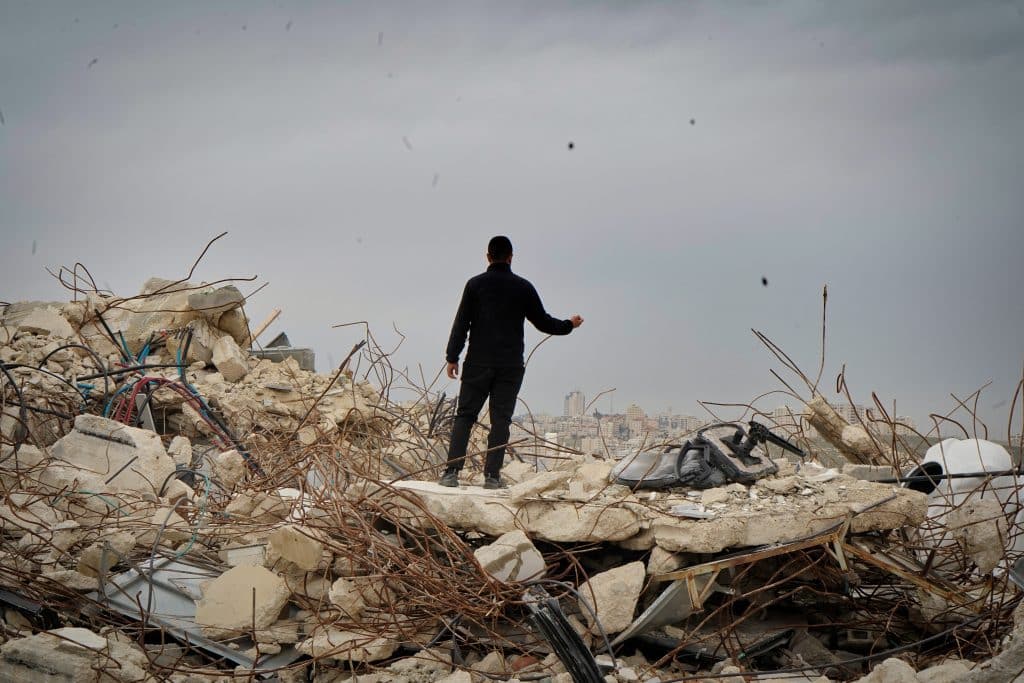
October 2026 arrived, marking another year of intensified settler violence. Now, settler mobs are going for the heart of towns and villages, taking over houses and land alike. In the neighboring village of Deir Jarir, a settler killed two men last July in the very center of the village. Settler harassment also forced a family in Deir Jarir to leave their house and live in a rental property in a different town. Since last October, a new settler outpost has popped up on the side of the neighboring hill, right above the Palestinian houses of Deir Jarir. The first time I noticed it and pointed it out on my way to work, the minibus driver uttered a slur, then shook his head and said, “‘aadi.”
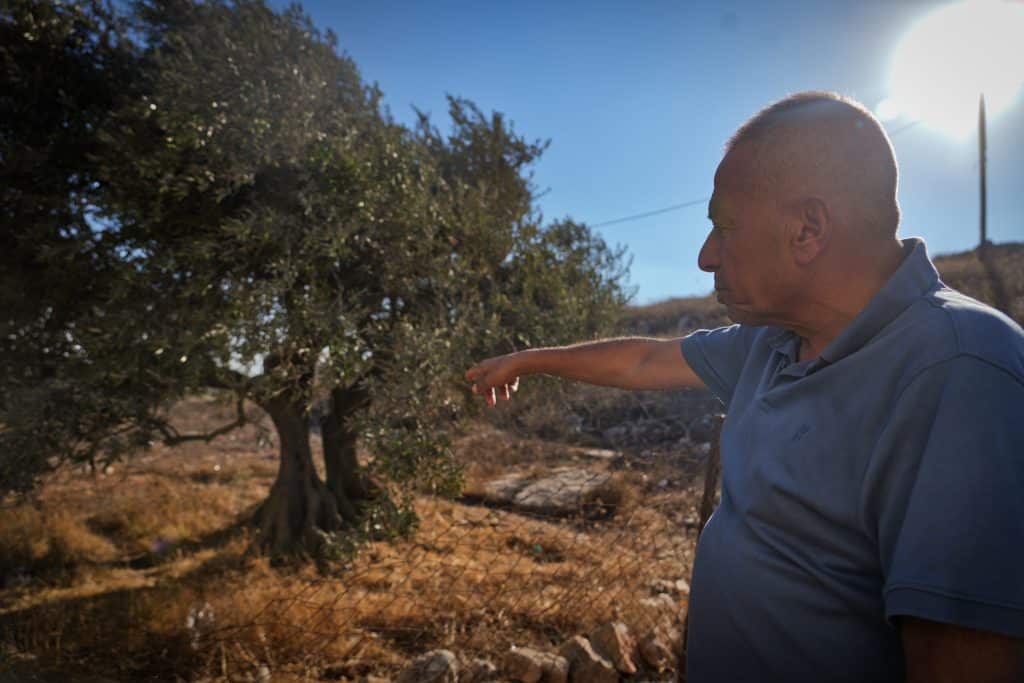
In Gaza, daily killings of Palestinians have been integrated into the “normal” daily reality of the “ceasefire,” just like the ongoing misery of 1.8 million displaced Palestinians, waiting for a reconstruction that Israel refuses to approve. This is what I had on my mind when this year’s family gathering turned into the annual discussion about the olive season. Everybody knew in advance what would be said: another year with no harvest. My uncle — the life-long farmer, the one with the rugged hands, the one who was threatened by a settler not to go back to the family groves last summer – sighs and repeats the expression. It was the heaviest “‘aadi” I had heard in three years.
Once upon a time, my village exported olive oil to Jordan and the Gulf countries. All my father’s generation were raised and educated on the proceeds of their labor, grown from the same land that our ancestors plowed and sowed for 4,000 years. The olive groves that provided the olive oil that our grandmothers have been using to light candles for 4,000 years. Today, it has been three years with no return in sight.
And yet, Palestinians continue to endure, to remain steadfast, to hold their breath. Many confuse this with some sort of superhuman capacity for resilience that only Palestinians possess, but that is not the case. It is the ordinary human behavior of people who have no other choice and who are left alone to their fate. And because it is human, it is not infinite. For three years, Palestinians’ capacity to endure the inhuman and inhumane reality imposed on them has been pushed to its extreme.
And there is nothing “‘aadi,” or normal, about it.
Qassam Muaddi
Qassam Muaddi is the Palestine Staff Writer for Mondoweiss. He covers social, political, and cultural developments in Palestine, and has written for several outlets in English and French, including the Catholic Terre Sainte Magazine and other outlets. Follow him on Twitter/X at @QassaMMuaddi.