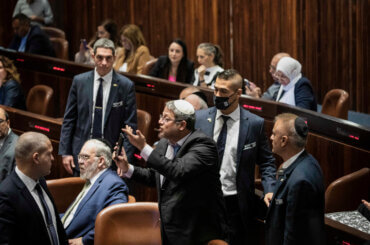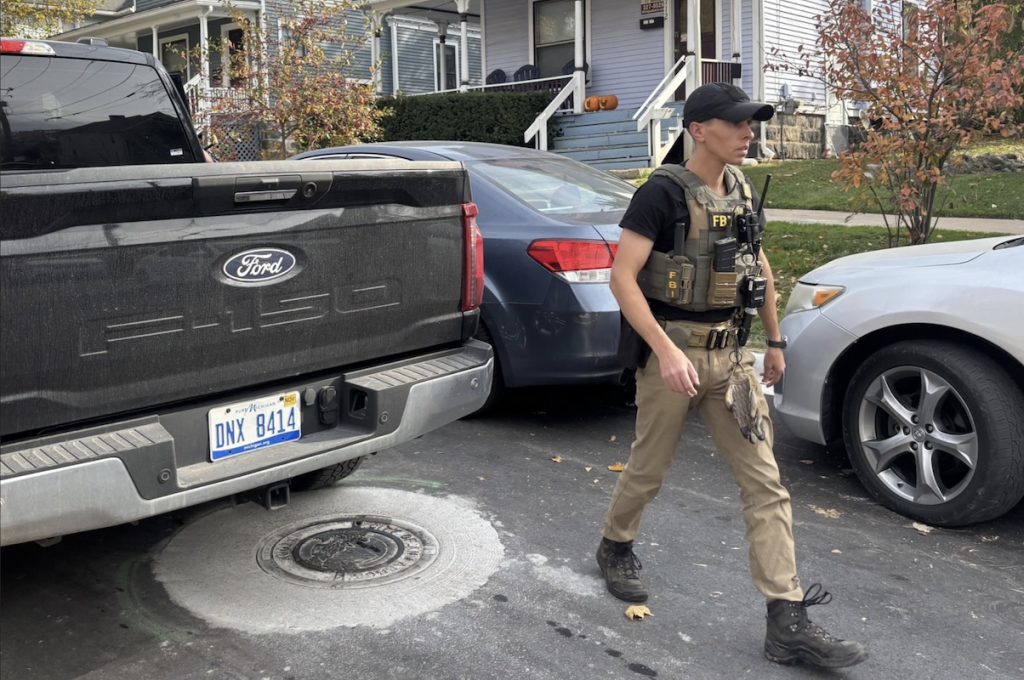
The U.S. government is expanding its assault on Palestine solidarity activism in Michigan. Last summer, the FBI conducted raids against pro-Palestine activists connected to the University of Michigan. The defendants, known as the Michigan 8, were indicted by the Department of Justice on “conspiracy” charges, specifically “conspiracy to transmit threats in interstate and foreign commerce” and “conspiracy to intimidate a witness.” On Thursday, October 29, the FBI raided the home of activists in the same circle. The next day, the government unsealed a superseding indictment that adds four more defendants to the case, turning the Michigan 8 into the Michigan 12.
The four new defendants are all recent graduates of the University of Michigan with ties to campus Palestine activism. Like the initial eight defendants, they are charged with conspiracy and potentially face long prison sentences, from five years to several decades.
The federal government’s new indictment doubles down on previous allegations of “antisemitism.” In a press release announcing the indictment, U.S. Attorney for the Eastern District of Michigan Jerome F. Gorgon, Jr. claims the defendants aimed “to terrorize our Jewish community” and even compares them to Hitler and the biblical Pharaoh. The government again portrays the defendants as “terrorists” because of their alleged support for Palestinian resistance groups, despite never charging any defendant with “terrorism,” “hate crimes,” or even “vandalism.”
As part of this attack, the government filed an emergency motion to detain one of the initial eight defendants (who had been released on bond) all the way until trial. In recent months, FBI agents have also made visits to the homes of several Palestine activists in southeast Michigan.
This new wave of repression and propaganda is intended to send chills through the Palestine solidarity movement and sway public opinion against the defendants. But community supporters, family, and friends of the Michigan 12 are continuing to fight back.
A new FBI raid, and a wrongful detention
On October 29, Henry David Mackeen-Shapiro (who goes by Drin Shapiro) was heading home from the Detroit public school where he teaches. Shapiro was stopped by FBI agents who had their guns pointed at him, with about six police vehicles present. They arrested him and seized his car and phone.
Around an hour later, about fifteen FBI agents arrived at Shapiro’s home. They knocked on the door, announcing they had a search warrant but refusing to show it, according to one person who was present for the entire raid. Those inside the house decided to open the door to avoid having the agents break through it (as they have done in the June 2026 and April 2025 raids on local Palestine activists). As the search began, two agents were stationed outside, pointing their rifles at the house windows, while another agent with a rifle guarded the door.
The agents conducting the search made clear to those present that if they stay in the house, they must remain put and not follow the agents. The agents soon received a message on their radio devices asking them to turn off their body cameras; they later confirmed to the residents that they have done so. The agents refused additional requests to show a warrant, only leaving it on the kitchen table when the search was over. The warrant instructs the agents to seize devices that may contain communications with several other Michigan 12 defendants (the agents took Shapiro’s computer).
FBI agents exiting defendants’ Detroit home after the raid, carrying a box with seized materials, October 29, 2026. Video by the Michigan 12 defense effort.
“It was a really unjust process,” a person present during the raid said. “I was not told what was happening, I was not told my rights, and I was not shown a warrant.” That the agents turned off their body cameras made it obvious the government is acting with “a total lack of transparency,” they added.
Shapiro spent the night in jail and was arraigned the next day in Detroit federal court, where he was released on $10,000 unsecured bond with similar conditions to those of his co-defendants, including restrictions on travel and wearing a GPS ankle monitor for which he must cover the costs.
On the day of the Detroit home raid, FBI agents searched Ann Arbor for a newly indicted defendant in the case, Aaron VonBargen. The agents ended up detaining and searching VonBargen’s younger sibling, Eric Ming VonBargen. “As I was walking to my car after class, multiple unmarked vehicles cornered me and about a dozen FBI agents proceeded to search and detain me. It wasn’t until minutes in that they asked for my name, and only then did they realized I was not my sibling, who is several years older,” VonBargen said in a November 3 statement published by the Michigan 12 defense effort. “By the time I was released, my car and backpack were already thrown apart.” The following morning, Eric’s sibling, Aaron VonBargen, turned themselves in. They were also released on unsecured bond with similar conditions to Shapiro’s.
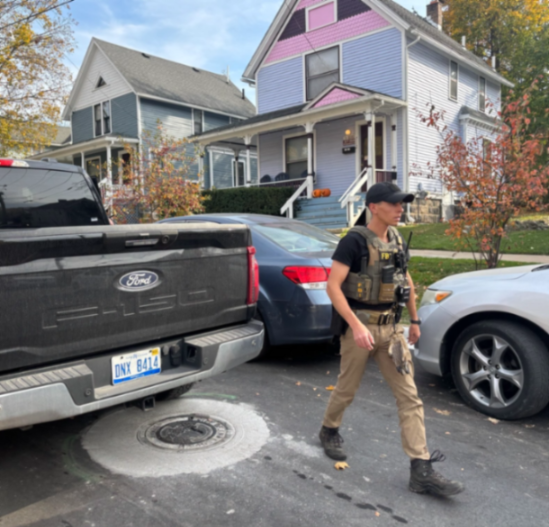
The agent who detained Eric Ming VanBargen has been attending multiple court proceedings in the Michigan 12 case. The authors witnessed him sitting next to and speaking with Ryan Cavanaugh, a Sergeant Detective with the University of Michigan Police (UMPD) who has a long record of going after local Palestine solidarity activists. Cavanaugh has also been speaking in court with the government’s attorney, and UMPD, which participated in the June 2026 raid on the initial eight defendants, alongside the FBI. While the University of Michigan has officially remained silent regarding the case, it is clearly aiding the Trump administration’s crackdown.
Following the raid on Shapiro’s home, on November 2, U.S. Attorney Maggie Smith filed an emergency motion to revoke the bond of Zainab Hakim, one of the original eight defendants, and jail her until the trial. The November 2 motion alleges that Hakim, who was present during the raid and lives with Shapiro (who is her boyfriend), damaged his computer to prevent seizure. Yet the government also used the motion to promote bigger allegations of antisemitism, revealing the absurdity of their case.
The motion attacks a statement made by the judge on the case, Judith E. Levy, who had stated in a September 2026 bond hearing that there is nothing to suggest Hakim is anti-Jewish. “There’s nothing that’s happened over the last two months or maybe last year or anytime I’ve seen, there’s nothing in the indictment, there’s nothing in any of this material that would indicate that that’s the case,” concluded Levy, who is Jewish and the daughter of a child survivor of the Nazi Holocaust.
To argue against Levy’s conclusion, U.S. Attorney Smith – who wears a large cross necklace to court – presented what are allegedly encrypted messages between Hakim, who is Muslim, and her co-defendant Shapiro, who is Jewish. The two appear to be discussing chants that could be used at protests against the genocide in Palestine. Smith claims that this is merely one example of Hakim and Shapiro’s “many conversations regarding their antisemitic feelings,” and supposedly evidence of their risk to the “Jewish community.”
It’d be hard to make up a more ridiculous scenario: a Christian prosecutor with strongly Zionist views arguing against the Jewish judge’s call that there’s no trace of antisemitism by showing that a Muslim woman and her Jewish boyfriend are resisting Zionism together. The only “antisemitic” thing here is the government’s premise that the Zionist organizations aiding it (such as the Jewish Federation of Detroit) speak for all Jews – and that the safety of Jews requires the settler-colonial brutality of Israel.
In the October 30 press release announcing the new indictment, Smith’s superior, U.S. Attorney Jerome F. Gorgon, Jr., also framed the case as a heroic mission to defend Jews:
“These alleged attempts to terrorize our Jewish community and government officials are nothing new. From Pharaoh to Hitler to Hamas, those who terrorize Jews have been the bad guys. As Americans, our job is to fight the bad guys.”
On November 3, the initial eight defendants were re-arraigned in Judge Levy’s courtroom based on the superseding indictment, which resulted in the same bond conditions.
In the same court session, Judge Levy also considered defendant Ahmet Korkaya’s motion to remove the curfew and GPS ankle monitoring from his bond conditions. U.S. Attorney Smith argued against the motion, again invoking Jewish safety. “I can tell you, and as the Court knows, [that] being a member of the Jewish community automatically puts them on edge and at risk [of the defendant],” Smith said. Judge Levy was not persuaded and granted Korkaya’s motion, citing the Bail Reform Act, which calls for “the least restrictive” conditions to be used when possible. Smith asked for 48 hours to appeal the decision, which the court granted, but the government abandoned the appeal and the requested bond conditions were removed.
During proceedings, an attorney for one of the Michigan 12 argued that Gorgon’s press release is an unethical attempt by the government to influence public opinion before the trial begins. Judge Levy agreed that the statement is “very concerning” and asked Smith’s office to consider “taking this [press release] off the government’s website” or at least “retracting this statement about Hitler and Pharaoh.”
Building grassroots solidarity
The Michigan 12 defense effort and community members have continued to fight the charges. On October 30, 2026, Drin Shapiro and Aaron VonBargen were arraigned in a courtroom packed with supporters, signaling to everyone that the defendants do not stand alone. Most court proceedings so far have been well attended by supporters, who often had to be redirected to court overflow rooms.
During the November 3 proceedings, a large crowd also gathered for a rally outside the Ann Arbor federal court. Community members raised the Palestinian flag, served food, and prepared gift bags and cards for the defendants. A hearing on the government’s motion to revoke defendant Zainab Hakim’s bond is scheduled for November 18 and is also expected to be packed with Michigan 12 supporters.
Michigan Democratic Party politicians, however, have not shown much support for the defendants so far. Representative Rashida Tlaib and Amir Makled, a lawyer who had represented student activists criminalized over Palestine and was recently elected to the University of Michigan Board of Regents, have said little about the case. One of the defendants had worked on the campaign of Abdul El-Sayed, the recent winner of the Michigan senate race, but after the June 2026 FBI raid, a spokesperson for El-Sayed distanced themselves from her.
The Michigan 12 case resembles other cases where the government is using “conspiracy” charges to criminalize social movements, like the case of the Minnesota 15 anti-ICE organizers. All this repression is linked: U.S. Attorney Gorgon, who oversees the Michigan 12 case, also brought charges of “using interstate communications to transmit a threat” against those making anti-ICE comments online in Michigan. This is why organizers across defense campaigns have been joining forces. It’s essential to strengthen these grassroots efforts, given the powers we are up against.
How to support the Michigan 12
- Donate to the M12 Legal Fund
- Get involved at michigandefendants.org