

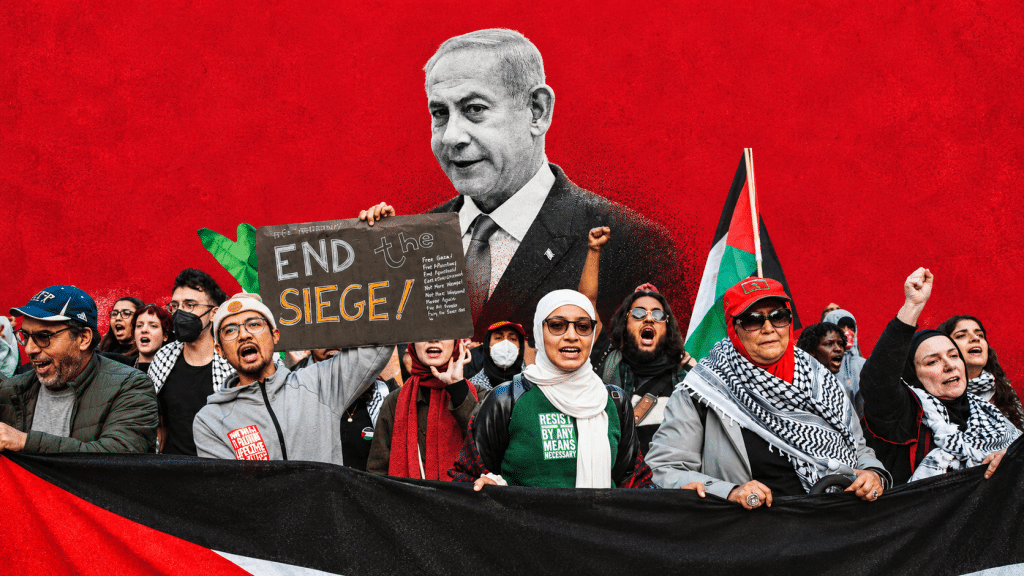
For nearly 40 years, Gallup has been asking Americans a series of questions about the Middle East and U.S. policy in the region.
One of those frequent questions is, “In the Middle East situation, are your sympathies more with the Israelis or more with the Palestinians?“
In 2003, just 16% of Democrats said that they sympathized more with Palestinians than Israelis. When the annual survey was carried out this past February, that number had ballooned to 65%.
There are many reasons for this dramatic shift.
2003 was the year that the United States launched its war on Iraq, spurred by government lies and a post-9/11 bloodlust that permeated a sizable chunk of U.S. society. 2026 also saw the United States launch a war in the Middle East, but this one is broadly unpopular with the population, which has naturally grown skeptical of foreign conflict after 20-plus years of disastrous Forever Wars.
The tireless work of Palestine activists has also increased support for the cause, as Americans have developed a deeper understanding of Israeli apartheid and occupation. These efforts found particular resonance during the Black Lives Matter protests of 2020, as many activists stressed the connections between liberation at home and abroad.
However, the biggest reason for the jump is obviously the Gaza genocide and U.S. support for it. Since Israel’s war on Gaza began three years ago, conservative estimates say 74,000 Palestinians have been killed, and more than 175,000 have been injured. More than 1,400 have been killed and nearly 5,000 injured since the Trump administration declared a “ceasefire” on October 10, 2025.
Those Gallup results are just a small part of a vast trove of polling showing that Americans have completely flipped on the issue, and although Democratic voters have soured on Israel at a higher rate, the shift is certainly not limited to one political party.
Here’s some more:
- A Pew report from this past spring found that 60% of U.S. adults have an unfavorable view of Israel, up from 53% in 2025. The country is viewed unfavorably by 41% of Republicans, but that number is 57% among Republicans aged 18-49.
- In addition to Democrats, the aforementioned Gallup poll shows that Independents sympathize with Palestinians more than Israelis, 41% to 30%, for the first time since the analytics company began conducting the surveys.
- A recent Marquette Law School poll found that favorability toward Israel has been steadily declining for the last 20 months.
In a recent interview about AIPAC, investigative reporter Eli Clifton told Mondoweiss that, because of the country’s actions in the region, the propaganda of pro-Israel lobbying organizations just isn’t hitting like it used to.
“I think some of this is out of their control. Images of dead children and civilians continue to flow out of Gaza. The mainstream media hasn’t been the best at covering it, but with social media now, it’s very hard to suppress the scale of what is going on in Gaza, or the settler violence in the West Bank, or the violence against various communities, including Christians in Lebanon,” said Clifton.
“This stuff horrifies people, and it’s significantly responsible for shifting public opinion. People get facts on the ground in a manner that they had previously been denied and I think as long as the facts continue to be this way where Israel is occupying lands, people don’t have equal rights in Israel, they continue to engage in these wars on multiple fronts, they continue to engage in genocide in Gaza, there’s a limited amount that AIPAC can do.”
“They are deeply, deeply unpopular with Democrats and increasingly unpopular with Republicans and even with Christian evangelicals,” he added. “That poses a nearly insurmountable challenge for them.”
Similar sentiments have openly been expressed by Israeli leaders.
“What concerns me—and I believe it should concern every American leader—is a troubling trend in public opinion, particularly among younger Americans,” wrote former Israeli Prime Minister Naftali Bennett in a July Time op-ed. “Surveys show growing skepticism about Israel among the next generation of U.S. citizens. I do not believe this reflects their true values. American young people are, overwhelmingly, decent and justice-seeking. This is not merely Israel’s problem. It is America’s problem, too. In my opinion, the same forces working to delegitimize Israel are working to undermine the Western alliance, democratic institutions, and American leadership itself. Countering this shift is a shared responsibility—and an urgent one.”
Will Israel’s PR crisis actually result in a rethinking of U.S. foreign policy? There certainly doesn’t seem to be any big changes on the horizon, as Israel has continued to receive an effective blank check regardless of which party occupies the White House. In this sense, Israel has simply become yet another issue, like health care and the environment, where U.S. lawmakers are completely out of step with their constituents.
However, the ultimate fate of the “special relationship” remains unwritten, as the domestic struggle continues. Since the genocide, we have seen the issue permeate our political discourse and even watched some successful candidates highlight the issue on the campaign trail. Congress has even begun to slowly move. When Senator Bernie Sanders introduced an amendment aimed at blocking arms sales to Israel in November 2024, just 18 senators backed him. In April of this year, 40 of the 47 Democrats voted to block a sale of bulldozers to the country.
This is obviously wildly insufficient, but it’s clear that this is no longer a third-rail issue in Washington and, barring an absolute miracle, it seems unlikely that it will ever emerge as one again.


“I think some of this is out of their control. Images of dead children and civilians continue to flow out of Gaza. The mainstream media hasn’t been the best at covering it, but with social media now, it’s very hard to suppress the scale of what is going on in Gaza…:”
Re images of dead children: I happen to be reading about the Israeli shelling of Beirut in 1982, an event that should erase from any sane persons mind the idea that Israel cares about civilian casualties. This is from the Ronald Reagan Foundation, emphasis mine:
Diary Entry – 08/12/1982 | The Ronald Reagan Presidential Foundation & Institute
Met with the news the Israelis delivered the most devastating bomb & artillery attack on W. Beirut lasting 14 hours. Habib cabled—desperate—has basic agreement from all parties but cant arrange details of P.L.O. withdrawal because of the barrage. King Fahd called begging me to do something. I told him I was calling P.M. Begin immediately. And I did—I was angry. I told him it had to stop or our entire future relationship was endangered. I used the word holocaust deliberately & said the symbol of his war was becoming a picture of a 7 month old baby with it’s arms blown off. He told me he had ordered the bombing stopped—I asked about the artillery fire. He claimed the P.L.O. had started that & Israeli forces had taken casualties. End of call. Twenty mins. later he called to tell me he’d ordered an end to the barrage and plead for our continued friendship. Spent rest of day meeting with Congressmen on Tax bill.
“One of those frequent questions is, “In the Middle East situation, are your sympathies more with the Israelis or more with the Palestinians?“
In 2003, just 16% of Democrats said that they sympathized more with Palestinians than Israelis. When the annual survey was carried out this past February, that number had ballooned to 65%.
There are many reasons for this dramatic shift.”
I have always believed that if people receive accurate, hard core fact based information they will think more clearly and be more likely to respond in humanitarian ways to atrocities. That is one of the main reasons I have chosen to pound the msm literally for decades with challenges about their often complete failings in covering the facts on the ground in the P/I conflict. Not only do people have more access to potentially more fact based information via social media (also access to tons of false claims as well) the U.S. MSM more recently has covered Israel’s heinous actions more often than ever before. We know Israel’s war crimes have taken place over decades and the coverage has been extremely inadequate and more often than not extremely biased by covering up Israel’s war crimes and crimes against humanity.
Of course the msm coverage of Hamas’s heinous acts (I believe anger built up over decades) were covered more than adequately.
What people do in response to knowing the facts is another issue.
How Israel, the I lobby etc will try to shut down the free flow of facts about the ongoing conflict, human rights crimes is also another issue. Facebook shutting down access to Pro Palestinian activist on Facebook by the thousands.
“Meta platforms have systematically suppressed pro-Palestinian accounts and journalistic content through account suspensions, shadow-banning, and livestreaming blocks, according to a report by Al Jazeera. [1]
https://www.hrw.org/news/2021/10/08/israel/palestine-facebook-censors-discussion-rights-issues
This week, there have been lots of events marking 3 years since Oct.7, remembering the atrocities, the victims and the heroes.
I want to recommend a documentary (Hebrew with English subtitles) about Soroka Hospital here in Beersheva on Oct7. Through footage from surveillance cameras, interviews and more we see how the hospital coped with an unprecedented situation. Doctors and nurses and other staff members, Jews and Arabs, civilians and soldiers. Very dramatic and emotionally charged.
https://www.kan.org.il/content/dig/digital/p-11412/s7/1106347/
A consideration is whether revulsion for the barbarity will bring about political support for ending the conflict without more discussion and understanding on plans for coexisting.