

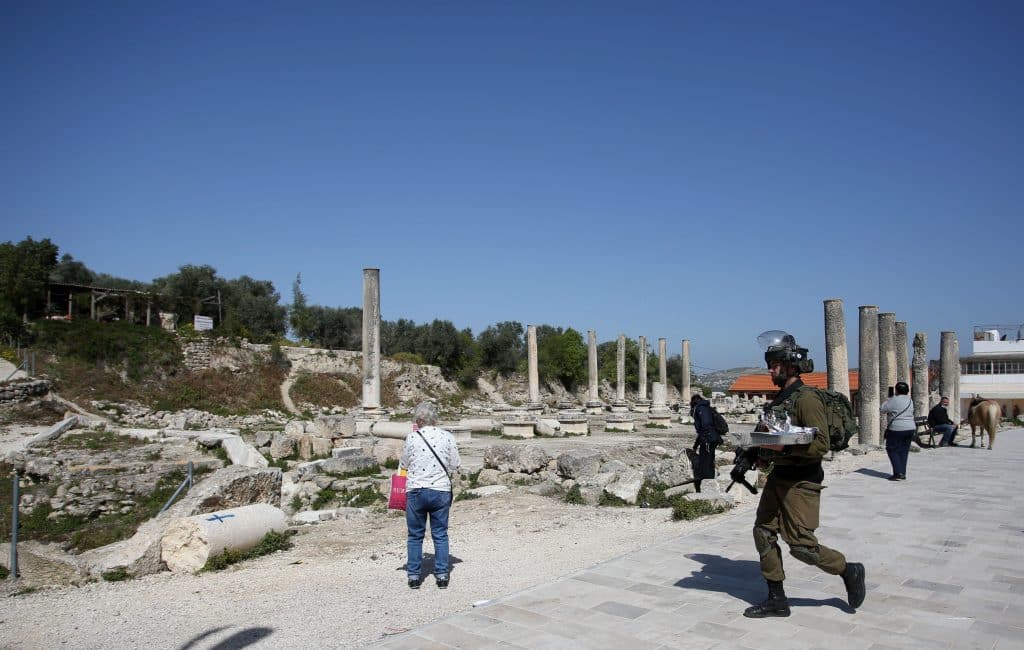
The Israeli Knesset has taken a significant step toward annexing Palestinian archaeological and historical sites in the West Bank, advancing a bill that would place them under direct Israeli civil authority and effectively legally annex them to Israel.
The bill, known as the Antiquities Law, was originally introduced in 2023, and its final draft was approved by the Israeli cabinet in February as part of a broader set of annexation measures. Introduced by Likud Knesset member Amit Halevi, it passed its first Knesset reading on Wednesday by 23 to 14. It is now due to go up for its second and third readings in the Israeli parliamentary body before being passed into law.
If it does, the bill would transfer authority over West Bank antiquities from the Israeli army’s antiquities officer to a new agency under the direct authority of the Ministry of Heritage. This would move the control of the occupied Palestinian antiquities from the army’s Civil Administration to a civilian agency in the Israeli government — a clear act of legal annexation in contravention of international law.
“Annexing historical sites is depriving the Palestinian people of what remains of an essential part of their collective memory, their folk culture, their historical record, and an important part of their development and economy.”
Dr. Hamdan Taha
But the change the bill seeks is much deeper, as explained by Dr. Hamdan Taha, a Palestinian archaeologist, academic, and the former director of the antiquities department at the Palestinian Antiquities and Tourism Ministry from 1994 to 2014.
“Historical and archaeological sites in Palestine have a double importance,” Taha told Mondoweiss. “They are part of our cultural and educational life, and a key component in preserving our identity. Not to mention that, as the main pillar of tourism, they’re also an important economic asset.”
“Annexing historical sites is depriving the Palestinian people of what remains of an essential part of their collective memory, their folk culture, their historical record, and an important part of their development and economy,” Taha explained.
The creeping Israeli state

The bill establishes a new agency, called the “Antiquities Authority for Judea and Samaria,” as the sole authority over Palestinian archaeological and historical sites across all three Oslo zones: Area C, the parts of the West Bank under Israeli military control as per the 1993 Oslo Accords; Area B, under ostensible joint Palestinian Authority-Israeli control; and Area A, supposedly under exclusive PA control.
The new agency would have the power to initiate, conduct, and supervise archaeological excavations, and would be the only authority to run and administer historical sites. It would also have law enforcement powers and legal priority in disputes with other entities, would be able to appoint supervisors to enforce Israeli antiquities law and impose fines, and have the power to buy or confiscate land for archaeological purposes. The agency has been allotted $86 million to implement its project.
The new agency would be the extension of Israeli state authority over Palestinian antiquities in the West Bank, turning them effectively into Israeli sites under Israeli law — a tool of effective annexation of archaeological and historical places.
In short, the new agency would be the extension of Israeli state authority over Palestinian antiquities in the West Bank, turning them effectively into Israeli sites under Israeli law — a tool for effective annexation of archaeological and historical places.
For twenty years, Taha was tasked with exercising Palestinian autonomy over the historical sites in the West Bank. “In Areas A and B we ran the sites and supervised excavations, and in Area C, where the Palestinian Authority doesn’t have access, we treated historical sites as Palestinian sites under occupation,” he explained. “We documented Israeli violations in those sites, and they included destruction, alteration, and damage, both by Israeli forces and settlers.”
Taha’s department reported the documented violations by his ministry and Palestinian NGOs to UNESCO and international organizations. “This was our way of affirming that these antiquities are Palestinian, and that we are the mandate holders over them,” he said.
The fact that antiquities in Area C are run by the army’s civil administration confirms the Palestinian position: that antiquities under Israeli control in the West Bank are protected by the treaties on the protection of cultural heritage in cases of conflict, and by the Geneva Conventions on occupation. In 2011, Palestine became a full member of UNESCO, giving it more tools to develop and protect historical sites. Yet none of the tools available under international law or through international organizations have protected against an Israeli takeover.
The timing of the bill is telling. The Knesset passed the vote in its last session before summer vacation, with the expectation of its dissolution soon and an early election. This means the legislation will most likely be adopted by the next Knesset, whichever coalition forms the next government.
The bill’s origins within Likud, rather than among its more extreme coalition partners, are also significant. As the party of Prime Minister Netanyahu and the central force around which successive Israeli government coalitions have been built, Likud’s sponsorship indicates that the policy the bill promotes is part of a broader Israeli strategy beyond the current government.
Although the bill concerns Palestinian antiquities in Area C, it also extends to historical sites with relevance for Judaism in Areas A and B, where civil authority belongs to the PA under the Oslo Accords. These include the Ibrahimi Mosque in Hebron, the Rachel’s Tomb site in Bethlehem, and Joseph’s Tomb in Nablus, in the heart of Nablus city’s Area A.
Qassam Muaddi
Qassam Muaddi is the Palestine Staff Writer for Mondoweiss. Follow him on Twitter/X at @QassaMMuaddi.


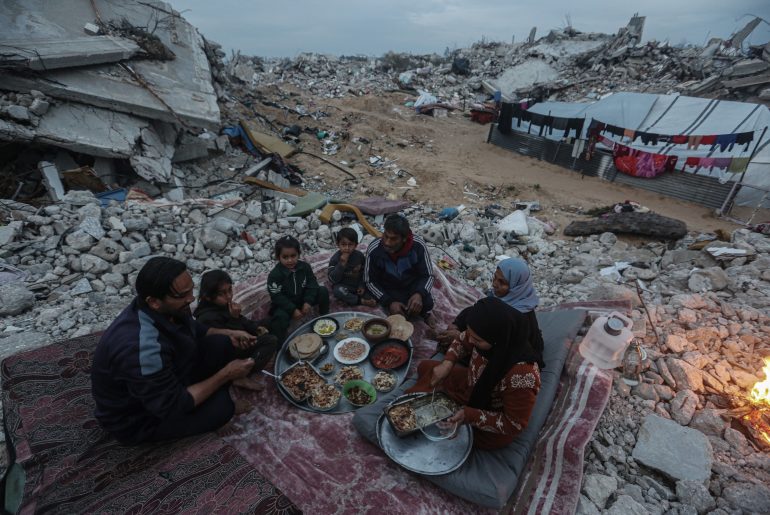
Situation worsening in West Bank, warn Italy, UK, France, Germany…..Italy, Britain, France and Germany warned Friday that the situation in the occupied West Bank has “deteriorated significantly” in recent months amid rising settler violence and Israeli policies they said are undermining stability and prospects for peace, Anadolu reports….In a joint statement, the four European countries said Israeli settlement activity — including a proposed development in the so-called E1 area — would violate international law and further fragment the territory, jeopardizing the possibility of a viable Palestinian state.
Situation worsening in West Bank, warn Italy, UK, France, Germany – Middle East Monitor
Writing in Israeli outlet Yedioth Ahronoth, Nahum Barnea said the violence of the so-called “hilltop youth” is not random lawlessness, but part of a state-backed project to remove Palestinians from their land. He described them as “an armed militia that is working for the government, with its authorisation and funding.”
‘First apartheid, then transfer’: Israeli columnist warns of West Bank expulsion plan – Middle East Monitor
RE: Although the bill concerns Palestinian antiquities in Area C, it also extends to historical sites with relevance for Judaism in Areas A and B, where civil authority belongs to the PA under the Oslo Accords. These include the Ibrahimi Mosque in Hebron, the Rachel’s Tomb site in Bethlehem, and Joseph’s Tomb in Nablus, in the heart of Nablus city’s Area A.
Qassam Muaddi suffers from mental colonization. The Ibrahimi Mosque, Rachel’s Tomb, and Joseph’s Tomb are historical sites with significance
Islam is a continuation of the universalist anti-euergetism of popular Palestinian Biblical Judaism. Rabbinic Judaism is a much later alien Mesopotamian/Babylonian religion, which is customized for a transnational commercial financial stratum. Rabbinic Judaism, whose Holy Scripture is the Babylonian/Mesopotamian Talmud, developed in the context
Palestinians have worshiped at these 3 sites sinc ancestors of Palestinians practiced Judean Biblical Temple religion and Samarian Biblical Temple religion.
The Romans never expelled Judeans or Samarians. By the 6th century CE practically all Judeans and Samarians had converted to Christianity.
The Palestinian peasantry considered Jesus to be the peasantry’s Messiah, who had transferred the covenant of the land to the peasantry.
[Matthew 5:5] Blessed are the meek [the humble people of the land], for they will inherit the land.
The peasantry had no problem with considering Jesus to be the son of God according to Biblical usage.
2 Samuel 7:14
אני אהיה־לו לאב והוא יהיה־לי לבן אשר בהעותו והכחתיו בשבט אנשים ובנגעי בני אדם׃
To call Jesus divine was probably a step too far for most Palestinian peasants, and the Palestinian peasantry eventually converted substantially to Islam, which is an evolution of Judean Christianity.
Zionist colonial settler invaders pollute these sites (e.g., Baruch Goldstein) and are trying to wipe out any knowledge that tells the world that we Palestinians have loved and cared for these sites for millennia just as we Palestinians have loved and cared for Palestine for millennia.
Not only the West Bank, but Gaza as well. This is apartheid. You should adopt the idea of an assertion of foreign sovereignty without annexation, to deny voting, representation in government, denial of infrastructure, etc. To great a extent, the US Government still treats unincorporated territories that way. President Taft called Congress into special session because lawmakers had ended the session, without bothering to include any federal budget or funding for Puerto Rico for the next fiscal year. Puerto Rico, Guam, US Virgin Islands, American Samoa, and Northern Mariana Islands have never been annexed, but are subject to the sovereignty of the US apartheid regime that doesn’t grant them equal protection or full Constitutional rights.
‘De Facto Annexation’ Despite Professional Opposition, MKs Propose West Bank Antiquities Authority Operate in Gaza
The army’s representative told the Knesset Education Committee meeting that applying the law to Gaza ‘could be perceived as characteristics of de facto annexation.’ She added that the plan is not ‘consistent’ with the Trump plan for the Gaza Strip’s rehabilitation. — Haaretz
We know what will happen. “Archaeologists” from Israel will dig down, throwing any artefacts of more recent origin onto the spoil heap, and erasing all traces of subsequent occupation, until they come across something indicating someone who may have practised rituals ancestral to Judaism thousands of years ago.