

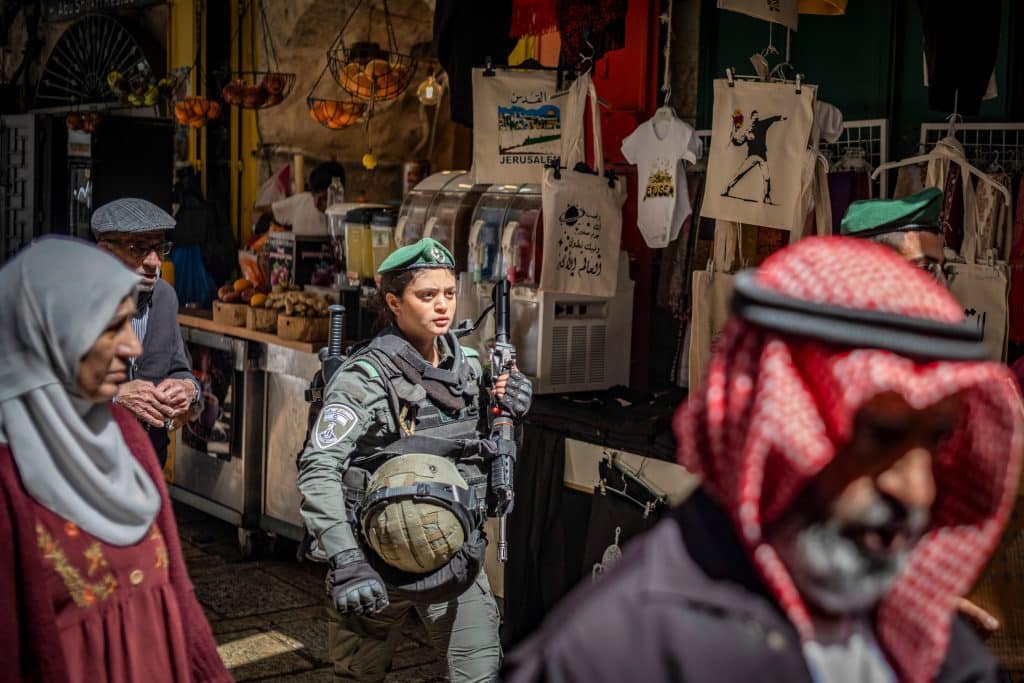
Another Palestinian neighborhood in Jerusalem is in Israel’s crosshairs after the Israeli government reopened a 58-year-old decision to seize the strategic street of Bab al-Silsila in the Old City of Jerusalem, which is adjacent to the Al-Aqsa Mosque compound. Many of the properties slated for seizure are centuries old, dating back to the Ottoman, Mamluk, and Ayyubite periods.
The decision was revived after the Israeli Ministry of Heritage recommended on Sunday that the state-owned Company for the Reconstruction and Development of the Jewish Quarter be given the green light to take over some 50 properties in Bab Al-Silsila. It is based on a 1968 decision made by the Israeli government to expand the Jewish Quarter in Jerusalem from its original five dunams to 116.
The 1968 decision detailed actions that Israel had already undertaken the prior year, including the demolition and forced displacement of the Magharbeh (Moroccan) neighborhood in the early days following the occupation of the city in June 1967. It also included the confiscation of Palestinian properties in Bab Al-Silsila for the benefit of the Company for the Reconstruction and Development of the Jewish Quarter, which was founded in July of that year.
The importance of Bab al-Silsila Street derives from its immediate proximity to the al-Aqsa Mosque compound, which has been a political flashpoint in Jerusalem over the past decade in light of frequent and repeated settler incursions into the religious site, considered the third-holiest site in Islam.
“My family owns a house in Bab Al-Silsila, which dates from the Mamlouk era, and is also an Islamic endowment,” a Palestinian from Jerusalem, who asked not to be named, told Mondoweiss. “Currently, there are 60 people from multiple generations of the family living in the building,” he noted.
The resident, who was six years old when Israel occupied the eastern part of Jerusalem, recalled that “hundreds of families were forced to leave their homes.” He also remembered that “I heard from my parents and uncles that before the Nakba we had Jewish neighbors and friends.”
He added that he later learned of the 1968 decision to confiscate the properties in his street to expand the Jewish Quarter. “We always lived worrying that any day, that could happen,” he explained.
Although the residents in Bab Al-Silsila haven’t received any notice yet, they are already bracing for the possible confiscation. “People are discussing which properties will be affected, although nobody has thought of leaving,” the resident went on.
“We believe Israeli authorities are testing the waters with this announcement, to see what the reaction would be if they actually confiscate our properties,” he said, adding that “what is obvious is that they are determined to take over the surroundings of al-Aqsa and all the ways leading to the compound.”
But why is the Israeli government deciding to reopen an obscure 1968 decision now, and what are the chances that it will actually get implemented?
The prospects for implementing the 1968 decision
The Israeli army has claimed that it needs to control the Bab al-Silsila area as a vital and strategic street, while the Israeli Ministry of Heritage said that confiscating the properties on the street would be “historic,” adding that it would allow Israel “complete control over the Jewish Quarter.”
The Palestinian Jerusalem Governorate warned last Sunday that the Israeli government’s decision to revisit the 1968 confiscation decision constitutes “an attempt to empty the surroundings of the al-Aqsa Mosque compound of any Palestinian presence,” stressing that Israel is “trying to impose facts on the ground to Judaize the city.”
The 58-year-old decision first resurfaced in the news in July of last year, when then-Israeli Minister of Jerusalem, Mayer Porush, made an official request to the government one day before his resignation to implement the 1968 decision. The request called on the Israeli government to green light the Development and Reconstruction company to take over the Palestinian properties in the street.
According to Palestinian lawyer and legal advisor to the Jerusalem governorate, Midhat Dibeh, successive Israeli governments have abstained from implementing the decision for decades, largely due to “the possibility of Arab and international repercussions.”
“Although similar confiscations took place in Jerusalem, the sensitive location of Bab al-Silsila made it more difficult,” Dibeh told Mondoweiss. “The current government seems determined to complete the Judaization of Jerusalem. It feels that the time is ripe.”
Dibeh pointed out that this is made easier by the composition of the current government, which is made up of extremist settler currents “who openly call for the expulsion of Palestinians.” He underlined that no official decision to implement the confiscations has been taken, but that there is now a serious discussion in the Israeli government about them.
However, there are still a number of practical and legal hurdles that the Israeli government would have to overcome to realize this objective.
According to Khalil Tafakji, a Palestinian expert in Israeli settlements, one legal challenge would be relying on a law that “has been in the drawer for over half a century, which makes it possibly null and void.” However, Tafakji stressed that “this assumes that there would be legal pushback against the confiscation.”
“The bigger picture is not Bab Al-Silsila,” he added, “but the Israeli government’s determination to advance the takeover of the city as fast as possible.”
Israel has escalated its policies against Palestinians in Jerusalem in recent months. Last March, Israeli authorities expelled 11 Palestinian families from their homes in the town of Silwan, adjacent to the southern part of the al-Aqsa compound. The properties had been claimed by an Israeli settler group under the pretext that the land had belonged to Jewish owners over a century ago. According to the Palestinian Ministry of Jerusalem Affairs, Israel has demolished 464 Palestinian properties in the Jerusalem Governorate, including 229 in the city during 2025.
Qassam Muaddi
Qassam Muaddi is the Palestine Staff Writer for Mondoweiss. Follow him on Twitter/X at @QassaMMuaddi.

Just a few thoughts about the photo. A rather small female soldier, loaded down with enough hardware to exhaust three marines, two starship troopers and bevy of police officers. Ignored by the people she’s lording it over, outside a shop selling, among other things, a reproduction of a Banksy artwork depicting a protester about to hurl – not a Molotov cocktail – but a bunch of flowers.
Nice choice, MW.