

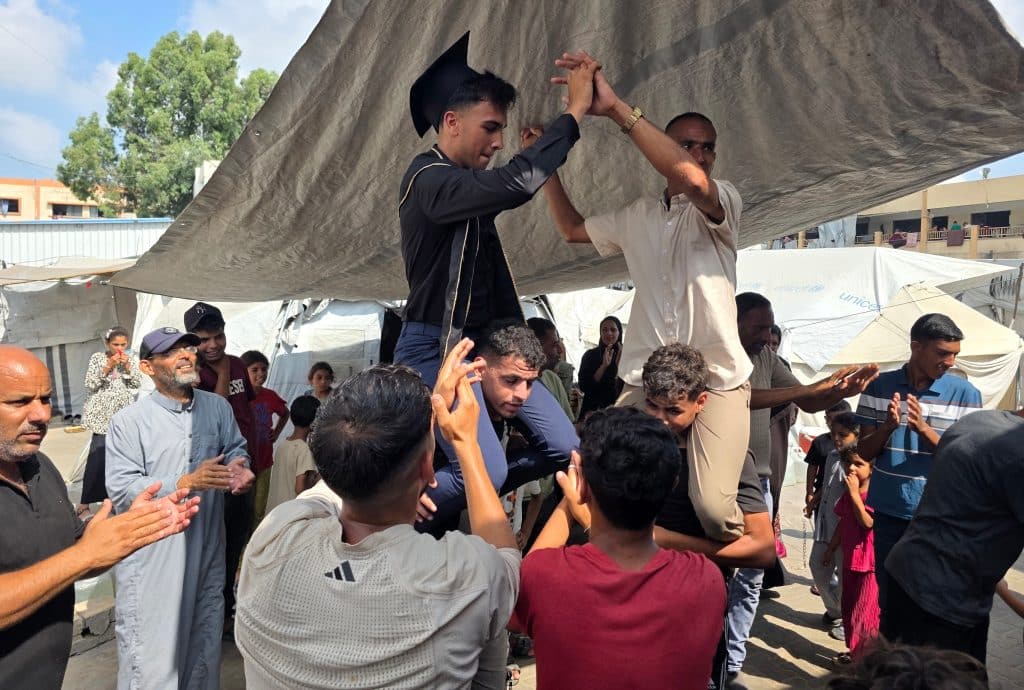
Last week, Gaza’s streets filled with celebrations, an uncommon sight amid the ongoing genocide.
Families gathered, sweets were distributed, and celebratory gunfire rang out, while congratulations were offered to young people across the Strip. It is one of Gaza’s longstanding social traditions: before the war, families marked this occasion with banquets, large gatherings, and fireworks that filled the sky from early morning until late at night. For some families, the festivities would continue into the following day.
This year, amid tents and displacement camps, the celebrations looked different, but they returned all the same.
The celebrations marked the results of Palestine’s General Secondary Education Certificate Examination, known as the “Tawjihi,” which were announced on Friday, June 24. It was the first time since 2023, following the outbreak of the genocide, that students in Gaza sat for the exams simultaneously with their peers in the occupied West Bank and Jerusalem.
According to the Palestinian Ministry of Education and Higher Education, this year’s examination recorded the highest pass rate in the past three years, reaching 74%. Amjad Barham, the education minister, announced that 36,900 students from the Gaza Strip sat for the exams this year, noting that over 1,100 students who were expected to take the examinations were killed during the war.
All the examinations were conducted electronically, since nearly all educational institutions where the exams used to be held before the war have since been leveled, alongside the over 80% of buildings that have been destroyed or damaged across the Strip. Gathering in coffee shops and public spaces with internet access, Tawjihi students took their exams on phones, laptops, and tablets, itself an achievement given the scarcity of solar-powered charging ports in Gaza.
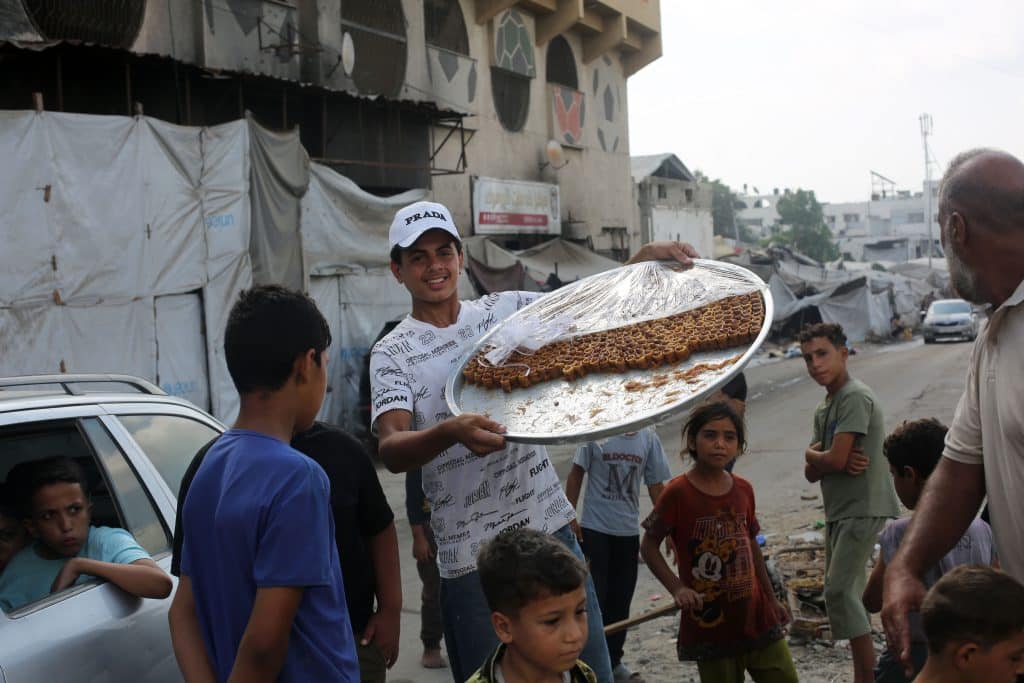
Ranked second nationwide, Ayham Faris, a student from Khan Younis, celebrated inside the modest tent where he had spent the academic year. Having achieved a score of 99.7% in the scientific stream, he dedicated his success to the souls of the Palestinian martyrs and to Palestinian prisoners.
“This success did not come easily,” Faris told Mondoweiss. “It came after immense suffering, including our displacement, the destruction of our home in Khan Younis, and life inside a tent that was unfit not only for studying but even for living. We also endured famine during this year. We went to sleep hungry and woke up hungry. But nothing could deter us from excelling and reaching our dreams.”
Faris explains that at the beginning of the academic year, his family was still struggling through repeated displacement.
“I lost all motivation at the beginning of the year,” he said. “There was simply no energy left to study, especially while living in a tent. I had no desk, no lighting, and none of the essentials needed for education.”
After some time, he realized the situation was unlikely to improve anytime soon. “So when I understood that this reality could continue indefinitely, I began pulling myself together,” he said. “I prepared a place to study on the ground. I spread out a mat, brought a small table, and got to studying.”
When Faris realized that the crisis was only deepening, he continued his studies first at a learning center and later at a bomb-out school that had remained partially intact. It provided lessons specifically for Tawjihi students.
“I worked hard, and I remained patient,” he said. “The hardships didn’t break me. I wanted to bring joy to my parents, who supported me financially, emotionally, and psychologically throughout this year. I wanted to reward all of their sacrifices with a success worthy of them.”
For Faris, these circumstances were forced upon him, but that doesn’t mean he had to surrender to them. “We in Gaza are a resilient people,” he explained. “And I want to become a doctor to serve my people.”

For Tawjihi students, the average score determines which university majors they’re eligible to pursue. Competitive fields like medicine, engineering, and pharmacy often require grades well above 90%, while an average of 80% can be disqualifying in many other fields.
Faris has dreamed of becoming a doctor since childhood, and, luckily, his final score qualifies him to pursue that dream. He says that he wants to stand beside his people and help heal the wounds that have carried since the war, particularly after the war devastated Gaza’s healthcare system and led to the killing and detention of dozens of Palestinian doctors. He says he wants to continue the mission they were unable to complete.
Ahmad Faris, Ayham’s father, says his son has excelled academically since his earliest school years and that his achievement wasn’t a coincidence, but the result of years of dedication.
He recalls that Ayham initially lost interest in studying after their home was destroyed and the family was displaced to the al-Mawasi area of Khan Younis. As a father, however, Ahmad says he was determined to help his son overcome his pain while concealing his own. He supported him and convinced him to confront the uncertainty of the future, believing that education remained the key to overcoming their present.
“You can’t put a price on moments like these,” he told Mondoweiss. “Outstanding success is born from difficult circumstances. I hope every father has the opportunity to experience these precious moments with his children. These moments fill parents with pride in the values and perseverance they have nurtured in them.”

Studying by phone light
Elsewhere in Gaza, another top-scoring student carried a similar story of perseverance, though her path looked different.
Jana Jadou, who ranked third in the Gaza Strip with an average of 99.6%, struggles to hold back tears of joy. Despite enduring the same harsh conditions as students across Gaza, she achieved a result she could be proud of, even though she had hoped to rank first nationwide.
She describes studying under conditions no less difficult than those faced by her peers, spending the academic year in a tent that lacked even the most basic necessities, including electricity. “Many nights, I studied for long hours by the light of my mobile phone, which I charged with great difficulty,” she said. “But I was determined to achieve one of the highest scores in Gaza to secure a full academic scholarship.”
“My family’s financial circumstances are difficult,” she added, “and they can’t cover the costs of my university education.”
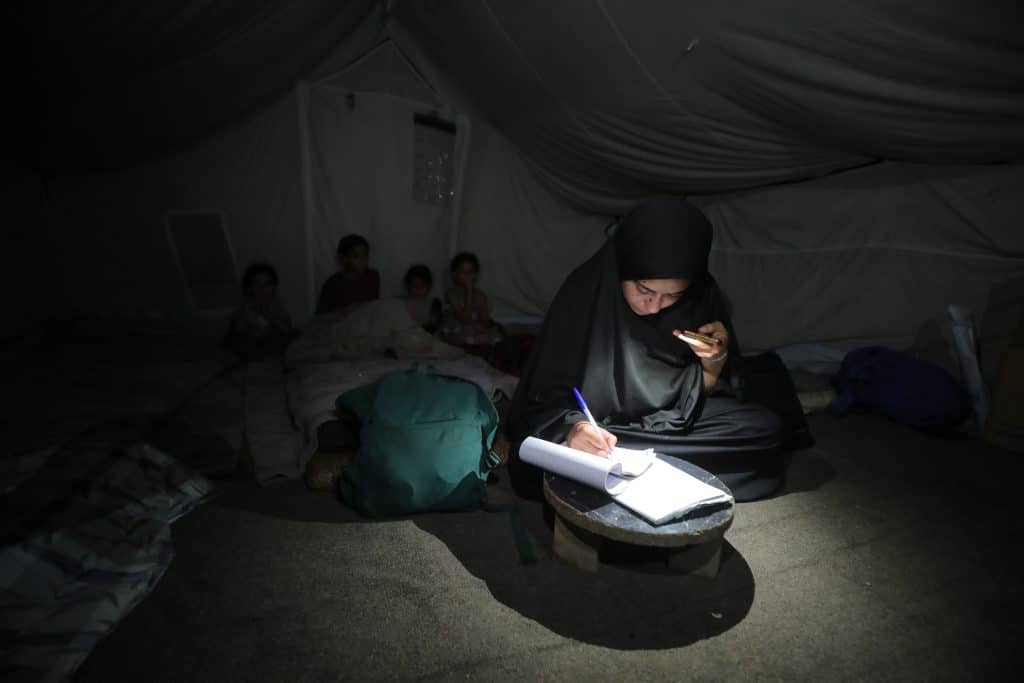
Jana says she wanted to help both herself and her family by having her own merit pay for it. She now hopes to study English, because “I want to add my voice to the thousands of others carrying the Palestinian people’s message in a language understood around the world,” she said.
Jana’s mother describes her daughter as exceptionally determined. She spent nearly all her waking hours last year studying, because lack of electricity made it exceedingly difficult at night. “But on some nights, she did keep studying well past dark,” Jana’s mother added. “I would urge her to rest, he she refused. She never lost sight of the dream she was determined to achieve.”
“I had a dream of academic excellence, and I achieved it,” Jana said. “Now I have another dream for my future. And I will achieve it, too.”
Tareq S. Hajjaj
Tareq S. Hajjaj is the Gaza Correspondent for Mondoweiss and a member of the Palestinian Writers Union. Follow him on Twitter/X at @Tareqshajjaj.


Heartwarming.