Today, Muslims around the world celebrate Eid al-Adha, the most significant holiday in the Islamic calendar. In Gaza, Eid once had a taste and a shape entirely different from what it has today.
The first day of Eid began with people waking up at home, visiting their parents, kissing their hands and foreheads, asking for their blessings. Families would then head together to the mosque for Eid prayers. Children wore their finest clothes, men wore new garments. After the prayer, people lingered outside the mosque, greeting one another, seeing friends, relatives, and neighbors all at once.
Then families began visiting each other at home, exchanging Eid greetings and giving children and women the traditional Eid gift, the Eidiya — an amount of money that fathers and brothers give to their daughters and sisters. Many women and children in Gaza eagerly awaited the holiday for these moments. Later in the day, families would bring sheep for sacrifice, sharing the meat with the poor and those in need across Gaza.
Many memories and traditions surrounded this holiday. Large calves would sometimes break free of their ropes and run through the streets, sending people scrambling after them. Despite the panic and chaos these moments caused, they were among the most joyful scenes of Eid in Gaza. Meat distribution would continue through the third day of Eid, families sacrificing livestock and sharing it throughout the community.
Alongside the sacrifices came another essential part of the holiday: family visits. Men in Gaza traditionally spent Eid traveling from house to house with their sons — visiting married daughters, siblings, relatives, loved ones — homes filled with greetings, laughter, and long conversations. During Eid, everyone saw one another. Everyone visited one another.
On the second and third days, married women would often return to their family homes, spending joyful days with relatives. Families gathered around large meals and barbecues, meat abundant. Others headed to the beach, grilled food, stayed together late into the night. During Eid, joy and family and social belonging came alive in Gaza in ways that felt specific to us.
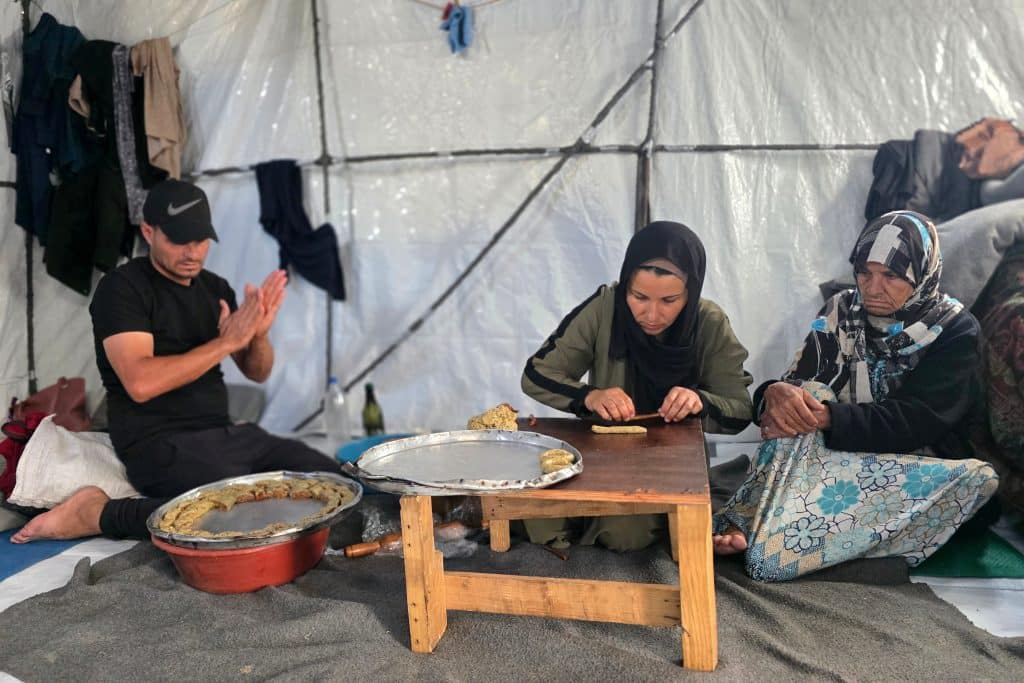
Today, Eid is in a tent. Prayer is in a tent. Visits happen in tents. Children live in tents. Entire communities live in tents.
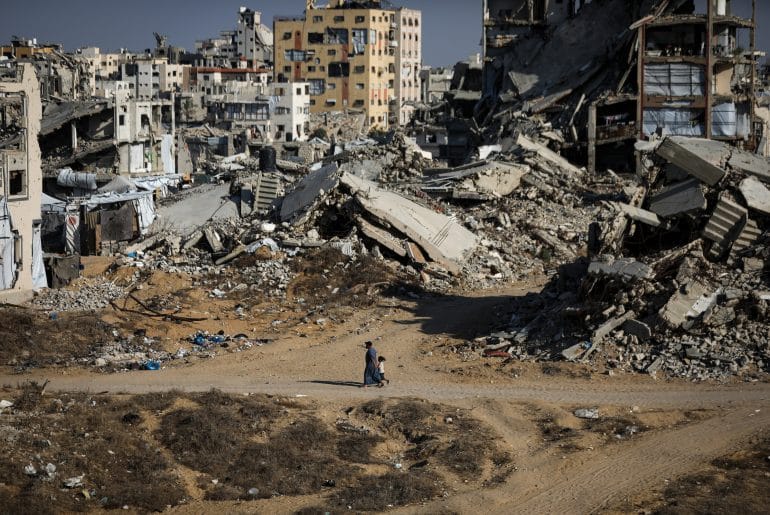
This war has not only destroyed Gaza physically — it has transformed the people who once made sacrifices and supported others into people confined to their shelters, waiting for aid. Those who once gave are now waiting to receive. The war has changed everything, even the shape and meaning of Eid.
Whenever I speak with relatives or friends in Gaza and call to wish them a happy Eid, they ask me: “What Eid are you talking about?” They no longer see reasons for joy. They cannot separate themselves from the reality they are living through.
Yesterday, I called a friend in Gaza to wish him a happy Eid. Instead of words, he sent me a short voice recording. It was the sound of drones hovering overhead and shells falling on Gaza City’s Rimal neighborhood. The night before Eid morning, heavy bombardment had struck across Gaza. Even on the eve of the holiday, there was no pause.
Yet there is something I think about often. Despite all the destruction, many people at least remain beside those they know — they can still see one another, sit together. But for those displaced into unfamiliar places, into exile, there is no Eid at all. They live among strangers, cut off from their communities and the lives that once held them.
I called a friend expecting to hear his voice. What I heard instead was the sound of drones — the sound that has replaced everything Eid used to mean.
Tareq S. Hajjaj
Tareq S. Hajjaj is the Gaza Correspondent for Mondoweiss and a member of the Palestinian Writers Union. Follow him on Twitter/X at @Tareqshajjaj.