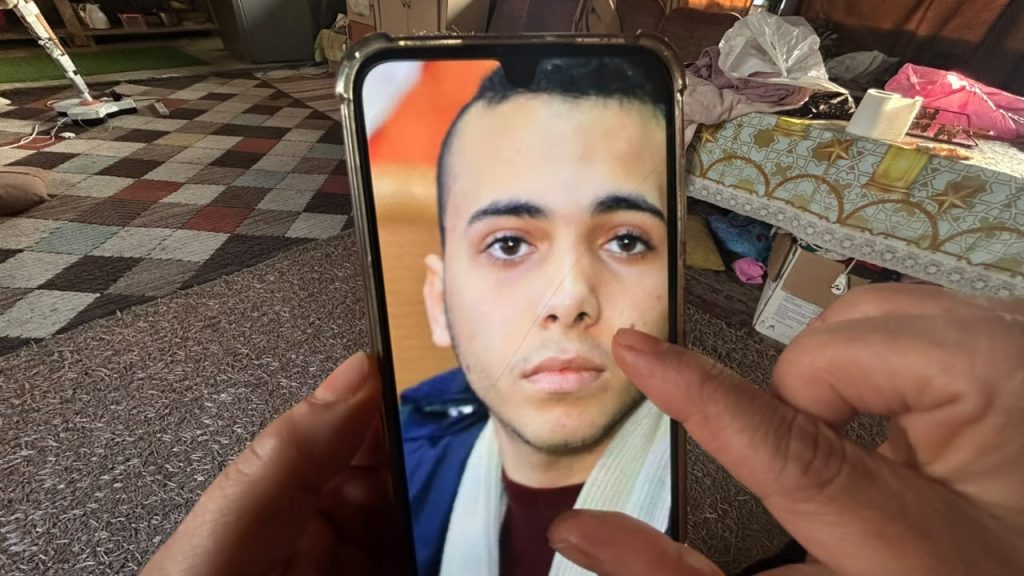
Every day, Tahani Fayez, a 52-year-old mother from Gaza, searches her phone for photos and videos of her son. Manar was 22 when he left the family’s tent in Gaza’s al-Mawasi in November 2024 and never returned.
It’s a ritual she cannot skip, she said, crying as a photo of her son filled her phone screen. Manar used to ask her to take pictures of him, so that his mother could feel his presence even when he was far away.
Fayez still has her son’s clothes, shoes, and other belongings, which she kept not just as keepsakes but in the hope that he will one day return home. She laid them out carefully, kissing his things and telling the story behind each item: the blue trousers and shirt he wore for the last Eid al-Adha he celebrated, the black tracksuit he lounged in at home. Even the socks had a story.
Israel has killed more than 74,000 Palestinians in Gaza since October 2023. According to the Gaza Health Ministry, over 1,400 were killed after the October 2025 ceasefire.
21,500 people have been officially reported missing, according to Omar Nofal, head of the government committee for the missing and a judge on Gaza’s Supreme Sharia Court. Most have since been confirmed dead, including 8,000 who remain buried under the rubble, but the fate of 6,000 people is still unknown: no one knows where they are, what happened to them, and whether they are dead or alive. These figures cover only the cases that were registered, Nofal said. Thousands more have never been reported.
‘I can’t bear to imagine the answers‘
Fayez said she hasn’t felt a single moment of peace since Manar went missing.
One of four brothers, Manar had a neurological condition and needed more care than the others. As a boy, he would leave his mother notes in a notebook and on scraps of paper, apologizing for tiring her out, raising his voice, and coming home late, always telling her that she was the dearest person in the world to him. When she reached for them, her hands were shaking. She described them instead.
“My whole life has been turned upside down,” she told Mondoweiss. “Imagine, I know nothing about my son, and no one will answer our question: what happened to him, and where is he now?”
“Was he killed? Was he taken prisoner? What happened? How did he spend his last moments? Was he wounded and left bleeding? Was he hungry, thirsty, cold? I can’t bear to imagine the answers,” she said.
All she wants to know is where he is: whether he is in Israeli detention, or whether he has died, so she can bury him, grieve for him, and visit his grave when she misses him.
“A grave, I don’t want more than that. Or tell me my son is a prisoner, or wounded, or where he is now.”
Fayez sobbed as she spoke, while her husband, 58-year-old Mohammed, tried to calm her with verses from the Qur’an.
Since Manar’s disappearance, the family has looked at more than 70 bodies in the hope that one would be his, Mohammed said.
At one point, they believed they had found him, until Fayez knelt to look closer. The body was in trainers and socks, but Manar had been wearing slippers when he went missing. His hair was coarse, not soft like the hair on the body before them.
Mohammed said they have searched everywhere: hospitals, police stations, burial sites. He contacted the International Committee of the Red Cross (ICRC) and gave them a description of what his son was wearing on the day he disappeared, hoping for information about his whereabouts. He hasn’t heard back since.
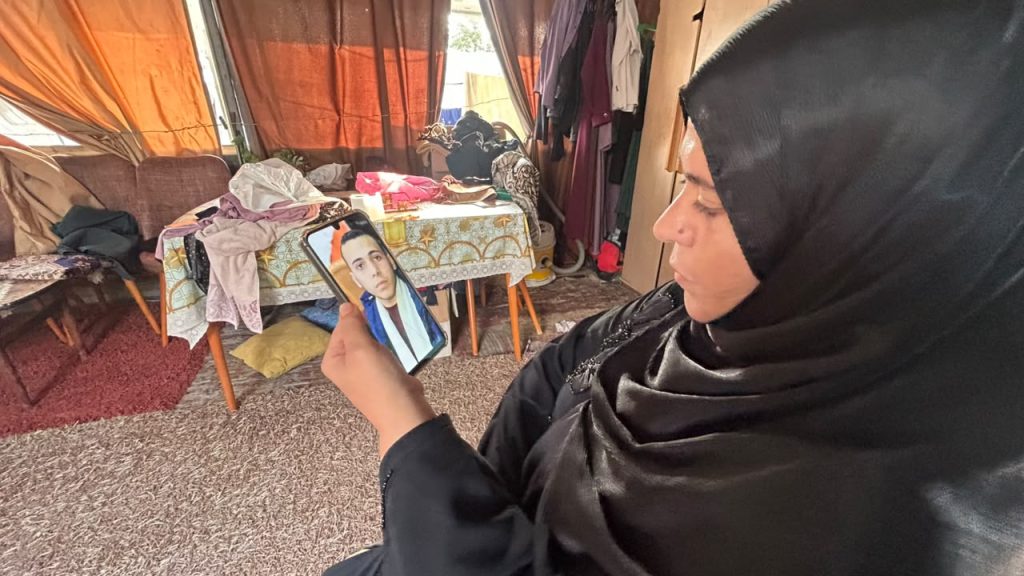
“Our homes were destroyed, we were displaced from the first days of the war, and we lost loved ones. But what happened to my son is the most painful,” he said. “We don’t know if he’s dead or still alive. And worse, there is no Palestinian, international or Israeli body that will give us a clear answer.”
“I, like other families of the missing, am lost,” he said. “We have no information, the occupation refuses to give us any, and we have no way of settling our son’s fate. If he’s dead, I’ll pray for him and I want his remains. If he’s been detained, let them tell us.”
‘By every means available‘
“We have received no information from the Israeli side about the living or the dead, except what it announces about Gaza’s prisoners,” said Omar Nofal.
Confirming a death does not always mean a body has been found, Nofal said. Some were incinerated in Israeli strikes, and their families confirmed they were inside when the building was hit.
Israel has handed over 800 sets of remains, he said, but families have identified only 120 from photographs. The rest were buried in numbered graves. DNA samples have been taken from only 400 people because of the war, and Israel will not allow them to leave Gaza for testing.
The committee has met with the ICRC more than 20 times, he said, but the organization said it has no power to force Israel to reveal the identities of the bodies it has returned or holds, or information about detainees.
Gaza also has no heavy machinery to clear rubble and recover bodies, and some of the dead bodies are still in bombed buildings behind Israel’s “Yellow Line,” where Palestinians are barred from going. “Our resources are non-existent,” Nofal said. “But our national, humanitarian, and legal responsibility drives us to carry this out by every means available.”
Nofal stressed that these numbers count only what has been registered. There are thousands of missing people who have never been registered, he said, for many reasons: entire families were killed with no one left to report them, relatives are outside Gaza, or a child is the only survivor.
“For the thousands on our lists, we have no information at all. That is our biggest challenge,” he said.
Searching for signs
Like the Fayez family, Ahmed al-Astal, 56, has been searching for his son Saeed since February 22, 2024.
Saeed, then 15, left his displaced family’s tent in al-Mawasi to try to return to their home in northern Khan Younis, in an area where the Israeli army was operating.
He never returned.
Relatives and friends have searched relentlessly for Saeed: digging up graves, looking through bodies and destroyed homes, checking hospitals, and contacting every organization that might help.
“Nothing. We found nothing,” al-Astal said. “I wished I could find his body, or his remains, or even scraps of the clothes he was wearing, so we could put our doubts to rest and know for certain that he was dead. At least we would have some peace, and he would have a grave, as my wife dreams.”
The day after Saeed went missing, his sister’s fiancé went looking for him and was shot and killed by the Israeli army, al-Astal recounted.
“We were able to bring back my daughter’s fiancé’s body and bury him,” he said.
Al-Astal contacted HaMoked, an Israeli human rights organization, and the Palestinian rights group Al-Dameer. Both told him that the Israeli army had refuted Saeed’s imprisonment.
“But the Red Cross and other rights organizations tell me that’s not necessarily accurate,” al-Astal said. “There are large numbers of people the Israeli army hasn’t disclosed, even though their families witnessed the moment they were arrested.”
Al-Astal said he still hopes for some news of his son, so that he, along with his wife and siz children, can find some relief.
Without a body or proof of death, the government committee for the missing cannot issue a death certificate for Saeed.
A deliberate policy
Dr. Hussein Hammad, a human rights activist in Gaza, said Gaza’s missing fall into three groups: those under the rubble, those who have been detained and forcibly disappeared by the Israeli army, and those who vanished or fled under fire.
Any figures for the missing are estimates, he said, because there is no central system to accurately count them amid continued war, displacement and Israel’s destruction of records. UN experts have also warned that the figures for Gaza’s missing and forcibly disappeared are hugely underreported. Israel has ignored legal inquiries and appeals from rights organizations and refused to deal with the ICRC for almost the entire war. The ICRC said it resumed visits to places of detention in Gaza in the first half of 2026, but not to those inside Israel.
Hammad said Israel deliberately keeps the fate of the missing shrouded in ambiguity, as a tool of psychological warfare and collective punishment.
“There are certainly dozens, if not hundreds, of detainees held by the occupation whose families know nothing about them, and who have not been visited by a lawyer to this day,” Hammad said.
He alleged that Israel has repeatedly handed over bodies and body parts with no identifying information, medical records or forensic evidence. In his view, that is a flagrant breach of international law and a way of evading accountability for how these people died, deaths he said often show signs of torture or extrajudicial execution. Hammad said Israel is legally responsible for the fate of everyone it detained or killed under the Fourth Geneva Convention, which obliges an occupying power to protect civilians, provide accurate information about detainees and respect the dead.
International bodies, such as UN agencies, have shown “severe shortcomings and bureaucratic slowness,” Hammad said, and have limited themselves to “timid documentation and statements of concern” without putting any real pressure on Israel.
In the meantime, Palestinians have built their own institutions to discover the fate of their missing, such as the Palestinian Center for Missing and Forcibly Disappeared Persons and the Palestinian Foundation for the Missing. Despite their limited resources, Hammad said they are a “lifeline” for preserving the rights of the missing, and could provide crucial evidence to hold Israel legally accountable.
He called for an independent international commission dedicated to Gaza’s missing and forcibly disappeared, firm diplomatic and legal pressure to open Israel’s prisons and camps to the ICRC without restrictions, and urgent funding for a national DNA bank and forensic laboratories.
“Systematic enforced disappearance is not incidental,” Hammad said. “It is a political and military decision designed to multiply the families’ suffering and terrorize the whole of society.”
This article is published in collaboration with Egab.