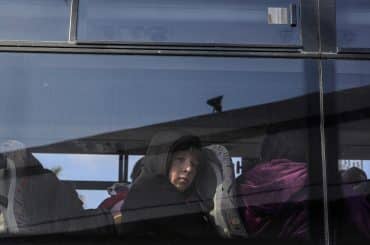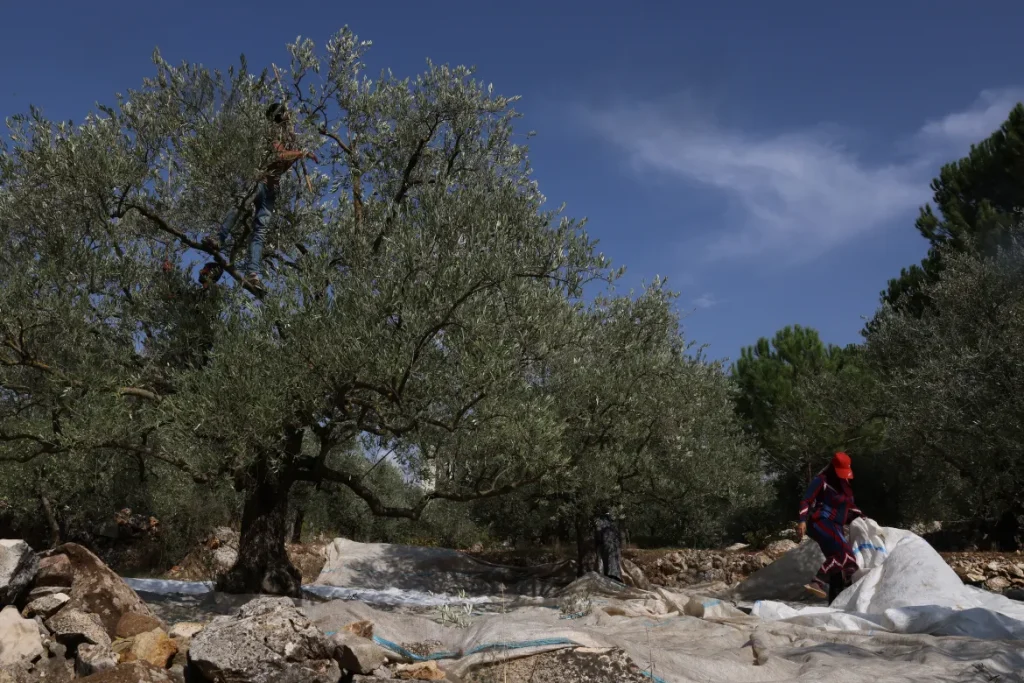
On October 15, Israeli forces expelled residents and farmers from Azariel, an olive grove on the outskirts of Kfarshouba in South Lebanon, ordering them to return the following week if they still wished to harvest their trees. The next morning, an Israeli bulldozer, flanked by two army tanks, invaded the olive grove and uprooted the trees.
A few days before the expulsion, Chebli, a farmer from Kfarshouba, had watched an Israeli bulldozer uproot 70 olive trees belonging to his neighbor.
“I went over to him and found him crying,” he told Mondoweiss. “He spent more than 20 years plowing this land and pruning the trees, and he hadn’t even harvested them yet.”
Following the partial ceasefire agreement that was signed in June of this year, Prime Minister Benjamin Netanyahu said the military would remain in what Israel calls its “security zone” in order to “continue to destroy terrorist infrastructure.” In addition to this, Israeli defense minister Israel Katz declared that Lebanese civilians will not be allowed to return south of the Litani River, leaving hundreds of thousands of people indefinitely waiting to return. For farmers and agricultural workers, this forced displacement means not only losing their homes, but also their livelihood.
Olive groves cover around 62,000 hectares of land in Lebanon – nearly a quarter of the country’s farmland – making it one of the most vital crops in the country. The autumn harvest, which peaks in October and November, yields around 19,000 to 20,000 tons of olive oil per year, according to the International Olive Council. One of the oldest olive trees in the world, estimated at 1,100 years old, reportedly resides in the northern part of the country. In Kfarshouba, Chebli’s village that is now occupied by the Israeli army, the olive trees range between 300 and 500 years old.
Across South Lebanon, farmers and residents describe a pattern of bulldozed groves, ancient trees uprooted and stolen, and Israeli troops expelling anyone who tries to reach their land. On October 11, the Lebanese Army said Israeli fire killed Ali Abdel Hassan Sweidan, a retired chief warrant officer, as he was inspecting his property in Yater, in Bint Jbeil district, during the olive harvest.
The war has also severed farmers from their markets. “Khiam alone used to buy half the South’s harvest,” Chebli said, by his own estimate, referring to the hilltop town on the Israeli border, which Israeli forces now occupy.
“The olive season is gold for people,” he said. “It lets you hold your head up.”
Beyond the Yellow Line
Israel continues to occupy a buffer zone behind what it calls the “yellow line,” an area that includes 55 to 62 towns and villages, totaling around 6 percent of Lebanese territory. The US-brokered ceasefire agreement was supposed to enforce an Israeli withdrawal from southern Lebanon, but has instead facilitated further land grabs and demolitions.
Israel expanded its occupation of the South during the latest military escalation of a protracted war that began three years ago. After the November 2024 ceasefire, Israel continued to strike Lebanon almost daily, killing 139 civilians during that time. On March 2, 2026, two days after a US-Israeli strike killed Iran’s Supreme Leader Ali Khamenei, Hezbollah fired rockets that the Israeli military said fell in open areas. Israel responded with a full-scale military campaign that killed at least 4,389 people in Lebanon, despite the temporary truce agreed upon in April, and the partial ceasefire agreement signed in June.
In Kfarshouba, Israeli forces have drawn a line through the farmland that no one may cross, according to Ali Salah al-Dhiyab, one of the village’s mukhtars, the elected officials who serve as village heads. Since 2024, he said, farmers have been able to reach their land only once, for a single day.
“We harvested like thieves,” he told Mondoweiss. “You don’t know how you’ll get there or how you’ll get back.”
The municipality had petitioned UNIFIL, the UN peacekeeping force in South Lebanon, and the Mechanism Committee, the US-chaired diplomatic body tasked with monitoring the ceasefire, for permission to harvest. Lebanese intelligence officials communicated Israel’s response, which allowed only 100 people and 25 cars to enter their village for one day. They also required farmers to hand over their phones and identity cards and barred the Lebanese Army and UNIFIL from accompanying them.
The municipal council rejected the offer. Kfarshouba has around 1,000 farming households, al-Dhiyab said, and families harvest their own trees.
“If you have 400 trees, you’ll pick five or ten and forget the rest,” he said. “Israel is bulldozing the land and the stones, everything. Unfortunately, half the olives are already gone.”
Al-Dhiyab said buyers were turning away oil from the South for fear of contamination. “You offer someone a tin of oil and he tells you, ‘I won’t buy it, there’s white phosphorus in it,’” he said.
Nothing left to press
For many farmers, there are no groves remaining to be turned away from. In May, while displaced with his family in Beirut, Rafik Baraka discovered that his olive trees had been destroyed by the Israeli army. He learned what had happened from satellite images on Google and from acquaintances in the Lebanese Army and UNIFIL. Some of his trees were bulldozed and burned, he said, but the eldest trees were uprooted and stolen.
“Israel changed the face of the land,” Baraka said.
The 64-year-old farmer from Rab Thalathin, a village in Marjayoun district in southern Lebanon, owned 152 trees, some of them between 100 and 200 years old. His grandfather had planted them, his father had cared for them, and he carried on the tradition. Every autumn, his family spent about 10 days in the village picking and pressing olives, making around 80 tins of oil in an average year.
This year, there was nothing to harvest.
“Our village was bulldozed completely, the houses, the cemeteries, and the olive trees,” Baraka told Mondoweiss. “They left nothing.”
The uprooting of olive trees has reached a French court. A 37-year-old French businessman of Lebanese origin, who has not been publicly named, has filed a complaint in Paris against unknown persons, accusing the Israeli military of uprooting about 600 olive trees from his family’s land in Zawtar al-Sharqiyah, an Israeli-occupied village north of the Litani River. He says some of the trees were around 500 years old, and that his family had farmed the land for 250 years.
The complaint alleges theft, destruction, and damage to property amounting to war crimes. It claims that Israeli forces took control of the area, and the trees were uprooted, roots and all, with suspicions that they were taken to Israel.
A war on all living things
The South produces around 38 percent of Lebanon’s olives, most of which have been destroyed or harmed. According to Greenpeace, Israeli attacks burned or bulldozed at least 65,000 olive trees in the 2023–2024 war alone. Officials and environmental groups have accused Israel of ecocide, with some campaigning to recognize the intentional environmental destruction as a crime under international law.
In February, Israeli aircrafts sprayed glyphosate, a weedkiller that kills plants down to the roots, over roughly 8.5 square kilometers (3.3 square miles) near the border. Lebanese authorities reported that Israeli strikes have also used white phosphorus, a chemical that ignites in air and can burn skin to the bone. Human Rights Watch said the Israeli military unlawfully fired white phosphorus over homes in the southern town of Yohmor al-Shaqif on March 3.
In addition to this, a recent study by Lebanon’s National Council for Scientific Research (CNRS) found chromium above permissible limits in about 45 percent of 134 soil samples taken in the South and the Bekaa, the fertile valley in eastern Lebanon that is the country’s main farming region, which has also been a target of Israeli airstrikes.
Sara Salloum, co-founder and president of AgriMovement, a Lebanese farming group that promotes chemical-free agriculture and local seeds, told Mondoweiss that ecocide includes “the destruction of the foundations of life and of communities’ ability to carry on living in their land.”
“Destroying productive land can prolong displacement, weaken the possibility of return, and make communities depend on aid instead of producing their own food,” Salloum said.
Similar destruction has been recorded in Palestine. In Gaza, a UN satellite analysis found that Israel’s military campaign had damaged 89 percent of orchards and trees by late September 2025, and by June 2026 only 3 percent of cropland remained both accessible and undamaged.
In the occupied West Bank, the Palestinian Authority says settlers and Israeli forces cut down or damaged more than 26,000 olive trees in the first half of 2026. In May, Israel’s finance minister, Bezalel Smotrich, announced plans to uproot 3,000 more to make way for settlements. Between September 25 and October 1, the Palestinian Ministry of Agriculture reported $1.75 million in losses to farmers across seven West Bank governorates.
“This is part of the pattern of systematic destruction in Lebanon, Palestine and Syria, and especially Gaza,” Salloum said. “Confronting ecocide means protecting the land and its people together.”
‘They destroyed our memories‘
For Rafik Baraka, the loss cannot be measured in tins of olive oil.
“Even if we go back and replant, we need twenty years before the tree becomes a tree that bears fruit,” he said. “They didn’t only destroy history and geography. They destroyed our memories. This tree didn’t grow by itself.”
Baraka described the harvest season like an annual festival, with families eating together under the trees and helping one another to complete the task.
“No reconstruction or rehabilitation can bring back that closeness,” he said. “The Israeli knows what he is doing. He doesn’t only want to uproot you from your land, but from your memory too.” Although Baraka’s children did not grow up as farmers, they always returned to the olive groves every year for harvest season, a tradition their father hopes will outlive this war.
“I am sure that when we are gone, they will come back and care for this land because it is part of their inheritance,” he said.
This article is published in collaboration with Egab.