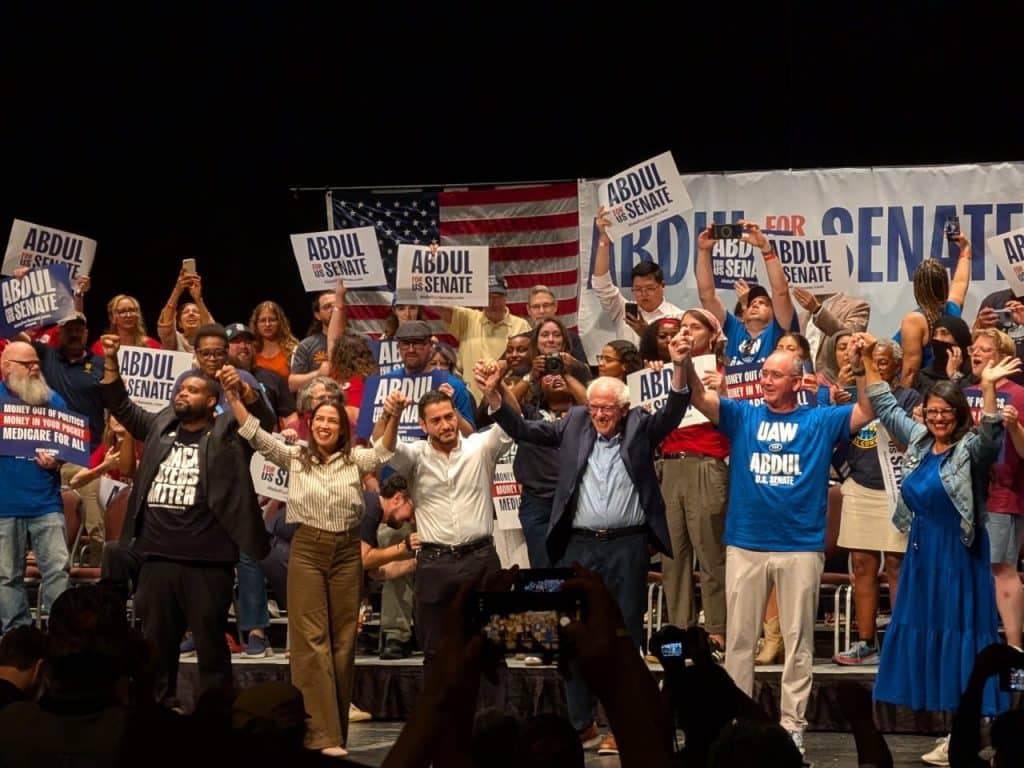
Last week, major gains made by leftist candidates across Michigan’s primaries were fueled by Democratic base outrage over the political establishment’s support for Israel, opposition to the ongoing legal assault against pro-Palestinian advocates, and the broad disrespect of the state’s huge Arab-American populations.
In turn, pro-Palestinian or anti-establishment candidates won in 11 out of 16 key races across the state’s ballots that pit the party’s two factions against each other, while all Democratic Socialist of America and Working Families Party candidates defended their seats. Meanwhile, the Israel lobby lost several races and burned over $30 million in the Senate battle between Abdul El-Sayed and Haley Stevens.
Among others who won on Tuesday are DSA-backed U.S. House candidate Donavan McKinney, whose district largely covers Detroit; DSA member and Ann Arbor mayoral candidate Yousef Rabhi; DSA-backed state House candidate Chris Gilmer-Hill in Detroit and the northern suburbs; and Michigan Senate candidate Abbas Alawieh, who in 2024 launched the Uncommitted Movement.
Alawieh will be the first Arab-American in the state senate, representing Dearborn, a city with the largest Muslim population per capita in the U.S.. Most of the eleven are in safe districts and will almost certainly win in November. Rep. Rashida Tlaib easily won her race as well.
Voters in Michigan, a critical swing state, clearly sent a message on Tuesday and will have its most pro-Palestinian representation at the local, state, and federal levels ever starting in 2027. But the question now is: What comes next?
Incumbent Michigan State Rep. Dylan Wegela, a Democratic Socialist of America member who won his district’s primary this year, told Mondoweiss that holding elected office gives pro-Palestinian advocates a louder voice and “the power of the letterhead.”
“I think it’s important for elected officials to be signaling change even if we don’t have that power right now,” Wegela said. “We’ll never get there if we don’t have people brave enough to say what they’re doing is wrong and we need change.”
Last year, Wegela introduced a House resolution condemning US support for the Israel’s genocide and calling on Congress to stop funding it. It died in committee, but having more voices to support these messages sends a signal, Wegela added.
Wegela noted how lawmakers working with Michigan Divest successfully campaigned last session to have the Michigan Treasury Department’s retirement fund divest from Israeli bonds. Now, Wegela says lawmakers are pressuring the Michigan Economic Development Corporation, a quasi-public body that manages taxpayer incentives for businesses, to stop funding the Michigan Israel Business Incubator (MIBA), which promotes economic ties between Michigan and Israel.
“That is a powerful statement,” Wegela said
And Tuesday’s gains were not limited to the legislative branch.
Amir Makled, a defense attorney who represented some University of Michigan protesters targeted by the school following pro-Palestine protests on the campus, beat pro-Israel U-M regent Jordan Acker in the April Democratic Party nominating convention for the Board of Regents. Makled will now be the lone member of the university’s governing body who has supported the protesters.
“I’m not trying to be the loudest voice at the table, but I am definitely making sure that the people who don’t have a traditional seat at the table finally have someone who can listen to them and speak for them,” Makled told Mondoweiss.
In the Michigan Attorney General nomination race, progressive prosecutor Eli Savit beat the pro-Israel and corporate-backed candidate, Karen McDonald, at the convention. If Savit wins in November, he will succeed pro-Israel Attorney General Dana Nessel, who has hammered U-M’s pro-Palestinian protesters.
Savit, a Jewish Prosecuting Attorney in Ann Arbor, likely would not describe himself as pro-Palestinian, but he declined to charge most protesters at U-M when the cases were first brought to him in late 2023. Nessel, however, then made an unprecedented move by taking the cases from a local prosecutor who had declined to charge and bringing them herself. Defense attorneys for the students alleged she was too biased to take the cases, and was ultimately forced to drop them.
Nessel later ordered raids on other protesters’ homes, and is working with the Trump administration in cases against protesters who allegedly vandalized pro-Israel businesses. Savit has not said what he would do with the cases, but given his track record, he may be less likely to work with the Trump administration or bring new investigations. However, pro-Palestinian advocates say recent charges brought against a University of Michigan graduate student union leader raise concerns.
Overall, the wins across the state bring Michigan’s electeds more in line with the base’s feelings about Israel – only 16% of state Dem voters support funding arms for Israel, an August poll found, while AIPAC’s favorability is at about 12%.
Mara Matta, a Lebanese-American organizer with the DSA, worked on El-Sayed’s 2018 gubernatorial campaign, then the Uncommitted Movement, prior to focusing on campaigns for DSA-backed Chris Gilmer-Hill in the state house and McKinney in Detroit and adjacent suburbs.
She said she would like to see state support for MIBA ended. But Matta said the most profound change lies in the animosity toward and suspicion of Arab-Americans that followed 9/11 finally beginning to dissipate. She noticed the shift while knocking on doors, campaigning on ending funding for Israel, and hearing sympathy from people who said things like, “I’m so sorry about what is happening to your people.”
“I feel hope because for more and more people my humanity is not in question,” Matta said.
“The fact that they care and they’ve made the big picture connection that we have a shared collective future together – that’s what gives me hope, and that’s what drives election wins.”
The results also show AIPAC’s and other pro-Israel donors’ waning power. Beyond Stevens, it heavily backed Rep. Shri Thanedar in his loss to McKinney and lost in the McDonald-Savit race, but notched a win by backing Justin Onwenu over leftist Yemeni-American former state rep. Abe Aiyash in a state senate race.
What comes next for the Israel lobby group in the state is now an open question.
Jess Newman, a Jewish former AIPAC staffer who left the group in 2013 and is now a DSA member who serves on the Ferndale Public School Board, said AIPAC “is on a retreat,” but it will not relent. She noted that it adjusted its strategies after DSA member and US Rep. Alexandria Ocasio-Cortez in 2018 beat the pro-Israel-backed former US Rep. Joe Crowley, setting off a political earthquake.
The lobby returned in the subsequent cycles, perhaps hitting the zenith of its power in 2022 when it backed Stevens, who is not Jewish, over former US Rep. Andy Levin, who is Jewish, because Levin had criticized settler violence. Stevens beat Levin by a wide margin.
AIPAC is already vowing to regroup against El-Sayed in the general election and support Rogers.
But Newman said the DSA has a strong ground game to counter the sheer volume of spending. The DSA knocked on tens of thousands of doors in the McKinney race, which he won by only a few thousand votes. And the lobby is tied to corporate and Republican donors at a time when many young Jews and the broader population is rejecting them.
“At the end of the day, AIPAC can’t buy integrity,” Newman said.
Gains made by pro-Palestinian advocates have rattled some generally pro-Israel folks in Michigan’s Jewish population, said Allan Lengel, who runs the Deadline Detroit news outlet, and covers issues related to the community. Some may not vote for El-Sayed or others in the general election, and some have even vowed to financially back Rogers. That could present a problem in a swing state where elections are often decided by narrow margins. Donald Trump won the state by 12,000 votes in 2016, and US Sen. Elissa Slotkin won by 80,000 in 2024.
Lengel said the pro-Palestinian gains have been “very painful for a lot of the liberal Jewish Democrats” who don’t support Netanyahu, but do support Israel, he added.
“They feel kind of lost and are asking ‘Is this party really for me?’” Lengel said. “But there’s no way they’re going to be Republicans, so it’s an interesting moment for Jewish voters as they figure out where they stand and what compromises they can make and still feel okay.”
Tom Perkins
Tom Perkins is a Detroit-based freelance reporter who covers the domestic response to the genocide in Gaza.