

At J Street, Leonard Fein, the tall and now white-haired Forward columnist, said in a promotional video that the greatest achievement of the Jews in the 20th century was the creation of Israel. I admit that his comment affected me. I have deferred a little in my mind to his feeling– out of respect for an elder. This is not so different from the feeling David Zellnik expressed to me, that he is a post-Zionist not an anti-Zionist, out of politeness toward the feeling of achievement Zionists have for what they’ve done. Well then I read the latest Middle East Report, and a shocking story by Monica Tarazi, describing in cold straightforward terms the treatment of the Bedouins in the Negev (in Arabic, the Naqab) desert, and I think, I really don’t care who regards this as an achievement, it is institutionalized racism, and a blot on my community.
The ethnic cleansing and discrimination that Tarazi exposes– well, it’s just like what happens on the West Bank. And I wonder how Leonard Fein can defend this, and when he thinks it will end, and what he thinks American Jews have gained by blindly supporting Israeli Jews in this disgraceful behavior– four decades after the end of Jim Crow in this country.
It’s not online, but I’ve typed out one of Tarazi’s most damning passages. Read this and you will understand why young American Jews write private emails to me saying that they are anti-Zionist; they wish to dissociate themselves from the unending Nakba of the Selfish state.
Considering the characteristics of the Jewish town of Omer and the Bedouin township of Tel Sheva side by side reveals two completely different realities separated by less than a mile.
Ranked second in Israel for socio-economic indicators, Omer is a development town founded in 1975. It has a population of 6,000 and is built on 17,000 dunams of land, 2.8 dunams per capita. More than 90 percent of its students graduate from high school. The town abuts a high-tech industrial zone and its municipal website brags of its "spectacular landscape of forest green vegetation and blooming flowers"… When Omer decided it wanted to expand, the [local planning commission] simply annexed an area of 7,000 dunams of land from the neighboring unrecognized Bedouin village of Tarabin al-Sana’. Rather than permit the 5,000 Bedouin residents of Tarabin al-Sana’ to move into Omer the Omer authorities are trying to force them into a specially created township. In 2007, Omer planning officials issued 75 demolition orders to all the remaining Bedouin homes in the Taraban al-Sana’.
Tel Sheva, by contrast, has 10,000 residents and is built on 4,00 dunams, 0.4 dunams per capita. It has been accorded no territorial expansion despite its considerably higher population density. It is the poorest locality in Israel and has little in the way of a "spectacular landscape." Less than 5 percent of students graduate from high school and Tel Sheva has no industrial zone to provide jobs and no economic infrastructure. It has no sewage system or paved roads, substandard municipal services and has one of the highest rates of unemployment in Israel..
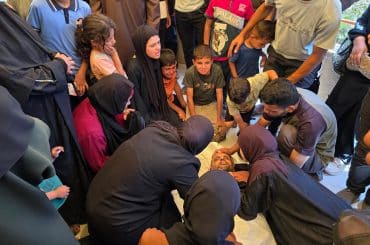

“…a shocking story by Monica Tarazi, describing in cold straightforward terms the treatment of the Bedouins in the Negev…”
What Phil! Don’t you know this is in the middle of nowhere? Just ask carnass…
I lived in Israel for many years but it was only as an expat, visiting from America that I visited Tel Sheva. We drove down a residential street and came to the perimeter fence that surrounds Omer. One side of the street is upscale suburbia (by Israeli standards) – the other is third world poverty. We passed through a gate and walked less than a minute to a Bedouin tent. Our Jewish group sat on the ground in the tent. We met with the male elders. Kids in tatters roamed around. Felt like the reservation. The only nice thing about it was that we were welcome guests and had not comes as Israeli interlopers.
Omer is relatively old. More recently, the Israeli government has been offering financial incentives to any Jew willing to settle in the Negev desert and claim the land. These latter-day Jewish farmers bring together the 19th century Zionist vineyard with Ben Gurion’s call to “make the desert bloom.” On my last trip, I tasted the wine produced from the grapes of one of these desert vineyards, near the Egyptian border. It was awful stuff. But at least it’s Jewish.
One thing that may help people living in the Negev would be to find a solution to bring a massive amount of water into that area.
That’s not a solution, that’s part of the problem. Misguided attempts to bloom the desert have drained the scarce water resources of the region.
Elliot, thanks much for that information, Phil
Get it right, Phil: “The World the Zionists made…”
To be fair, yeah. It’s not as if Jews like Phil need to be all self-loathing about something that takes place in spite of their actions, not because of them.
Leonard Fein happens to be Israel’s most severe critic within the organized Jewish community as well as a critic of the Jewish establishment itself. He has taken on AIPAC and the ADL as has no other “internal” Jewish critic. He has invested years of time, effort and emotion into prodding Israel to fulfill his dream of what it should have been but never was and never could have been.
When he says that the greatest achievement of Jews within the 20th Century was the creation of Israel and that achievement was at the same time one of the century’s greatest crimes, it simply shows how, at the end of the day, how morally bankrupt Zionism is and was at its very core. As the late, great Prof. Israel Shahak, wrote, “There is no such thing as humane zionism.” And that’s even had there been no ethnic cleansing of the Palestinians.
Yeah. I mean, honestly I’d say Albert Einstein’s accomplishments alone single-handedly out rank Israel, and that’s merely one Jew. But as a former physics student, perhaps I am biased. :)
You got to hand it to ‘em, the Zionists used everything and anything, and managed to dress up a straight bit of colonial land-theft and nation-building with an aura of heroism.
Whoa, there! Let’s start at the beginning. My actual words were that Israel is the most significant collective project of the Jewish people in our time. “A project” is not the same as “an achievement.” But even were I to say “achievement,” I would not and did not say, in the same breath or any other, that it is also one of the century’s greatest crimes. That is evidently what Blankfort thinks; it is not what I think or believe. I cannot figure out people who choose to lay all the blame for what’s happened on one side or the other. In my view, both sides are right, both sides are wrong. That doesn’t add up to a crime; it adds up to a tragedy. Plus: I have known, up close, far too many humane Zionists to think Shahak’s words more than a failed attempt at cleverness.
The American Songbook will outlive Israel.
One might hope. Some of us aren’t exactly convinced that it’s still alive, presently, though. One would like very much to be wrong about that, though.
“The American Songbook will outlive Israel.”
I’m with you, and I’m doing my best. Today it was Porter: “You’d be So Nice to Come Home To” and “It’s Allright with Me” and “You’d be So Easy to Love”
Cole Porter’s songs written around or in (he did both) minor keys sound especially good on the Hammond organ. Not that I don’t give everyone from Berlin and Cohan to Mancini and Legrand a good beating when I can, but this week it’s been Porter.
Pingback: More on house demolitions and ‘unrecognized villages’ in the Negev