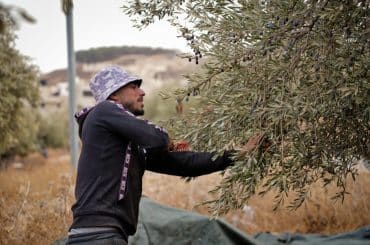
Dialogue re Kristof, non-violence, and stones

Weiss: Matthew Taylor has published a couple of pieces on this site urging Palestinians and solidarity activists to adopt nonviolence as a strict rule of engagement. Lately Nicholas Kristof made a similar argument in the New York Times under the annoying headline, Waiting for Gandhi in the West Bank, and this site has mocked and disputed him. But Taylor agrees somewhat. Below I engage Taylor in a dialogue-- because I'm uncomfortable with the ideas, but do want this site to be a forum. It goes back and forth a couple times. Taylor first:

Nicholas Kristof's NYT piece on Bil'in and Palestinian non-violence has sparked mostly acerbic responses, such as Glatzer's and Desch's.

First off: I agree that Kristof strays into some clueless, elitist condescension, for instance his characterization of years of dedicated Palestinian non-violent resistance as "dabbling." Many of Glatzer's digs ring true.

But here are some positive points about this piece:

1) Kristof hands the microphone to Palestinians. Listen to what they say:

“This is what Israel is most afraid of,” said Dr. Mustafa Barghouthi, a prominent Palestinian who is calling for a nonviolent mass movement. He says Palestinians need to create their own version of Gandhi’s famous 1930 salt march....

Quite a few posters and commenters here (including Desch) express skepticism that a Gandhi-like approach would accomplish anything. Tell that to Barghouti, and the grassroots Palestinian organizers who see that pathway as the road to liberation.

“With nonviolent struggle, we can win the media battle,” Mr. [Ayed] Morrar told me, speaking in English. “They always used to say that Palestinians are killers. With nonviolence, we can show that we are victims, that we are not against Jews but are against occupation.”

As I noted in my previous opus, and Morrar makes clear here, changing Israeli psychology and public opinion, and helping them feel less afraid, is a key to unlocking Palestinian freedom. Also note that Morrar's comments reflect one of the basic tenets of principled nonviolence: oppose the behavior, never the individual or group that perpetrates the behavior.

2) Kristof correctly notes one of the biggest challenges the Palestinian non-violent movement faces:

At first the mood was festive and peaceful, and you could glimpse the potential of this approach.

But then a group of Palestinian youths began to throw rocks at Israeli troops. That’s the biggest challenge: many Palestinians define “nonviolence” to include stone-throwing.

Many Palestinians have said the same thing and condemn stone-throwing and say it's counter-productive and unhelpful to the struggle, and that the movement should be more committed to disciplined nonviolence. Kristof's comments about "what Gandhi would have done" are entirely accurate. You can impeach Kristof and say he's an elitist, privileged, pro-Zionist, blah blah blah ad hominem, but in this column he knows exactly what he's talking about when he says:

It’s a far cry from the heroism of Gandhi’s followers, who refused even to raise their arms to ward off blows as they were clubbed.

No one with a serious knowledge of Gandhi would conclude anything else, regardless if they are Palestinian, Israeli, Zionist, non-Zionist, mainstream media, alternative media, or Martian. Just refer to the Dharasana Satyagraha.

Now here are two negative points/problems about the piece:

1) Israeli activist and UC Berkeley divestment bill co-author Tom Pessah writes: "I was in Wadi Rahal on Friday, south of Bethlehem, and the villagers stage protests every week with no stones - as do several other villages."

So why didn't Kristof cover that, and only Bil'in and its stones?

2) The frame implies we must wait for all Palestinians to turn into Gandhi or stop throwing stones for the Palestinians to be "worthy" of justice.

Our job in the international community is to push hard for justice regardless of anything the Palestinians do. But Morrar is right that Palestinian nonviolence will make the arrival of freedom more possible, more likely, and sooner.

Conclusions

Kristof is pushing the edges of the mainstream media's coverage of Israel/Palestine. Let's hope he goes farther, and starts reporting in a more serious way on the realities of Israel's occupation and apartheid policies, which to date he has only lightly touched.

P.S. He's right that women played a major role in the Budrus struggle. I won't comment on whether the idea of Palestinian women taking a lead in protests is a good one or not -- or whether such proposals are condescending -- let's hear what the Palestinian grassroots nonviolence leaders have to say.

P.P.S. Speaking of which, we should be asking Palestinian grassroots organizers and leaders to post to Mondoweiss on this topic. What do they think of Kristof's column? Let's ask Sami Awad, Ayed Morrar, Mohammed Khatib, Dr. Mustafa Barghouthi, and others to post.

Weiss: Matthew, As you know, I know nothing about Gandhi and don't study his ideas. Ira Chernus, who has studied Gandhi, says that he wouldn't take a hard line on the kids throwing stones. (Saying that nonviolence was a choice that he made for himself, not to try and affect others' behavior... ) More important, Chernus gets at my own discomfort with Kristof's view: "when oppressed, militarily occupied people resist, let's recognize that it's not our place to tell them what means they should or should not use -- and certainly not when our own nation is contributing so much to their oppression."

Kristof doesn't talk about what these kids experience, daily humiliations, killings of Palestinians on a fairly casual basis. And that background makes me personally very reluctant to judge those kids. I wish they weren't throwing stones, but as I frequently say to you, Here I am in my nice house living in the U.S., commenting on kids who are oppressed. Isn't my role, as Chernus says, to talk to my community and try and change that? I want to air your views because I want a broad community, Kristof is the best the Times has to offer on the subject in print in the mainstream, and I welcome his engagement here, and I don't want my community to become insulated and self-reinforcing. Also, I do think that westerners can give advice to the Palestinians; I don't defer to Palestinians automatically.

But having been to Gaza and the West Bank, I think these people are tyrannized and it's hard for me to condemn an expression of rage that is fairly gestural. We're not talking about suicide bombing, or indiscriminate rocket attacks, which I think are bad.

Taylor:
1) Gandhi would have said Palestinians have every right to resist violently "within today's accepted social norms" (thus, no targeting civilians).
 
2) But he would have said (did say) nonviolence is infinitely superior to violence, and he would recommend nonviolence (and did recommend it) to the Palestinians.
 
3) If Palestinians are going to resist nonviolently, Gandhi would have absolutely advised them to make their definition of nonviolence the same as his, obviously including no rocks. 
 
4) Many Palestinians say they are doing nonviolent resistance. Any serious definition of nonviolent resistance does not include stone throwing.
 
5) The stone throwing harms their efforts and is counterproductive. Many Palestinians say this. There is a major debate within the Palestinian resistance movement about to stone or not to stone. I've heard the debate, in real time, in Bil'in.
 
6) I think Ira Chernus is right that Gandhi primarily focused on trying to change Indian behavior, but wrong in that he understates how much Gandhi focused on persuading the British to change their behavior. Gandhi was clear and consistent that through nonviolent struggle and sulf-suffering, he and his fellow Satyagrahis would persuade the British to leave as friends, which is precisely what happened.
 
7) Kristof's primary obligation is to criticize the U.S. Government's Open Tab bartender-like enabling of Israel's addiction to land theft. AND to expose, without caveat or sentimental distortion, the realities of Israel's worse-than-apartheid policies. So far he has not done this in a serious way.
 
8) But he has taken steps in that direction with some of his criticisms of the occupation.
 
9) Yes Kristof is privileged, and shouldn't preach to Palestinians. He should do his job per #7.
 
10) AND that doesn't change the fact that he is writing accurate and true words about what Gandhi would do, and also that the stone-throwing is counter productive and incompatible with the ways of Gandhi that many Palestinians say they aspire to.
 
It's easy to think simplistically about Kristof, as follows: Either he wrote a condescending elitist column that is consistent with a general dereliction of his responsibilities as a journalist to expose Israel/U.S. crimes, OR he wrote an excellent analysis of the ways in which Palestinian non-violent struggle is both achieving victories and falling short. I think both are true, in certain ways.
 
Us nonviolent scholars aren't in the business of judging. We look at what succeeds and what doesn't, what works and what doesn't, from the point of view of the resister. What is consistent with principled nonviolence? With pragmatic nonviolence? Or none of the above? What helps move the resistors toward freedom, equality, and reconciliation, and what backfires? This is an analytical question. Stone-throwing, for example, can be analyzed within these frames. Palestinians have done this analysis too. We nonviolence scholars analyze all kinds of justice struggles around the world... anti-globalization, environmental, Burma/Myanmar, you name it, always from the point of view of the resistors and the resistors' actions and ways of being.
 
So one can analyze the stone-throwing without judging it. One can empathize with the rage these kids feel and say that you might throw stones if you were in their shoes, and also say, any rational analysis can only conclude it's not helping the cause.
 
An Israeli soldier reportedly lost an eye to a stone a few years ago. So no one should pretend the stones have no impact. Yes yes yes they are 1/100000000000000000 of the violence of the occupation. But that's not the point, from the perspective of a nonviolence scholar. The point is, Does stone throwing help or hurt the cause? We already know the oppression is brutal. Our job as nonviolence scholars is not to say how bad is the oppression (already well-documented), but to analyze how the resisters can use the power of nonviolence to transform the situation from oppression to justice, equality, and reconciliation.
 
Weiss:
Honestly, I don't think about Gandhi would do, I think about What I would do. I try and be Everyman about some stuff.
And I think that were I a kid in that situation, hearing what he heard about his parents/uncles/grandparents, facing the future that he does, I'd frikkin throw stones.
And I think that there is something in the human breast, everywhere, that responds with affirmation to that. Maybe it's because we're a violent species, but we relate to that. Just as some people felt, when commandos were descending on that boat in international waters-- good for them, they grabbed sticks! (While I would have been sitting at my computer in a back room of the boat, typing). Just as we honor the person who risks his life to kill a dictator....Note this anthropological piece from the Bulletin of Atomic Scientists,
by Hugh Gusterson, saying that enraged and humiliated people are going to violently resist it...
 
Taylor:
Were I a teenager in that situation, I'd definitely want to throw rocks, or much more than that. Wasn't it Ehud Barak who said: "If I were a Palestinian of the right age, I would join, at some point, one of the terrorist groups."
So sure, we can spend all day debating what we would do if were in the Palestinians' shoes.
But that is not, **at all**, what nonviolent scholars debate. What we debate are the points I mentioned previously... like how, from the perspective of the resister, to achieve freedom, equality, and justice -- something that has been achieved by oppressed peoples in the past through nonviolent struggle.
So our frame is not: "What would we do in their shoes?"
Our frame is: "What does the history of nonviolent struggle tell us would be a course of action and way of being that would help end the oppression? What would succeed and work?" Remember the definitions of success and work from my opus.
The fact that some villages such as Wadi Rahal stage protests without stones (according to Tom Pessah) shows it's possible. I suspect the leadership and discipline is coming from the village elders, not the shabab (the youth). Wadi Rahal has probably prepped their teenagers on what to do (and achieved buy-in and consensus) in a way Bil'in has not, just a guess.
Phil, you're wrong when you say "there's something in the human breast, ***everywhere***, that responds with affirmation to that [stone throwing]." Although some Israelis have expressed sympathy for the Palestinians who do this, many say it gets in the way of feeling empathy for the Palestinian experience. Remember, in one widely reported incident a few years ago, an IDF soldier lost an eye to a stone. As is clear from Bradley Burston's columns on this topic, he and other Israelis feel more influenced by the nonviolent resistance when it is disciplined and stone-free. No doubt, the Palestinians shifted the international discourse in a positive direction overall with the First Intifada and now the Third Intifada with the resistance to the wall, unlike the suicide bombings of the Second Intifada. The images of Palestinian kids facing down tanks with nothing but stones helped some internationals want to support Palestinian freedom. (And yes, that's analogous to Mavi Marmara passengers with sticks vs. armed Israeli commondos.) But I think history makes clear that more positive influence happens with a greater level of nonviolent commitment and discipline. Stones and sticks and clubs and all that other stuff isn't nonviolence and it won't help win over the most important people, the Israeli public (and American Jews), in the way disciplined nonviolence would, and history proves this true.
As your remarks on The Bulletin article, for sure, violent resistance is a highly natural reaction to oppression. Any of us would do it in their shoes, Ehud Barak would do it. But is it strategically helpful? "What would I do in their shoes" is the not the frame of nonviolence scholarship.
The Bulletin article in places takes the same frame that you, and 90% of the commenters on your blog, take: who/what is to blame? But we on Mondoweiss already know the answer: Israel's oppression and policies are overwhelmingly responsible for the suffering of the Palestinians, not Palestinian resistance or lashing out (I think suicide bombing is more lashing out than coherent resistance). So when I say, "disciplined Palestinian nonviolence is more likely to succeed at ending the occupation and work to create conditions for equality, reconciliation, freedom, and justice than less disciplined non-violence that includes stone-throwing," most people hear that as saying, "the Palestinians are to blame." But I'm not saying that. That's an inaccurate interpretation. I think the statement is clear and speaks for itself when it's not washed through the "who's to blame" lens.
Also, The Bulletin article doesn't reflect much knowledge of the history of nonviolent resistance. If it did, it would recognize that enduring major onslaughts and not striking back has been done, successfully, on numerous occasions, by nonviolent resistors throughout the world and throughout history. It's not easy (and requires training, preparation, coordination), but it's been done. The piece makes it sound like that would be impossible, almost implying the Palestinians have no choice but to throw stones. The Wadi Rahal examples proves that wrong.
Finally, I REALLY want to IMPLORE you to agree (i can handle sending the invitations) to invite Palestinians into this discussion. I find it preposterous that all us non-Palestinians, mostly American Jews, are debating this stuff. The debate's not getting old, but without Palestinians, it is getting old, sick, and tired. Let's hear from the grassroots Palestinian organizers of nonviolent struggle.
I kind of think a lot people on your site don't really get what I'm saying, and hear everything through the "who's to blame" frame instead of the one I'm actually using.
BTW in your post about The Bulletin article, you didn't quote the most important paragraph, this one... It's interesting you siphoned off the parts that in your mind show you'd throw rocks if you were Palestinian, instead of this paragraph which in a very profound way shows the power of nonviolence, and I see as the heart of the whole piece....
An Israeli activist tells us in Budrus that "nothing scares the army more than nonviolent opposition." I hope this is true. The Hamas lawmaker Aziz Dweik was surely right when hetold the Wall Street Journal that "When we use violence, we help Israel win international support." But maybe the deeper comment was made by Mayor Morrar when he said in a subsequent interview that "criticism of the occupation by its own people is more powerful than criticism by someone who lives under it, whose opinion is pre-determined. It is very important to find someone amongst your opponents who is willing to side with you." If the film shows us anything, it is that 10 Israeli protesters are worth 100 Palestinians. Their participation in the protests shows that Israelis and Palestinians can work together and, in a context where Israeli soldiers look awfully like Police Commissioner Bull Connor's men beating up blacks in Birmingham, the appearance of blond-hair under the nightsticks makes it that much harder to dehumanize the protesters, that much harder for soldiers to ignore the quiet questions about the orders they are just following, that much harder for the state to simply crush resistance. So far, 600 Israeli soldiers have refused deployment to the West Bank and Gaza.

Posted in Israel/Palestine | Tagged , , , , , , ,

{ 42 comments... read them below or add one }

  1. gazacalling says:

    Wow, Matthew really won me over. Very thoughtful arugments. Ultimately, we need the media though. If a nonviolent protester falls in the street, and there’s no media coverage, it doesn’t make a sound. Both these perspectives seem to me complementary, the need for objective media coverage (Weiss) and the need for a resistance strategy that works (Taylor). One without the other falls far short.

  2. I wish I’d thrown this into the post before it ran, but ya just gotta check out Bradley Burston’s latest piece on Palestinian (and Israeli!) nonviolence.

    So it is, that dyed-in-the-wool anti-Palestinians have long delighted in denouncing the Palestinian movement for having failed to produce a home-grown Mahatma Gandhi or Martin Luther King.

    Of course, the criticism is as disingenuous as it is self-serving, since over the years the pro-settlement right has been the primary, perhaps the sole, political beneficiary of Palestinian attacks against Israelis.

    But the denunciation also tends to obscure a revolution gaining traction among Palestinians…

    What actually happened was a march in which settlers stared in wonderment and a certain anxiety at a large and unified force of Jews and Arabs taking a powerful stand against occupation.

    When one Palestinian youth picked up a rock to throw at the settlers, Arabs and Jews alike stopped him and distanced him from the march.

    The fact is that Israel may need a Gandhi more than the Palestinians do. As the Jewish state begins to examine its own actions and decision-making in the flotilla disaster, it is becoming that much clearer that Israelis need, for their own sake, to begin to study non-violence.

  3. Burston’s piece on nonviolence is here, I can’t figure out how to make a link work properly:

    link to haaretz.com

    Trying that again, test:

    • David says:

      Thanks for the conversation, which is interesting, and for the necessary point that Palestinian voices should be represented in this.

      But one major issue I’d raise
      “Also, The Bulletin article doesn’t reflect much knowledge of the history of nonviolent resistance. If it did, it would recognize that enduring major onslaughts and not striking back has been done, successfully, on numerous occasions, by nonviolent resistors throughout the world and throughout history.”

      Ok, yes. But you’re skipping out on some of the history, too. Nonviolent movements have also succeeded despite the fact that nonviolent discipline was not 100%.

      The U.S. Civil Rights Movement is just one example. As a nonviolence scholar, I’d imagine you’ve read Taylor Branch’s excellent 3 part history. Branch writes, very honestly, of the fact that protests in places like Albany and Birmingham weren’t always the 100% violence free things we have whitewashed them to be in our collective memory. Stones and bricks were thrown at police; sometimes people fought back instead of sticking to nonviolent discipline.

      So it seems to me that as a scholar of nonviolence, you’re job is not just to ask “what succeeds and what doesn’t, what works and what doesn’t, from the point of view of the resister,” but to do some analysis. What did internal critiques of violence and nonviolence look like within the Civil Rights Movement? Within Gandhi’s movement? Gandhi would call off marches if people didn’t adhere to total nonviolence–was this the most effective thing to do?

      What would be “more effective,” in your analysis? For the nonviolent resisters of Bil’in to call of the march if kids throw stones? But wait. I’ve been to Bil’in, and seen the leaders of the marches call off the marches when stone throwing start. People like Kristof don’t notice–because they are focused on the 1% of the protest that’s not 100% nonviolent.

      And this is exactly what happens in media coverage here in the U.S. of any major nonviolent mobilization. 1 or 2 people, perhaps put there as instigators or perhaps not, start a ruckus and that’s what get’s the coverage.

      The problem is in the coverage, not in the 99% of people in the mobilization who stuck to nonviolence.

      So you can say you’re not judging, but I think your critique is still pretty surface-level, and isn’t really addressing a lot of the complexities of nonviolent conflict.

      • LeaNder says:

        Thanks, David. Heartfelt: Danke! Something feels pretentious about this scholarly self-presentation, he honestly can’t imagine to never go nearer “wanting” to throw a stone at at tank, maybe “wanting” it? Could this be that he was born as a scholar, and thus knows he will always be on the side of power? No tanks will ever confront him? Surround his village?

        Phil, you’re wrong when you say “there’s something in the human breast, ***everywhere***, that responds with affirmation to that [stone throwing].” … No doubt, the Palestinians shifted the international discourse in a positive direction overall with the First Intifada and now the Third Intifada with the resistance to the wall … The images of Palestinian kids facing down tanks with nothing but stones helped some internationals want to support Palestinian freedom.

        Hmmm?

        On another “scholar’s reading list” (H-*) the link below was sent beneath the header: Harvard prof comments on B/O and Israel

        convince me this guy isn’t an arsonist. some scholars.

  4. notatall says:

    First off, all measures of resistance taken by an oppressed people are moral, whatever their tactical strengths and weaknesses.

    Second, it would help to clarify the ultimate goal of the resistance, whatever form it takes.

    Third, what about a million-person march on the borders of the Zionist state, from Jordan, Lebanon, Syria and Egypt, met by sympathizers from inside, with the aim of implementing the right of return and establishing majority-rule through direct action? Of course, that idea cannot be organized from New York.

    • Bumblebye says:

      First, I’m sure that just as BDS has been called “economic terrorism” so the Israelis would find some way to call this a form of, maybe, psychological terrorism!
      To expand on your idea, what if Palestinians everywhere – OPT, refugee camps, all around the world – were to march (with supporters abroad) to checkpoints, embassies, borders as you suggest, non-violently, but chanting in the three relevant languages (Hebrew, Arabic & English) “We want to go home”. If it were to happen regularly, say once a month, it could grow & become powerful enough to force positive action from the world’s politicians. If it could be everywhere, it couldn’t be ignored.

    • “First off, all measures of resistance taken by an oppressed people are moral, whatever their tactical strengths and weaknesses.”

      This reminds me of the line from the Tina Turner song: “What is love but a second hand emotion.” We can say the same thing about the word “moral” if we can reduce it to a notion of revenge, lashing out, or an irresistible urge to strike back.

      Proportionality matters. Resistance can range from passively going limp at a sit-in, to actively struggling to be removed from an area, to punching, to throwing stones, to using sticks, to using a knife, to using a gun. If we abstract from the immediate crowd control scenario we quickly get to terror: this can range from bulldozing the wall, to blowing it up with dynamite, to suicide bombings, to flying planes filled with people into tall buildings, to launching a missile with a 50 megaton nuclear warhead. There was the image of Palestinian women ululating after the assault on the World Trade Center on 9-11. I assume they considered that action moral.

      The strength of non-violent resistance is that it cuts through all that and stands on solidly moral ground.

      • Donald says:

        I don’t consider all acts of resistance moral–that’s absurd. But it’s impossible to judge from your post what you’re trying to say. Are you saying it’s a slippery slope from throwing a rock to flying planes into a building?

        If you are advising total nonviolence, does this apply to everyone or only the people that Westerners kill? Should Israelis respond to terrorist attacks with Gandhian nonviolence? There’s a pragmatic argument for saying Palestinians should be followers of Gandhi, but there’s no moral argument that one could possibly make that says Palestinians and not Israelis and Americans should be Gandhian pacifists.

        All this talk of Gandhism is just ludicrous coming from comfortable Americans anyway–I exclude from this criticism only those people who actually do practice what they preach. If the Berrigan brothers were still around (I don’t recall if they’re alive) and they want to tell Palestinians to be nonviolent, then they’ve earned the right to do so because they’ve lived what they preach. The rest of us are, to put it in religious terms, condemning ourselves with our own words every time we preach a nonviolence for Palestinians we don’t practice.

        • Donald:

          I’m saying throwing rocks is not necessarily moral. Yes, it’s understandable someone wants to throw rocks, but that very same impulse is what drives people to blow themselves up in crowded markets. I’m saying nothing about the morality of Israelis.

          I don’t think that anyone has to “earn” the right to express an opinion on this site. If you’re only going to permit Ghandi and the Berrigan Brothers to comment on the value of non-violent peaceful resistance, or on suicide bombings for that matter, then I suppose we should close down this site and nobody should say anything.

        • Donald says:

          “Yes, it’s understandable someone wants to throw rocks, but that very same impulse is what drives people to blow themselves up in crowded markets. ”

          Really? The very same impulse that has a teenager throwing a rock at Israeli soldiers with body armor on also motivates someone to strap on explosives, march on down to the local marketplace and blow up some women and children? Gosh, I didn’t know. So when Edward Said famously chucked a stone at an Israeli guard post on the border of Lebanon it was the same impulse that led Mohammad Atta to fly a plane into the WTC.

          I think you might be oversimplifying here just a tad. And nobody except a completely consistent pacifist who abhors all violence could say what you just said. Well, they could say it anyway, but at the cost of any moral coherence to his or her position.

          “I don’t think that anyone has to “earn” the right to express an opinion on this site. If you’re only going to permit Ghandi and the Berrigan Brothers to comment on the value of non-violent peaceful resistance, or on suicide bombings for that matter, then I suppose we should close down this site and nobody should say anything.”

          Bull. Censorship doesn’t enter into this. People can say almost any damn thing they want around here (depending on what Phil will tolerate), but that doesn’t mean they have the moral right to say it. People get confused about this all the time. You have the right in one sense to say what you want, but there are many things no moral person has the right to say. You are perfectly free to tell Palestinians they should practice heroic Gandhian nonviolence–you can tell them, as Kristof did, that they should march stoically towards policemen who will beat them senseless and possibly kill them. You can ridicule Palestinians who don’t live up to your high standards. You can do all of this while having absolutely no intention of practicing anything remotely like it yourself, even though as an American you help Israelis oppress and kill Palestinians.

          And if you do so, others can point out the gap between sermon and practice.

          Criticizing suicide bombing is actually different. This should be obvious, but apparently it isn’t. In that case you’re not asking someone to risk his or her life–you’re suggesting that they not murder people and themselves. Nothing hypocritical about that unless you yourself are a suicide bomber or some other sort of murderer (though it becomes hypocritical if you only criticize murder by Palestinians and not murder by Israelis or Americans).

        • Donald says:

          Incidentally, my paragraph mentioning Kristof is about Kristof only, not you. I have no idea what you are advocating–you mention a continuum of actions that ends with 50 megaton bombs and later a post that equates stone throwing with the mass murder on 9/11 and as you say, you’re only talking about Palestinian violence, not Israeli. Which is also part of the problem. Does nonviolence as a moral stance only apply to Palestinians?

  5. Oscar says:

    Matthew, I’m grateful that Phil gives an opportunity for the Mondoweiss community to hear your compelling perspective on nonviolence — it’s important that we have multiple viewpoints to consider, otherwise the site will become an echo-chamber.

    That said, I agree with Phil that it seems to be an elitist Western conceit that we dictate to Palestinians how they should resist the US-taxpayer-funded, violent apartheid. Kristof’s reporting smacked of such elitism and perhaps intentional obfuscation of the brutality. His kid experienced being stoned by frustrated Palestinian children? So he equates that with the IDF teargassing the peaceful protesters? Then he has the balls to suggest that a throng of non-violent women protesters should take the forefront, put their hands in the air and allow themselves to be teargassed by the IDF so the ubiquitous “Israeli media would transmit the images around the world.”. (no, Nick, that’s the job of you and Ethan Bronner).

    This apartheid of our making will not stop until the Western media starts humanizes the Palestinians. This 2-minute YouTube video not only shows the inhumanity of the IDF, but it also, I believe, is a powerful rebuttal to your argument that Palestinians shouldn’t throw stones:

    link to m.youtube.com

    • Oscar says:

      One more thing . . . It also plays into self-defeating oeuvre of the so-called “peace process.”. There is never a moment when the Israelis are satisfied enough to truly call for peace.

      If only the Palestinians would find their Gandhi . . . If only the Palestinians would renounce violence . . . If only the Palestinians would rise up and overthrow Hamas . . . If only Hamas would stop firing rockets into Sredot . . . If only Hamas would turn over Gilad Shalit . . . If only the Palestinians would love their children enough to not use them as human shields . . . If only Hamas would remove the pledge to destroy Israel from its charter . . . Now it’s the Kristofian “if only the Palestinian children wouldn’t throw stones at tanks and armed soldiers.”

      More than anything else, I’m fed up with being lied to by my government and manipulated by the MSM. The horizon for peace in the Middle East is always disappearing, the effort a Sisyphean boulder that seems to never have a hope of reaching the top.

    • LeaNder says:

      The link doesn’t work for me Oscar. Give me a title so I can try to find it elsewhere.

  6. I think the KEY point about dissent is that it is communication, and communication for a purpose.

    And, that then touches on the goal of dissent.

    Dissent can be a communication to the community that unconsciously oppresses. (I think that is a largely accurate description of the Israeli society, as the two populations are extremely separated now and have very little paths of communication.)

    If the purpose of dissent is to the community of the oppressors, then to intentionally or accepting adopt rock-throwing is literally counter-productive. They might as well be throwing rocks at themselves. It will be seen, and will be interpreted by the Israeli press as “they are out to get us”, which will be partially true in fact.

    If there is any hope of change of hearts and minds within Israel, and a path to realize that in application, then the Israeli populace will be the object of communication.

    If the purpose of the dissent is to the soldiers themselves, the most that will happen by rock-throwing is that the soldiers will become confused as to what they are confronting. And, they will either respond by hiding from the rocks, dispersing the crowd with teargas, or by more desparate approaches.

    Rock-throwing can be deadly, so a soldier cannot ignore the rocks as “non-threatening”. They make good theater but only ONCE, Tienamin Square if repeated would be ignored.

    If the communication is to the Palestinian community, “join in uprising”, that will result in worse persecution likely, and again consented by Israeli populace.

    If the communication is intended to the world, then the political strategy becomes to isolate Israel, by BDS for example.

    If the purpose of the communication is to the sympathetic Arab and solidarity world, then the purpose would be to keep the Gazan and Palestinian community remembered (sadly used for opportunistic as well as kind purposes). And, to stimulate communication back “we are with you”.

    But positive change for Palestinians will NOT occur by rallying the solidarity, or by orchestrating the isolation of Israel with any spillover to attitudes and acts of anti-semitism in Europe, US, Asia.

    Positive change for Palestinians will only occur by reconciliation. And, the only communication that will appeal to more than a small token of Israelis and even Europeans towards that end, is entirely non-violent.

    Like it or not, prejudicial or not, the current public perspective of the Arab world and of Palestinians is of violence. The history of terror has made a large imprint in the consciousness of Israelis and westerners. To ignore that is to be ignorant.

    The ONLY means by which Palestine will achieve improved relations with Israel and others is by non-violence. And the only means by which Palestinians will be able to transition to a civil democracy in whatever format, will be by the development non-violent and institutional leadership, not by guerilla leadership.

    Phil’s comments of not judging are skew to the question. MANY can understand the anger. I can. The problem is the construct the resolution.

    • Further,
      To respond in rage because of a nuance of vanity in Kristof’s, or Bronner’s, or my comments, is an indication of the absence of discipline and coherence on the part of dissent (if this group is any representation).

      It is a failing, a stubbornness, a violence itself, not an asset, not a backbone, not courage, not justice.

      Its the logic “power comes from the barrel of a gun”, rather than “power comes from knowledge, reason, justice, and moral conviction”.

    • “I think the KEY point about dissent”

      Again you’re using the word dissent without saying dissent from what.. I want to know the party line we’re dissenting from.

  7. Donald says:

    “I find it preposterous that all us non-Palestinians, mostly American Jews, are debating this stuff. ”

    It is preposterous. For Americans who want to urge Palestinians to adopt a Gandhian strategy the thing to do is show solidarity by engaging in protests where they take a real personal risk of jail or physical harm. As for Palestinian nonviolent activists coming here to write a guest column, fine with me.

    Without feeling the right to lecture them about it, I’ve always wanted Palestinians to adopt a totally nonviolent approach and am repelled by Western lefties who glorify violent resistance, especially given that in practice it usually involves terrorism. But Americans who wish to lecture fellow Americans about how Palestinians should adopt a Gandhian approach ought to be aware of how it comes across–they should know that as “well documented” as Israeli atrocities may be, they are rarely presented that way in the press. Instead, we are constantly told that Palestinians suffer, but it’s the fault of their leaders or themselves and if only they would be nonviolent a just solution could be found. So while I hope Palestinian advocates of nonviolence succeed in persuading their people, just about the last thing we need are Americans lecturing other Americans on the need for Palestinians to be nonviolent. That is the almost universal opinion amongst Americans–in fact, I think it’s safe to say that many Americans favor complete nonviolence on the part of all foreigners, unless they aim their guns at our enemies.

    And what about those Israelis who, Matt tells us, really aren’t bigoted or anything–they’re just afraid for their lives. That’s why they get so upset when someone throws a stone, because an Israeli soldier once lost an eye that way. Certainly what Americans need to be told is that there are massive numbers of Israelis who would be willing to make peace with Palestinians, if only an Israeli soldier hadn’t lost an eye to a stone some years ago. Coupled with information about what Israelis have been doing to Palestinians, I think that would have a desirable effect on how people view the conflict.

    Incidentally, Kristof didn’t hand the mike to the Palestinians–he quoted some making a point he wanted to make, the same thing that Tom Friedman does. Kristof then put those remarks next to his own condescending ones. It’s unfortunate that the NYT doesn’t seem to think Palestinian activists or intellectuals could contribute semi-regular opinion pieces to the NYT.

    • VR says:

      “Without feeling the right to lecture them about it, I’ve always wanted Palestinians to adopt a totally nonviolent approach and am repelled by Western lefties who glorify violent resistance, especially given that in practice it usually involves terrorism.”

      Time for you to get disgusted Donald, and I am not one of the “lefties,” left and right are two idiots arguing inside of a prefabricated box.

      “…isn’t it cowardly to use your women’s baskets to carry bombs which have taken so many innocent lives?”

      response:

      “Isn’t it even more cowardly to attack defenseless villages with napalm bombs [insert white phosphorous] that kill many thousands more? Obviously planes would make things easier for us. Give us your bombers sir, and you can have out baskets.”

      BATTLE OF ALGIERS

      Perhaps the Americans can tell them how successful they were with non-violent actions stopping the war against Iraq or Afghanistan? Or for that matter any of the recent non-violent activity has stopped anything which harms the people both foreign and domestic? Of course, afterward we go to our homes and take up personal peace and comfort.

      I find this whole argument of throwing or not throwing stones absolutely ludicrous. Maybe you can join your favored politicians who say when homes are demolished, or bombs are dropped on innocents by Israel – “that is not helpful – this is unsustainable – this is not acceptable” and wait for the next round.

      • VR says:

        Again –

        “Terrorism is a normative term and not a descriptive concept. An empty word that means everything and nothing, it is used to describe what the Other does, not what we do. The powerful – whether Israel, America, Russia or China – will always describe their victims’ struggle as terrorism, but the destruction of Chechnya, the ethnic cleansing of Palestine, the slow slaughter of the remaining Palestinians, the American occupation of Iraq and Afghanistan – with the tens of thousands of civilians it has killed … these will never earn the title of terrorism, though civilians were the target and terrorising them was the purpose.”

        GAZA: THE LOGIC OF COLONIAL POWER

      • Donald says:

        I’m not talking about throwing stones as violence, VR. That was sarcasm in my paragraph which mentioned the horror of how stone throwing upsets the Israelis. I agree that all this talk of stone throwing as violence is moronic at best and racist at worst. I’m talking about real violence against civilians as a method of war. People who use such tactics don’t usually stop when their war is over. They usually go on and use the tactic again, either against civilians in other countries in yet another war, or against their own people. If it’s okay to blow up children in a supposedly just cause, then it’s okay to torture prisoners and so on. It never stops. You might have noticed, or maybe you didn’t, that movements of the 20th century which used terrorist tactics usually ended up with governments that were repressive against their own people. It’s entirely predictable. And in those cases when the victors didn’t oppress their own people, they would continue to use those tactics in other wars. It’s quite true that the word “terrorism” is used by Western governments to describe what the evil enemy does, but it can also be used (or some equivalent term can be used) to describe without bias any group that targets civilians and that’s what Chomsky does, for instance. It’s the inability to understand this rather simple point that makes me cynical about some on the left. Orwell wrote about the way ideologues judged atrocities as either meritorious or vile depending on which side committed them–maybe you should google “Notes on Nationalism” and read that.

        • VR says:

          “I’m talking about real violence against civilians as a method of war. People who use such tactics don’t usually stop when their war is over. ”

          Donald, I hate to break the news to you, but there is no form of war that does not target people. You are living in a fantasy.

  8. LeaNder says:

    This is my fear. The Israeli crowd control will be the future paradigm for the whole west. The high tech army in the larger picture vanishes. All that is left to look at are sticks and stones.

    Stones and sticks and clubs and all that other stuff isn’t nonviolence and it won’t help win over the most important people, the Israeli public (and American Jews), in the way disciplined nonviolence would, and history proves this true.

  9. Uncle Akiva and Ari had this same argument, in Exodus:

    Ari: The minute Haganah adopts our policy of fighting instead of talking…
    …an alliance between us becomes automatic.
    Akiva: You’re not being fair.
    When it comes to fighting, Haganah has lost more lives than Irgun.
    Ari: We fight to defend ourselves, or to capture positions that we can occupy and hold.
    When you attack it’s just to spread terror.
    Your duty is done. You have given me the official line.
    But what about you, Ari?
    Forget Haganah for one moment, and tell me what you think.
    I think these bombings and these killings hurt us with the United Nations.
    A year ago we had the respect of the whole world.
    Now, when they read about us, it’s nothing but terror and violence.
    It’s not the first time this happens in history.
    I don’t know of one nation, whether existing now or in the past…
    …that was not born in violence.
    Terror, violence, death.
    They are the midwives who bring free nations into this world.
    Compromisers like the Haganah produce only abortions.
    Before you have a country, you have to have people.
    That’s the job we’ve done. Tens of thousands of people smuggled in…
    …with the whole British Navy blockading the coast.
    The population we’ve built is our most valid argument for independence.
    How can we ask the UN for a just decision…
    …when we keep blowing up things like a bunch of anarchists?
    You have just used the words “a just decision.”
    May I tell you something?
    Firstly…
    …justice itself is an abstraction…
    …completely devoid of reality.
    Second, to speak of justice and Jews in the same breath…
    …is a logical uncertainty.
    Thirdly…
    …one can argue the justice of Arab claims on Palestine…
    …just as one can argue the justice of Jewish claims.
    Fourthly…
    …no one can say the Jews have not had…
    …more than their share of injustice these past years.
    I therefore say, fifthly…
    …Let the next injustice work against somebody else for a change.
    You just changed the subject on me.
    You noticed.
    I suppose that means more bombings and more killings?
    I’ll put it this way.
    Let the National Committee keep on trying to talk the British out of Palestine.
    We have no objections. We will continue to bomb them out.
    -Now tell me, how is your mother? -She’s fine.

  10. syvanen says:

    Matthew Taylor has credibility advising Palestinians to engage in non-violence given that he has a record of supporting sanctions against Israel. Kristof has absolutely no credibility — what has he done with his forum to support justice for the the Palestinians? He is basically in line with the NYT — one big apologist for Israel.

    But I lean towards Phil in this debate. I cannot criticize Palestinian youth who resist armed soldiers and tanks by throwing stones.

  11. robin says:

    I like the format of this post. This kind of instant probing and discussion can help the author better make his point and address the concerns of readers.

  12. potsherd says:

    Not all stones are created equal. Not all stone-throwers are treated equal.

    When Israel starts firing rubber bullets at the haredi stone-throwers, I’ll take seriously their concerns. Until then, it’s just another instance of oppression.

  13. ish says:

    Non-violence has a beautiful spiritual and moral integrity.

    But before any non-Palestinian who advocates non-violence as a strategy for Palestinian activists should be taken seriously, they need to advocate non-violence for the State of Israel first. That’s what creeps me out about Kristof: the constant NYT rationalizations for Israeli violence, and then the lofty condescension to the quaint noble savages. And aren’t there all kinds of unstated implications: every time a liberal of Kristof’s ilk lauds Palestinian non-violence, aren’t they really issuing a silent condemnation of Palestinian militants, or worse, silent approval for Israel dispatching those militants who, we must assume, are getting what they deserve?

    • Donald says:

      “every time a liberal of Kristof’s ilk lauds Palestinian non-violence, aren’t they really issuing a silent condemnation of Palestinian militants, or worse, silent approval for Israel dispatching those militants who, we must assume, are getting what they deserve?”

      Yep. They’re also endorsing the view that virtually all Zionists embrace, that the main obstacle to peace is the fact that Palestinians are violent.

  14. Dr Gonzo says:

    A good debate. The Violence/Non Violence question is an important one. Since most here would agree that the current Israel/Palestine situation has shades similar to South Africa during Apartheid its useful to here what Nelson Mandela had to say during his struggle.

    “There are many people who feel that it is useless and futile for us to continue talking peace and non-violence – against a government whose only reply is savage attacks on an unarmed and defenceless people. And I think the time has come for us to consider, in the light of our experiences at this day at home, whether the methods which we have applied so far are adequate.”

    My feeling is to defer to Palestinians who say that a Third Intifada should be waged through non violent means, as this will most likely be the most successful. It does make sense.

    But I by no means worship Ghandi who also advised the Jews under Nazi Germany to non-violently resist. He was a bit of a peace radical. There does come a time when non-violence becomes a waste of energy and in certain circumstances allows to oppressor to continue crimes uninterupted.

  15. “Beyond Violence and Non-Violence: Resistance as a Culture” by Ramzi Baroud

    Resistance is not a band of armed men hell-bent on wreaking havoc. It is not a cell of terrorists scheming ways to detonate buildings.

    True resistance is a culture.

    It is a collective retort to oppression.
    Understanding the real nature of resistance, however, is not easy. No newsbyte could be thorough enough to explain why people, as a people, resist. Even if such an arduous task was possible, the news might not want to convey it, as it would directly clash with mainstream interpretations of violence and non-violent resistance. The Afghanistan story must remain committed to the same language: al-Qaeda and the Taliban. Lebanon must be represented in terms of a menacing Iran-backed Hizbullah. Palestine’s Hamas must be forever shown as a militant group sworn to the destruction of the Jewish state. Any attempt at offering an alternative reading is tantamount to sympathizing with terrorists and justifying violence.

    The deliberate conflation and misuse of terminology has made it almost impossible to understand, and thus to actually resolve bloody conflicts.
    link to palestinechronicle.com

  16. bindup says:

    “Finally, I REALLY want to IMPLORE you to agree (i can handle sending the invitations) to invite Palestians into this discussion.” – Matthew Taylor

    Please, Phil, would you agree to do this?

    I’d add to Matthew’s list Khaled Abu-Awwad, the Palestinian General Manager for the Parents’ Circle/Family Forum, whose son, Mohaned, was arrested in January 2010 and whose “confession” to being a terrorist was announced in Haraatz– under the headline “Son of Palestinian Peace Activist Admits to Attempted Terror Attack”– a month later. Awwad was kind enough to email me a statement that the PCFF sent to other Israeli peace groups after that development, a statement that went way beyond the blame game at a moment when a father, and an organization such as the Parent Circle, would have every temptation to indulge in it. I’d like to pass it along, but am not sure how (paste it into this Comments section? I’ll try it in a separate post)

    My point is that Palestinians practicing non-violence, and the Israelis who join them, are putting their lives and their families on the line every day in ways we cannot imagine. As others have already said, this conflict is different from India because the Land must eventually be shared; it’s different from our Civil Rights struggle because the two sides are not (yet) subject to one juridical system. So something entirely new is in the making. Palestinian participation in this discussion is crucial if we are to understand what that “new” is, and learn from it ourselves.

    Finally, I have to register my feelings about what Matthew quoted in his longer article, the statement of a “senior leftist Israeli negotiator” that a “massive unjustified slaughter” would be necessary to end the occupation. Please. This is certainly something that can never be legitimately wished for. And emphasizing this outcome is a distortion of Satyagraha, substituting a partial truth for a whole one. The whole truth is that the outcome of such actions can go either way: soldiers can refuse to fire, or innocents can die. The task is to increase the chances of the former, not set up the latter in order to win sympathy. Another reason to hear from Palestinians & Israelis on this subject. To keep it real. To learn from them.

  17. bindup says:

    The Case of Muhaned Abu Awwad: “Who are these children”

    Feb 18  Confession  as reported in Haaretz, by Avi Issacharoff
    link to haaretz.com

    BACKGROUND: Arrest a month earlier.

    Jan 23  - Arrest reported by Palestine Solidariy Project
    link to palestinesolidarityproject.org

    Jan 23 – Arrest as reported by Haaretz, Avi Issacharoff
    link to haaretz.com

    Jan 24, 2010-  Arrest reported on Parents’ Circle web site
    link to theparentscircle.com

    Jan 25
    British Friends of Parents’ Circle link to theparentscircle.com

    Jan 26 – Arrest as reported in Palestine Monitor
    link to palestinemonitor.org

    Jan 28
    Italy  
    link to world.pressenza.org

    Statement I received March 8, 2010. The original is in both Hebrew and English.

    Dear friends,
     
    I thank you for your concern and support of our family.
    Attached you will find a letter which the Parents Circle – Families Forum wrote as an answer to the Peace NGO’s. I hope that it will be helpful for your conference and thank you again for your support.
     
    Kindest regards,
     
    Khaled Abu Awwad
    General Manager

    Who are these children?

    Who are these children, these Palestinian and Israeli children of peacemakers?  Do we expect miniature Martin Luther King’s who will follow in the footsteps of their fathers or will the pressure of the street be stronger and will they be forced to take a path to prove a loyalty to their ethnic identity.

    And what identity is that for a young Palestinian who grows up in the West Bank, devoid of parks, cinemas, malls, concerts and yes sport.  Playing in the street does not breed a gentle spirit.   How can he feel a need for reconciliation when he cannot even touch the sand of a beach without permission or see a lion in the zoo or feel the freedom of movement without being challenged to prove he is indeed a peace maker at every check-point and barrier. 

    This young Palestinian will not only be challenged in his daily life by the powers that be, he will also have to prove that he is loyal to the cause and not, certainly not a collaborator, even though the stickers on his door talk about the fact that the conflict will never end if we do not speak.  What do you mean by speak, should he come to a seminar and meet with his Israeli brothers, and form friendships and understanding and begin to understand the other, or should he be pressured by his peers to prove that he too will fight this occupation and be a hero.   Most of the fathers of these young men, who are now peacemakers, have their credentials in their society by serving time in Israeli jails during the uprisings and being wounded and losing family members, but this glory does not exempt their children.  Indeed their children carry a heavy burden of belonging.
    What is the consequence for these children of peacemakers?  One week they are at a meeting with their Israeli counterparts creating friends and looking for ways for a safer future and for a non-violent solution and then on their way back they are stopped at the entrance to their village by a young soldier, who is bored with his job, and would rather be anywhere else.  Yes this young soldier decides to have some “fun” and keeps the children of the peacemakers for three hours until he has had enough and lets them go.  What should that child feel? Should he produce an olive branch? Or should he go away with the feeling that all the past week talking of reconciliation was just a sham.  It takes a pretty mature person of any age not to let this indignity effect who they are.

    And so after the encounter with the soldier, he decides to prove to his mates on the street, that he is loyal, he still sticks to his non-violent ways and demonstrates against the occupation, then the army swoops in and arrest him at 3 in the morning.  Whatever happened to other hours of the day.  Remember on the door there is a sticker, “It won’t stop until we talk”, nevertheless the whole family including the small children are thrown into the street while the defenders of our future search the house Now starts the most painful and terrifying time for the “peacemaker” and his family he is punished twice. Once for being a father and again for being one fighting for years for a non-violent solution.  The powers that be have a field day, and what are we left with, a broken family.  The father says at the next meeting with Israelis, no matter what, I will not be broken, I will go on with my mission for peace.  This father has lost two brothers in the conflict, has had his son on deaths door after being shot by Israeli soldiers.  And yet, he is willing to go on, where is our compassion, can we not understand the dilemma and the pressure he has to face.

    And what of the Israeli peacemakers children, they too have to face the dilemma of their peers, and the decision to go to the army and serve their country.  Suddenly one week they are talking peace at a seminar and getting to know their Palestinian friends, and then the next they are standing at a checkpoint having to check their papers.   They may even find themselves searching the houses of friends at 3 in the morning, what will that do to their souls.  We are not advocating refusal of army service, we only want to demonstrate a need, an urgent need to take responsibility for the future of all of the children.

    It is clear to all that the current situation is just a breeding ground for more and more hatred and fear, it is time to realize the needs of the other.  It is time to nurture the peacemakers and not to try and pass laws to stop their urgent work on the ground.  We can not allow a minority of war and fear mongers to ruin the moral fiber of Israel and what it should stand for. 

  18. Tom Pessah says:

    Since I was quoted here, I just wanted to clarify my own position. Kristoff seems to think he understands the occupation better than the Palestinians, based on a visit of a week or two. In reality, the mainstream media isn’t eager to cover non-violent protests (which go on all the time, there are many villages who do this, and most Palestinian resistance has always been non-violent) and the army can be very brutal in suppressing them (I think the film Bil’in My Love shows soldiers shooting teargas at protestors in wheelchairs). Therefore, I don’t think the stones/no stones dilemma should be such a focus of discussion, especially not an online discussion among non-Palestinians. If we want to support the resourceful and brave popular committees of Bil’in and the many other Palestinians villages who protest every week (Wadi Rahal, Maasara, Um Salamuna, al-Walaje, Beit Omar, Hebron, South Hebron Hills and many others places) we can help them cover their financial and medical costs, put pressure on the army to end arbitrary arrests, try to get more news about them into the mainstream media etc etc.

    Here is a call for action against Canadian companies building illegally on the village’s land, including details for online donations
    link to bilin-village.org

    if you really care about supporting them, check this out and see what you can do.

    • “Since I was quoted here, I just wanted to clarify my own position. Kristoff seems to think he understands the occupation better than the Palestinians, based on a visit of a week or two.”

      That is actually your presumption Tom.

      Kristoff is more accurately stating, “non-violence convinces us, violence, even David/Goliath rock-throwing doesn’t”.

      “What is your goal, to communicate to yourself, or to communicate to us?”

  19. Tom Pessah says:

    Anarchists Against the Wall, one of the main Israeli organizations supporting these protests, are also facing mounting legal costs. Their legal fund also serves to support Palestinians.
    here is their call for support -
    link to awalls.org

    and more about the range of activities they are involved in
    link to awalls.org

  20. Hi Matthew: a few quick points:

    1.) I don’t care about what people think Ghandi would or wouldn’t do. But, If anyone should be preached to about Ghandi it’s the IDF not the Palestinians.

    2.) I don’t care what nonviolent scholars debate about. Maybe they should get off their asses and get teargassed in the West Bank or get shot at challenging the buffer zone in Gaza, before they challenge the Palestinians with a stone-throwing purity test.

    3.) I don’t care about stone-throwing. If I was there protesting and I saw a youth stonethrowing I would probably advise them to stop. But it’s not as if I would spend all my time telling them what to do. You seem very concerned with one Israeli troop who lost his eye due to a stone. What about the Jewish girl from New York, Emily, who lost her eye protesting in the West Bank? It’s as if you have this value for Israeli life that you don’t seem to see in Palestinians or their supporters.

  21. The author of the original piece obviously hates advocates of nonviolent revolution over all, as he buys into the attacks on Gene Sharp which always seemed spurious and which were well addressed by Stephen Zunes last year in something he wrote for Foreign Policy in Focus (link to fpif.org
    And maybe pacifists like to over-claim victory, but in the last century revolutionary struggles mostly needed their nonviolent actors or they wouldn’t have had any life in them or chance to succeed. There were overthrows without blood-letting; that is a sign of growth. Now if only some of thost movements would hold to their repudiation of violence and arms once they come to power…

    And I’m not advocating for Palestinians to do anything; I am standing with Palestinians who already reject violence and the taking up of arms for social change. I may or may not take up a fighting stance or even a weapon in self-defense or in defense of someone else, but I wouldn’t see that as helping a movement, or doing something that will save us societally from other violence. Sometimes I like to quip that I am in the War Resisters League, not the Violence Rejecters League, but I have been in attack situations and haven’t resorted to violence in the past; still, we never know.
    In 2008, the WRL Peace Calendar featured 60 or more examples of nonviolent resistance and organizing spanning the Greater Middle East from Western Sahara to Pakistan. There were numerous examples of Palestinian and joint Palestinian/Israeli nonviolence, some practical and some principled. I edited it, and in my intro, I point out that my original vision was to focus solely on Palestine and name it “52 Palestinian Gandhis” challenging the ignorant lament I hear far too often from well-meaning people, “If only there were a Palestinian Gandhi.” When I reject conscription and militarism, I am standing in support and solidarity with the millions of people around the world who choose to demonstrate against violent repression like we usually aren’t subjected to in the U.S. When I reject violent organizing, I stand with the realists who see taking up arms repeatedly making things worse for most people, not better.
    And many pacifists are willing and able to argue against military or para-military actions putting aside our overarching critique of such actions. One doesn’t have to be a pacifist to see how stupid war is.

Leave a Reply