Great post by Nate Silver at fivethirtyeight.com showing that opposition to the mosque is not what the media have made it out to be. I have included Silver’s stunning map of the site for Cordoba House. Jeez, how far does the mosque have to be from Ground Zero for it to be hallal?
To be clear, Cordoba House is "in the neighborhood" of Ground Zero, and this seems to have been a deliberate choice made by its developers. But to suggest that Cordoba House is "at" Ground Zero, as some reporting and opposition groups have, is either negligent or willfully misleading.
The World Trade Center campus, shown in purple in the map below, is quite large, roughly two-tenths of a mile by two-tenths of a mile across. Eleven different streets abut or intersect it, and there are numerous points of access by foot, by cars or taxi, or on public transportation networks.
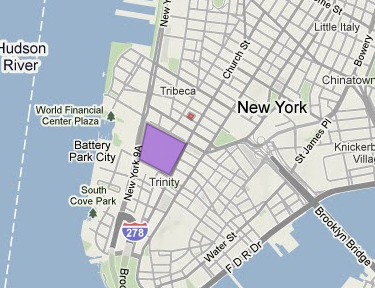
Cordoba House, shown in a red outline on the map, would be on Park Place between West Broadway and Church Street. Park Place does not intersect Ground Zero; instead, it runs parallel to it, two blocks to its north.
…Interestingly, although the Quinnipiac poll showed a majority of New York City residents opposed to the project, a 46-36 plurality of Manhattanites were in favor of it. There could be a variety of reasons for this, but one might be that they have a superior understanding of the borough’s geography. It is not as though there’s just one road to Ground Zero and some huge mosque would be built right next door to it.
Although the Quinnipiac Poll described Cordoba House fairly completely — as "a Muslim mosque and cultural center" — the Rasmussen poll describes it merely as "a mosque near the 9/11 Ground Zero site", omitting any description of its multipurpose nature. It is hard to say how much difference this makes, but Rasmussen, which often has problems with question wording, would probably do more to inform its respondents by referring to it as Quinnipiac did.
Another problem with both the Quinnipiac and Ramsussen polls is that it’s a bit ambiguous what it means to "support" or "oppose" the project in this context. I imagine there is a spectrum of about five different positions that one might take on Cordoba House:
1) I support the project: its goals seem laudable, and it would be a welcome addition to the neighborhood.
2) I am indifferent about the project itself — I can see the arguments both for it and against it. But this is a free country, and the developers certainly have a right to express themselves.
3) I’d rather that the project weren’t built, especially so near to Ground Zero. But it’s certainly not the government’s business to stop its construction.
4) I’m opposed to the project and hope that it isn’t built. But I’m indifferent about whether or not the City should act to stop it.
5) I’m definitely opposed to the project, and the City should exercise its authority to prevent it from being built.
Arguably, responses 3 through 5 all qualify as "opposition" to the project, whereas only the first one indicates clear support. But one’s personal position on the mosque is not necessarily the same as thinking that the City should take affirmative steps to prohibit its construction by eminent domain laws by or other means, a position held by only those in Group 5. This is somewhat analogous to asking: "do you support or oppose flag-burning?". Without additional context, it would be quite natural for someone to say they opposed it, but they might nevertheless consider it to be Constitutionally protected activity.