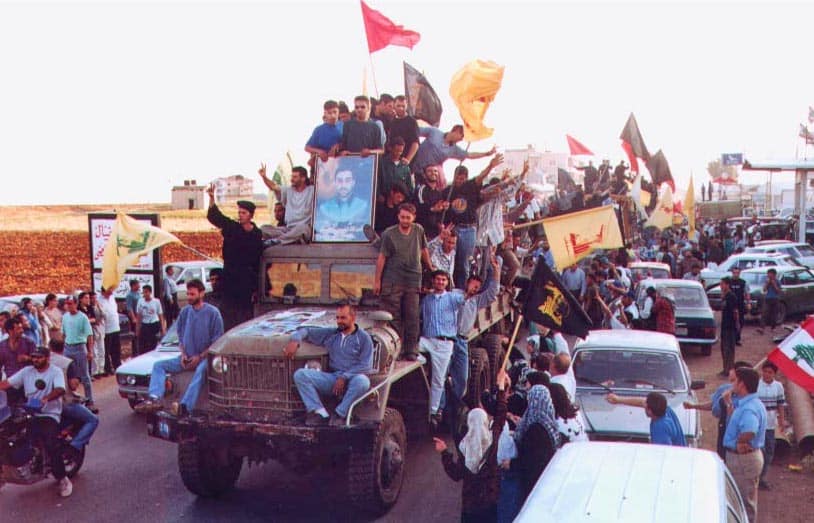
Ibrahim Hennawi, now 70, was in Blida in south Lebanon on May 25, 2000, the day Israel ended its 22-year occupation. That morning, cars and motorcycles entered the village carrying flags: Lebanon, Amal, Hezbollah, and Jammoul — the factions that comprised the Lebanese National Resistance Front. Women scattered rice, and ululations rang through the air. The day was later commemorated as Resistance and Liberation Day.
“We didn’t understand at first what was happening,” Hennawi told Mondoweiss. “We didn’t even realize that we ourselves had become the event.”
People came out of their homes not believing that the Israeli army and the South Lebanon Army — the Israeli-backed militia commanded by General Antoine Lahad, a defector from the Lebanese army — had actually withdrawn.
The exit was so sudden that many villages, effectively cut off from the rest of Lebanon for years, only understood it when they stepped outside and suddenly found the soldiers gone.
“We met again with people we hadn’t seen in years,” said Hennawi. “We didn’t know if we would ever see them again.”
Twenty-six years later, the same villages are once again out of reach because of an Israeli occupation.
On May 17, Lebanese Prime Minister Nawaf Salam issued a memo declaring May 25 an official holiday, taken, in his words, “in solidarity with the families of martyrs, the wounded, prisoners, displaced persons, and our people in the South and the frontline villages, and in support of their resilience.”
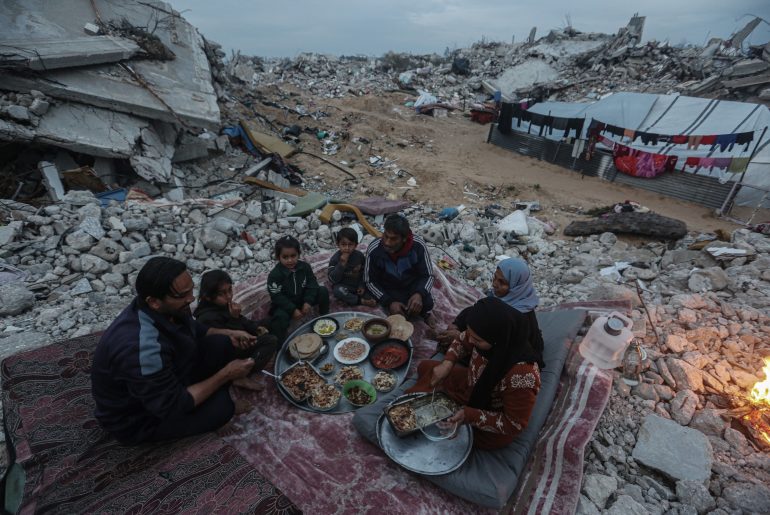
Even as the holiday is being observed, the villages it commemorates lie in rubble.
The Yellow Line
In April, as part of an ostensible ceasefire, Israel drew a so-called “Yellow Line,” creating a buffer zone deep inside southern Lebanon that cuts across at least 55 towns and villages, extending between six and fifteen kilometers beyond the border. A line that carries the same also cuts through Gaza today, placing over 65% of the Strip under Israeli control.
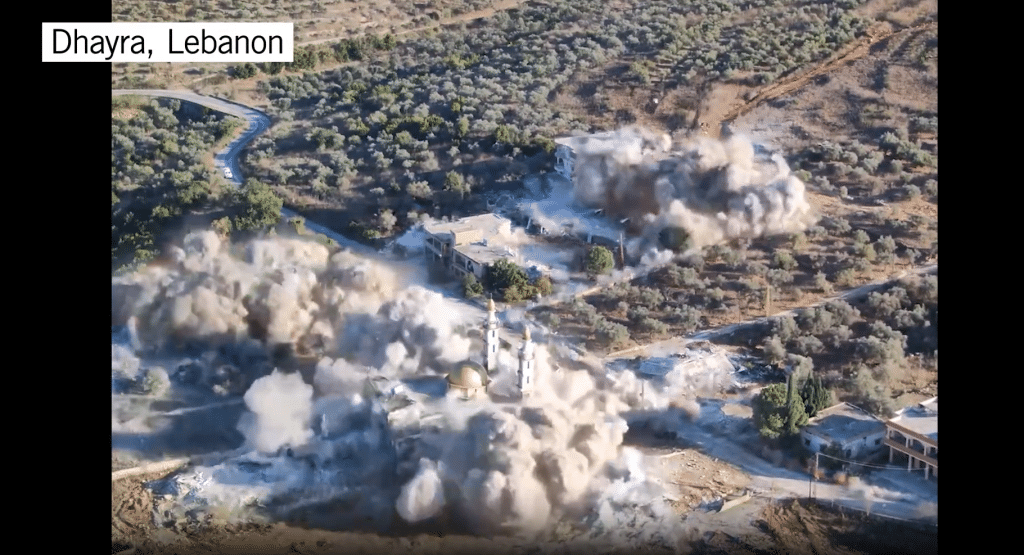
Since early March of this year, when Israel invaded southern Lebanon as part of the broader U.S.-Israeli war on Iran, it has razed homes, roads, and civilian infrastructure and has prevented civilians from returning to what it has labeled as military zones. Israeli Defense Minister Israel Katz openly stated that the destruction of villages along the contact line will continue, describing the homes as “terrorist outposts.”
Since fighting began on March 2, more than 3,000 Lebanese have been killed, including hundreds after the April 17 ceasefire, according to Lebanon’s Ministry of Health. Around 20 villages have been partially or completely destroyed, their homes demolished in what human rights experts describe as deliberate and systematic destruction.
Nearly 1.3 million Lebanese are displaced, and if they approach the line, they risk death.
Fatima Ftouni, 80, is one of them. She was displaced from Bint Jbeil, a town five kilometers from the Israeli border that has long been both a symbolic and strategic flashpoint. It is referred to by some as the capital of the resistance. In recent months, it’s been systematically demolished.
Ftouni’s grandson found their house on an OnGeo satellite application, and told her it had been bulldozed. “I felt my heart being squeezed,” she said.
Ftouni was forced to rent a place in Khaldeh, a southern suburb of Beirut. “I don’t know how people bear to live here, small crowded apartments, no land, no garden, no seedlings. Day and night, the sound of cars never stops,” Ftouni said.
Before 2000, the South Lebanon Army pressured Ftouni’s husband because their eldest son, at 18, refused to enlist in its ranks. “I remember every face, every name from those difficult years,” she told Mondoweiss. “But today we are living the worst nightmare.”
The cruelest irony, as she described it, is that before Liberation Day, she had a house. Twenty-six years later, she is displaced, living in a rented room in a city she did not choose.
Khiam: the prison that was
Fatima Sweid was ten years old in 2000. Her village of Khiam, a strategic hilltop town about five kilometers north of the border, was, for generations, a place that instilled only fear among the people of southern Lebanon.
Khiam prison, set up by Israel and run by the South Lebanon Army from 1985 until the withdrawal, held between 250 and 300 detainees at any given time, according to Amnesty International. Over its 15 years of operation, more than 5,000 prisoners passed through its cells, some held without trial for over a decade, without access to lawyers or the Red Cross.
When Israeli forces withdrew in May 2000, residents stormed the prison and released 144 people who were still inside. Prisoners were showered with rice and flowers, replacing the whips and boots of the years before. The scenes were captured on video and broadcast worldwide. Lebanese filmmakers later documented the testimonies of six former detainees in their film Khiam, preserving the memory of what happened inside those cells before Israel bombed the site in 2006, which was widely believed to be an attempt to erase the evidence.
“The whole village lived under the shadow of that place,” Sweid told Mondoweiss.
Her father traded livestock, which meant his livelihood depended on moving between villages and across checkpoints. The Kfar Tibnit crossing, on the edge of the occupation zone, closed at 2:00 in the afternoon. “We were prisoners too, in a way. Just without the walls,” she said.
“The people of the south are used to returning after every war. We go back. We rebuild. We plant again.”
Marwa Saab
Sweid and her family are now displaced in Hasbaya, about 25 minutes from Khiam. It’s so close to the occupied zone that she can make out the sound of her village being bombed.
“The bitterness is doubled,” she said, “because we are so close and cannot go back.”
Sweid does not believe her return is near. Many people around her have begun to think about emigration.
“For us, the dream is simple. To go back to Khiam. To drink a cup of tea on the roof of the house, as before,” she said.
Marwa Saab, a journalist, was three years old on Liberation Day.
Her clearest memory is the image of her grandfather in a Volvo station wagon, flags waving from the windows, the sounds of celebration. She wrote about that day seven years ago, she said, trying to fix in her mind the childhood images before they disappeared. Now, she covers the war, moving daily through what is being done to those same villages.
“Every time the South is mentioned, I no longer picture the return, the celebrations,” she told Mondoweiss. “I picture destruction and death.”
What troubles Saab most is the shift in the question itself.
“The question is no longer ‘how do we celebrate Liberation Day?’ It has become, ‘Is there still any liberation to speak of?’’’ she said.
Her grandfather’s house in the southern village of Mais al-Jabal was burned completely. She’s unsure if even his grave is standing.
She draws on what her family told her of previous invasions, and on what the southern families lived through after 2000 and 2006. “The people of the south are used to returning after every war,” Saab said. “We go back. We rebuild. We plant again.”
The Third Nakba
Among the displaced, the word Nakba has surfaced — the word Palestinians apply to their mass expulsion in 1948. It is now borrowed deliberately, a way of saying the same catastrophe is at work.
Mondoweiss met Fatima Sweid at the condolence gathering for her brother. The old man had fled to the Dawhet Aramoun area in south Beirut at the start of the war, a 20-hour journey that broke him. He was diabetic and had high blood pressure, and his condition never recovered. He died a few days before Liberation Day. At the gathering, people said he died of grief.
The writer Riad al-Asaad said to Mondoweiss that three Nakbas have marked the history of Jabal Amil, the historical name for South Lebanon.
“The first was the campaign of Ottoman governor Ahmad Pasha al-Jazzar, which in 1781 crushed Nasif al-Nassar, the most powerful Shia sheikh of the region, and ended the independent Amili entity, a centuries-old political order that had governed the region with a degree of autonomy,” he said. “The second was the French campaign of 1920, which destroyed the Arab Faysali option.”
“Villages have been wiped entirely from the map.”
Ali al-Amin
The third is the present, which he calls “the Nakba of Israel’s current war, and the bulldozing and destruction that have come with it.”
Ali al-Amin, a writer and political analyst, told Mondoweiss that what is happening today “has no precedent in contemporary history, in the scale of the bulldozing and the destruction, and in what it means for the fate of the Shia in Lebanon.”
The greater catastrophe for al-Amin is the dependency on outside forces and a military imbalance.
“All choices are difficult today, with no clear horizon,” he said. “And people have not yet grasped the scale of the disaster in the frontline areas. Villages have been wiped entirely from the map.”
Ibrahim Khanafer was at school in his hometown, Einata – now largely destroyed – when the principal called all the students to gather. The teenagers assumed someone was in trouble. “Then the crowds had poured into the streets and began chanting the name Hassan Nasrallah,” he told Mondoweiss.
The years between 2000 and the July War of 2006 were, he said, a period of real flourishing. Houses that had been locked for years reopened, people bought land, and buildings went up.
“The social fabric of South Lebanon began forming again, differently than before, but forming. No one expected the front line villages to reach where they are today,” Khanafer said.
Einata is among the villages behind the Yellow Line. Khanafer knows his house has been blown up. He saw it on a satellite image, like so many others who cannot reach their villages. But return, he said, remains his only option.
“This land is mine. I want to give it to my three daughters,” he said.
He holds on to the same hope he had in 2000, when liberation came suddenly and without warning, and dreams that moment will repeat itself one day.
This article is published in collaboration with Egab.
Ali Awada
Ali Awada is a Lebanese journalist with bylines in several international outlets, focusing on human rights.