

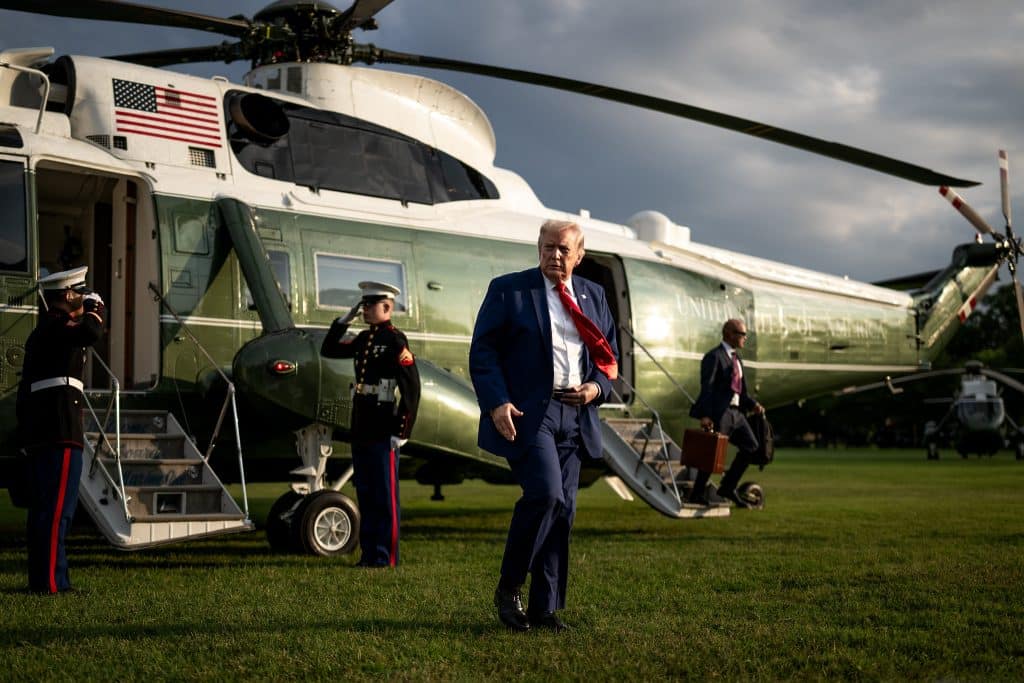
On July 22, the Trump Administration and Saudi Arabia signed an agreement for the U.S. to provide the Saudis with nuclear material and equipment for a civilian nuclear program.
In announcing the signing, U.S. Energy Secretary Chris Wright said, “Rest assured, these agreements uphold the highest standards of nuclear safety and nonproliferation, while relying on the world’s best nuclear technology and scientists, designed right here in the United States.”
That is a blatant lie.
The agreement, as signed, was dangerously light on oversight, did not include restrictions that have been used with similar allies in the recent past, and gave the United States, rather than the International Atomic Energy Agency (IAEA), the ultimate responsibility for ensuring the Saudi nuclear program is not diverted to weapons manufacturing.
It was a reckless, irresponsible deal that, even from a crass, imperial point of view, did little to serve the United States’ interests and caused significant harm to the U.S., the Middle East, and global stability.
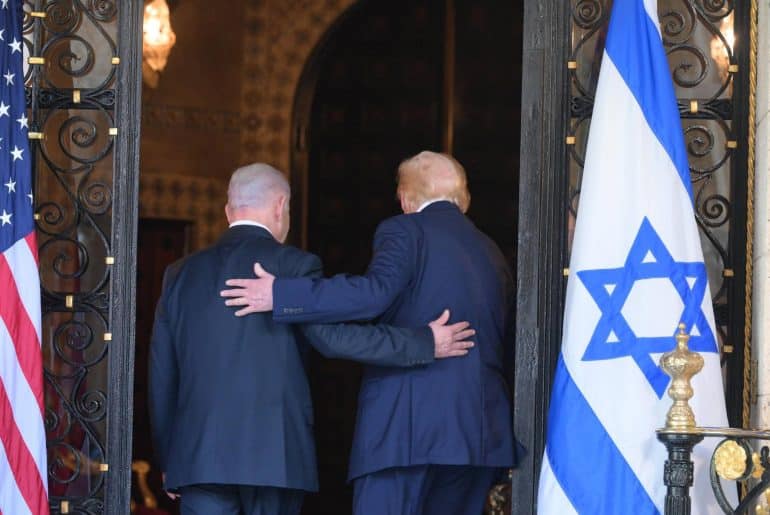
But then, on Thursday, U.S. President Donald Trump responded to the backlash against the deal from the pro-Israel far right by claiming that the entire deal is dependent on Saudi Arabia normalizing relations with Israel.
When asked if Trump had discussed the new condition about Israel with Saudi Crown Prince Mohammed in Salman, White House Press Secretary Karoline Leavitt said, “As you know, the president just put out this statement a few hours ago. I don’t believe he’s had a call with MBS in the hours since.”
For any other president, that would be unthinkable. Based on both Trump’s and Leavitt’s statements, it is clear that, as reported, Israel was not part of this negotiation, and Trump tried to add it by decree after getting backlash on the deal from pro-Israel quarters.
Even for Trump, it is utterly stunning that he didn’t even think about how his Israel-hawk supporters and allies in Tel Aviv would think of this deal.
In practice, if Trump insists on this condition, the deal will die. The Saudis have been very clear that the price for normalization is a verifiable path to a Palestinian state. Israel is not going to agree to that, and the U.S. is clearly not about to insist on it.
But even if the deal dies, this will have had a significant impact on geopolitics in the Gulf and beyond.
The danger of a nuclear Saudi Arabia
The purpose of the Nuclear Non-Proliferation Treaty (NPT) is to allow for the civilian use of nuclear power without expanding the already too high number of countries that have nuclear weapons. One, as we have seen from the fact that the first country to get a nuclear weapon is still the only one that’s been barbaric enough to use it, is already too many.
But Saudi Arabia is particularly dangerous in this regard. This is a country that has violently tried to assert its dominance well beyond its own borders and is a brutal dictatorship.
Worse, it has repeatedly expressed a desire to acquire a nuclear weapon if Iran got one. For decades, Riyadh, as much as Israel, has stoked the anti-Iran hysteria that has been a driving force in policymaking in Washington.
As a result of the current war, Iran has a powerful deterrent in its control over the Strait of Hormuz. In many ways, that deterrent is superior to a nuclear deterrent. It’s cheaper, it cannot be taken away, and it is a threat on a global scale, while also being one that is much easier to reverse than dropping a nuclear bomb if the deterrent “bluff” is called.
That’s a severe strategic disadvantage for Saudi Arabia, whether it rebuilds a relationship with Iran or not. Nothing Saudi Arabia can do can directly counter that deterrent power, but a Saudi nuclear weapon would create a counter-deterrent of equal power.
It is worth noting that the UAE, which, in 2009, was less territorially ambitious than it is today, was willing to accept the IAEA’s Additional Protocol, allowing for more than the usual intrusive inspections of nuclear sites, a layer of insurance that makes it extremely difficult to keep clandestine nuclear activity hidden. Iran, as well, signed the Additional Protocol, and, while it never ratified it, it did voluntarily follow the terms of the Protocol from 2003-2006 and again under the JCPOA.
Saudi Arabia, however, has steadfastly refused to agree to the Additional Protocol, which reinforces concerns that it wants to at least hold open the option of a weapons program.
Israel and Iran
While Iran did not react with much alarm to the idea of a civilian Saudi nuclear program, Israel did. And Iran surely would react much more strongly if it suspected the Saudis were ready to start a weapons program under American auspices.
Even the suspicion of such a program could lead to another war. Israel is certainly not going to simply watch any Arab country, no matter how seemingly friendly, even start on the path toward a nuclear program. It would risk the ultimate trump card they hold as the region’s only nuclear power.
Any Israeli action against a Saudi nuclear program risks the Israelis being forced to acknowledge their own nuclear arsenal, which, despite its being perhaps the worst-kept secret on the planet, is likely to greatly magnify pressure on them to give up those weapons.
If the U.S. simply ignored Israeli concerns about this, it is certain that Israel would have taken clandestine action against it, perhaps including sabotage and assassinations, as it has in Iran, greatly increasing tensions between U.S. allies that Washington is working hard to diminish.
Someone probably explained this to Trump after the agreement was signed, which would explain why he suddenly added the poison pill condition of normalization to the deal.
But Israel would not be the only country with serious concerns. Virtually every country in the region, regardless of its relationship with Riyadh, which has sufficient technical and human resources, would likely pursue its own nuclear program rather than sit idly by and watch Saudi Arabia potentially move toward becoming a nuclear power.
Beyond the nightmare that such a nuclear arms race in the Middle East would represent, there is a more immediate result, one that will not be mitigated if this U.S.-Saudi deal falls apart: the current war in the Strait of Hormuz.
As difficult as it is to envision an end to this war right now, Trump’s agreement with Saudi Arabia makes it even more difficult.
To fully end the state of war, Iran’s own nuclear program would have to be resolved in some way. Iran already made it clear it would not agree to give up the ability to enrich uranium on its own soil, but, thus far, it has not publicly changed its position that it has no desire to acquire a nuclear weapon.
Clearly, in the wake of this agreement with Saudi Arabia, whether it holds or not, zero enrichment is even farther off the table. But now Trump’s willingness to abandon both that and any but the most basic oversight of Saudi Arabia by the IAEA will push the Additional Protocol off the table as well.
Until now, it was reasonable to hope that Iran, if the two sneak attacks by the U.S. and Israel hadn’t made it change its mind, would still agree to open its nuclear sites to the IAEA to reassure the world that its use of nuclear power was entirely peaceful. That is no longer the case. After the U.S. offer to Riyadh, Tehran is more likely to see this issue in terms of fairness and its unassailable sovereign rights, rather than as a gesture to resolve a contentious issue.
It’s possible that Iran might still be willing to make some kind of agreement on its nuclear capabilities, but Trump just made that a lot less likely and a lot more difficult. That means ending this war also becomes less likely and more difficult.
What is motivating this deal?
Trump envisioned this deal as a public-private partnership, one where American corporations would reap enormous revenue from Saudi construction of numerous nuclear plants. Aside from whatever details he had worked into the deal that would personally benefit him or his family, the deal isn’t much different from the one that Joe Biden was trying to nail down with the Saudis before the October 7 attacks put paid to those plans.
Beyond the profit motive, there is a certain geo-strategic thinking behind this deal, one that reflects the short-sighted views of foreign policy thinkers in both parties.
Saudi Arabia has been losing faith for years in its security partnership with the United States. As I’ve often noted, this has led the Saudis to look toward a regional security network that could reduce their military dependence on the U.S. militarily.
Beyond the direct defense aspects, the Saudis have every reason to diversify the benefits they derive from great-power alliances. There has long been a fear in Washington that if the United States does not partner with Saudi Arabia on a civilian nuclear program, China or Russia will.
Saudi Arabia has a good relationship with China, and the U.S. sees that in zero-sum terms; any growing warmth between Saudi Arabia or any U.S. ally and China is a loss for the United States in their eyes.
For some American observers, it is safer to give Saudi Arabia the kind of nuclear deal it wants than to risk their finding that deal with China or Russia.
Jennifer T. Gordon, of the Democratic-aligned, centrist Atlantic Council, said of the deal that “A 123 agreement between the United States and Saudi Arabia is … a victory for the US-led global nonproliferation regime. Saudi Arabia has made it clear that it will purchase nuclear energy technologies and begin a civil nuclear program; the only question has been whether the kingdom would choose to work with the US and its allies, or whether it would turn to Russia or China.”
Twisting this deal into a victory for nonproliferation is a remarkable feat of mental gymnastics. And, while it is true that if the U.S. didn’t work with the Saudis, China likely would have, there is no reason to believe that Washington would be a more effective guarantor that a Saudi nuclear program would not be weaponized than Beijing.
Indeed, Russia and, especially, China would be just as concerned about the Saudis getting a nuclear weapon as the U.S. It’s worth recalling that both countries worked with the United States to secure the JCPOA and have consistently expressed opposition to an Iranian nuclear weapon.
The gain for U.S. planners is not in non-proliferation but in preventing the Saudis from growing even closer to China than they already are.
But Trump, due to his desire to act as if the president of the United States has the power of a dictator and his monumental ignorance of world affairs, has now incentivized Saudi Arabia to turn to China anyway.
By once again demonstrating how unreliable and capricious the United States is, he has created a situation where either Riyadh will turn to China or it will exact even more concessions from Trump not to do so, all while continuing to deprive him of the normalization deal that he, and his predecessor wanted.
Mitchell Plitnick
Mitchell Plitnick is the president of ReThinking Foreign Policy. He is the co-author of Except for Palestine: The Limits of Progressive Politics and maintains the Cutting Through newsletter.
Plitnick misses the obvious. The US could have offered Saudia a nuclear deal in return for greater Saudia involvement in the US war against Iran. Saudia might not be willing directly to take military action against Iran but might have offered a pre-emptive strike against Ansarullah (an Iranian ally) in return for a nuclear deal.