
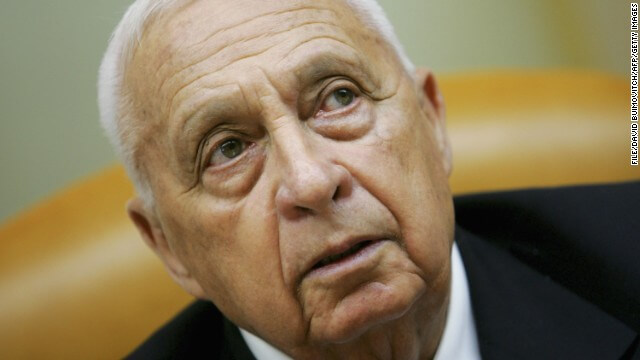
From the disturbing/unsurprising file: In a “Dear Colleague” letter, the Council on Foreign Relations sends out its list of articles on Ariel Sharon and well, check out the bandwidth on these pieces. Fulsome praise from neoconservatives Max Boot and Elliott Abrams– “His Eye Was Not Dim” — and liberal interventionist Richard Haass– the “genius” of Sharon — and Robert Danin, who comes off as a liberal Zionist. The only one of five featured posts that is critical is from conservative Palestinian Hussein Ibish, who decries Sharon’s “gun Zionism” and says, “The bodies piled up in Sabra and Shatila irrevocably defined Sharon’s reputation for Arabs and many others.” The several archived pieces linked at the bottom of the letter include some critical analysis of Sharon, but nowhere do we see him denounced as a war criminal, which is how many people round the world look on him.
Dear Colleague,
With the death of former Israeli Prime Minister Ariel Sharon, CFR and Foreign Affairs offer analysis of his legacy.
CFR Senior Fellow Robert M. Danin lays out the commonality between Sharon’s approach to politics and battle.
“One of the most important lessons that Sharon applied to the battlefield and to politics was that Israel had to seize the initiative, not simply react to events. He, more than any, appreciated the country’s basic security dilemma: while possessing a strong and highly motivated army, Israel is dwarfed in size and numbers by an inhospitable region. For him, taking the initiative was the enduring legacy of Jewish history, of his military experience, and of his political success.”
Read “Israel’s Ariel Sharon: Always Seizing the Offensive.”
CFR Senior Fellow Elliott Abrams describes the wide scope of Sharon’s political legacy in a piece posted today by Commentary magazine.
“He had taken the blame for the failures of the 1982 Israeli invasion of Lebanon—he had been defense minister—and the massacre of Palestinians in two Lebanese refugee camps by Christian militiamen was deemed a stain not only on his leadership but his character. On [a 1991 trip to the United States], he was not invited to one U.S. government office. Through the intervention of friends, HUD Secretary Jack Kemp finally agreed to see Sharon in the lobby of the hotel where he was staying. By 2004, the president of the United States was calling him ‘a man of peace’ and Sharon no doubt enjoyed it.”
Read “Ariel Sharon: His Eye Was Not Dim.”
CFR President Richard N. Haass explained in a 2006 CFR interview [with Bernard Gwertzman] the policy importance of Sharon’s decision to withdraw Israeli settlers from Gaza.
“And the genius, if you will, of unilateral disengagement from Gaza was that it offered you an approach to a peace process, but didn’t require two partners, which was the traditional approach. My hunch is that had Sharon remained viable politically and physically, what we would have seen was not a return to a traditional peace process, but instead a period of successive unilateral disengagements up to a certain point. And then my guess is that Sharon would have said, ‘Ok. We will go this far unilaterally. We are only prepared to take the final steps, though, of disengagement and withdrawal if we have a Palestinian partner.'”
Read the CFR interview.
In a piece that is now live on the Foreign Affairs website, American Task Force on Palestine Senior Fellow Hussein Ibish draws a connection between the Gaza pullout and prospect of a two-state solution.
“Sharon demonstrated that settlements can, in fact, be evacuated. Because of his actions, it is no longer even possible to ask whether the Israeli government is capable of dismantling settlements. The questions are simply when and where they will choose to do so. And that means that none of the existing settlements and other demographic, infrastructural, topographic, or administrative changes Israel enforces in the occupied territories should be regarded as irreversible. The implications of this for the prospects of a two-state solution are profound.”
Read “The Sharon Doctrine.”
Sharon’s primary achievement, according to CFR Senior Fellow Max Boot in a 2006 op-ed for the Los Angeles Times, was “to bulldoze the fantasies of the left and right.”
“The Israeli left for years had dreamed of reaching an accord to live in peace with the Palestinians. Yasser Arafat’s cynical resort to violence in 2000—even though he was offered sovereignty over almost the entire West Bank and Gaza Strip—showed that no meaningful negotiations were possible when so many Palestinians had not truly accepted the legitimacy of a Jewish state. The right, for its part, had dreamed of settling Jews in the West Bank and Gaza Strip to make those areas forever part of Greater Israel. But the Palestinians’ higher birth rate meant that before long they would become the majority, forcing Israel to jettison either its Jewish identity or its democracy.”
Read “Ariel Sharon’s Unending Legacy.”
More from CFR and Foreign Affairs:
“Sharon’s Lessons for Israel,” a 2014 article currently on the Foreign Affairs website by Hebrew University Professor Emeritus Martin van Creveld
“Sharon is Making History with Gaza Pullout Plan,” a 2005 CFR interview with Middle East scholar David Makovsky
“In Israel, Ariel Sharon’s Dark Victory,” an 2003 op-ed by former CFR senior fellow Henry Siegman
“The Last of the Patriarchs,” a 2002 Foreign Affairs essay by Israeli journalist Aluf Benn


Let the PTB keep up their assault on our intelligence. For all you NFL playoff & Super Bowl fans, early warning: the fight against BDS, in this case, against Sodastream, will be in full view on Superbowl day, this coming February 2–Scarlett J is the new face of Sodastream! http://www.haaretz.com/mobile/1.568108
Obviously, the Ziocons are digging everywhere to find support for their dream at the expense of the whole goy world, and, most especially, Dick and Jane Taxpayer, with a kid in the US military.
The so-called infiltrators?
A few decades ago on an oil rig in Saudi an Egyptian taught me a colloquial expression, “RaaH lil ma’bara u ba’at sukkara bi Teezu.”
Literally “He went to the cemetery and a sugar lump was found in his ass.” The expression is used when someone unpopular with no redeeming characteristics dies. When carried to the cemetery for burial people manage to find something nice to say, finding sugar where the sun doesn’t shine.
Isn’t Hussein Ibish of Lebanese, not Palestinian, descent?
He appears to think that more than half a million Israeli settlers can be removed from the occupied West Bank simply because 8,000 were from Gaza.
He’s wedded to the two state solution. On the one hand Ibish holds out unilateral disengagement from Gaza as proof a permanent two state solution is achievable, but also admits said disengagement was about ridding Israel of a strategic liability (1.5 mil Palestinians) rather than peace. It’s all a bit shaky. No mention of all that lovely fresh water Israel steals from the West Bank aquifer every day, and other such plunder.
Phil,
I think much of the praise of Sharon as an effective military and political leader is valid. Whether or not you can stomach the morality of his cause and actions, he was clearly effective at promoting and advancing that cause.
Sharon’s life and accomplishments, atrocities and all, didn’t occur in a vacuum. Sharon must be viewed in the context of Jabotinsky and his creed and followers. Is Sharon any different than Ben Gurion, Meir, Begin, Shamir, or Netanyahu? I think only in that he was far more effective in advancing the Jabotinsky crusade for a Greater Israel than all except Ben Gurion. They all were willing to commit atrocities to gain their Greater Israel. Sharon was just more direct and brutal (and effective) than most of Jabotinsky’s warrior/disciples.