

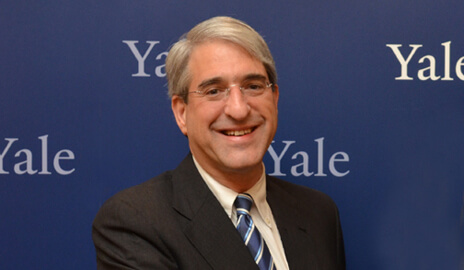
Good news: Journalists are writing up the Rev. Bruce Shipman case at Yale in a sympathetic manner. Was it really necessary for the Episcopal chaplain to lose his job at the school because of a three-sentence letter to the New York Times saying Israel’s “carnage” in Gaza is a factor in growing anti-Semitism in Europe? After that letter came out August 26 (full text at the link) Shipman says he experienced an “avalanche” of criticism and hate mail almost instantaneously, and that calls for his termination went to the Yale President’s office from angry alumni– calls that were promptly conveyed to him by the university chaplain, per one of these news accounts.
The two pieces of reporting raise questions about whether a prestige university can field a debate over Israel/Palestine without requiring red lines that prevent open discussion. And Shipman says straightforwardly, “I will not be silenced.”
Elizabeth Dias at Time Magazine spoke to Shipman, and he cited other great controversial causes as models for him. And notice the importance of donors:
For Shipman, the controversy raises a number of “troubling questions” about free speech on campus. In addition to the hate mail, Shipman says he has also received letters of support from people thanking him for taking a courageous stand for Palestinian rights. University chaplains, he adds, have a long history advocating unpopular cultural positions. William Sloane Coffin Jr., a chaplain at Yale during the 1960s, gained fame for practicing civil disobedience in prostest of the U.S. war in Vietnam. Clergy today, he continues, need to know what protections they do and don’t have when it comes to taking unpopular positions. “I think of abolitionism and the role the church played in that, I think of the civil rights movement, I think of the anti-war movement and the role the chaplains played in that, often incurring the wrath of big givers and donors of the university, but they were protected and they were respected,” he says. “That seems not to be the case now.”
As to what’s next for him, Shipman isn’t yet sure, but he doesn’t plan on remaining silent. “I think the truth must be brought out and it must be discussed on campus by people of goodwill without labeling anti-Semitic anyone who raises these questions,” he says. “Surely this debate should take place on the campuses of the leading universities across the country. If not there, where?”
The same themes are present in Deborah Straszheim’s excellent report on the case in The Day, in Connecticut. My headline comes from this account:
Within two hours of the publication of the letter [on August 26], which included a line at the end identifying him as the Episcopal chaplain at Yale, Shipman said, “there was an avalanche of hate mail calling me every name imaginable, and an anti-Semite, (saying) I was a disgrace to my calling and I ought not to be in any public office.”
He received an email from Yale University Chaplain Sharon M.D. Kugler, who also lives in Groton, saying she was certain he had no clue how her office and its work had been affected by what he’d done.
“Confused students, angry alumni, staff and random people from across the country have been in touch with me and with President (Peter) Salovey’s office all day,” she wrote in the Aug. 26 email. “Some calling for your termination and others calling for mine. Even our Hindu Life Advisor who shares your last name has had to field some very inflamed emails.”…
Shipman is talking about official pressure here. Kugler was obviously incensed. And President Salovey’s office wasn’t just twiddling its thumbs. Yale quickly sought to distance itself. “Yale pointed out that Shipman was not on staff but was rather employed by the Episcopal Church.” But the controversy raged.
Shipman said the executive committee of the Board of Governors of the Episcopal Church of Yale called a special meeting on Sept. 2 to discuss his letter.
“The executive committee made it clear that I should resign or be fired,” Shipman said. Members said his actions damaged the church’s relations with the university and generated bad publicity, he said….
But he’s not backing down on his witnessing for Palestine (Shipman has been there several times):
“They have got to move together to share the land,” he said. “They both have compelling claims to the land. You hear the stories and you weep. And the stories are real and true, the suffering is real, and there’s got to be some hope. Otherwise, you’re locked in this tragic struggle for the land that seems to be to the death.”
He said he didn’t think he had to discuss his views about the Israeli-Palestinian conflict with the chaplain first before airing them.
“If it can’t be discussed in good faith on a university campus, why not?” Shipman said. He said he’s not anti-Semitic and he should be able to discuss the conflict without being labeled. “That is the last thing that I am, and I will not be silenced.”
I believe this controversy stems from the fear on the part of the lobby that criticism of Israel is moving from the grassroots to the inside, and that lines must be drawn at prestigious institutions. It’s clear that Shipman’s letter was a 9 on the Richter scale at Yale within a couple of hours and that Yale was being called on to excommunicate him in a hurry. The Episcopal Church did so within days. And tomorrow night a Yale program on anti-Semitism at the school will be holding a panel on Shipman’s letter and the piece it responded to without Shipman’s inclusion. It is very much like Steve Walt’s bastinado at Harvard — within hours of the publication of the groundbreaking Israel lobby paper in 2006, there were demands that Harvard’s name be taken off the paper, that leading funders withdraw their gifts, that Walt lose his chaired professorship and deanship. Walt said last spring:
[I]t’s made it impossible for me to serve in the U.S. government, because it would be just too politically controversial. Even if someone wanted me, say, to work on U.S. policy in Asia, it would just be not worth it. I’m not so valuable that a president or a secretary of state would want to deal with the political fallout. It has probably had some impact on my upward mobility in academia – if I wanted to be a dean or something like that. –
The great thing is that Walt didn’t go away, but worked harder at elaborating his ideas, and Shipman isn’t either.

How Yale has fallen. Once upon a time, Yale President Kingman Brewster supported William Sloan Coffin in his controversial stands.
Is Shipman not participating in the panel because he chose not to participare or because he was not invited? A failure to invite him would demonstrate a shocking lack of commitment to intellectual honesty in an academic setting.
To assert that the Israeli Government’s policies in occupied Palestine over the past 47 years, particularly its recent aggression, has contributed to a rise in antisemitism in Europe is surely just stating a fact, although most people would say it has nothing to do with antisemitism but anti Zionism, conflating the two are used by dishonest people to tar people like the good Chaplain Shipman.
Yale has disgraced itself, and it appears that many in the various administrations are part of the scurrilous mob.
Reverend Shipman stands tall, with his grace and dignity intact.
Thanks Phil. Both UIUC and Yale are testament to the fact that the fish rots from the head.
I suspect this continual hounding of those who speak out against Israel will eventually cause such revulsion that the general public will turn against the Zionists, but many careers will be destroyed before that happens.